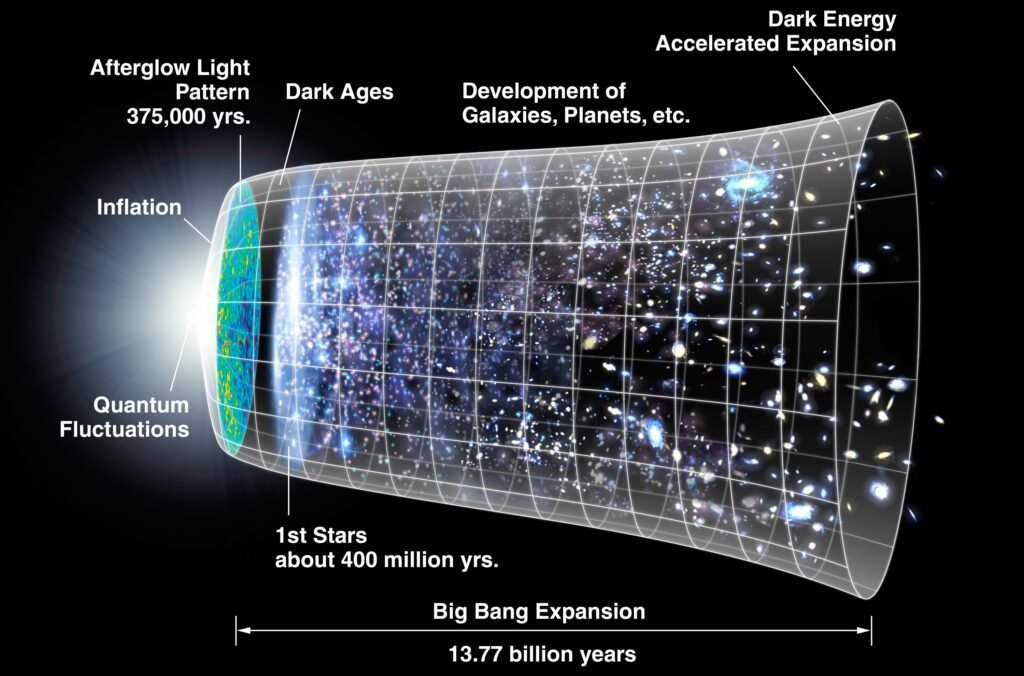
Einstein’s Theory Hits a Wall (Image Credits: Upload.wikimedia.org)
Physicists have long grappled with the Big Bang’s origins, where standard theories predict an uncomfortable singularity of infinite density and curvature. A recent study introduces quadratic quantum gravity, or QQG, as a refined extension of Einstein’s general relativity that navigates this extreme phase without breakdown.[1][2] This approach promises a more stable starting point for cosmic evolution, potentially reshaping how scientists view the universe’s birth.
Einstein’s Theory Hits a Wall
General relativity excels at describing gravity on cosmic scales, from orbiting planets to expanding galaxies. Yet it falters at the universe’s inception. Researchers noted that the equations foresee a point where space-time curvature spikes to infinity, rendering predictions meaningless.[1]
This singularity signals the need for a quantum upgrade to gravity. Traditional fixes, like cosmic inflation, require extra ingredients beyond Einstein’s framework. The new work sidesteps such additions by embedding quantum effects directly into gravity’s core equations.
QQG Enters the Scene
Ruolin Liu, Jerome Quintin, and Niayesh Afshordi published their findings in Physical Review Letters, detailing QQG’s quadratic terms in curvature.[1][3] The theory starts with an action incorporating squares of the Ricci scalar and Weyl tensor, ensuring consistency at ultraviolet scales – high energies and tiny distances akin to the Big Bang.
At these extremes, QQG proves asymptotically free, simplifying as energies rise, unlike general relativity’s collapse. As the universe expands and cools, it smoothly transitions to familiar Einsteinian physics. Afshordi explained, “What makes quadratic quantum gravity interesting is that it may provide a mathematically consistent way to describe gravity at very short distances and very high energies.”[1]
From Infinite Curvature to Finite Beginnings
The model begins precisely at the would-be singularity, where pure QQG governs without infinities derailing physics. Finite density and temperature emerge naturally, marking a controlled high-energy epoch. This phase evolves through renormalization group flow, driven by one-loop beta functions that adjust couplings dynamically.
No ad-hoc inflaton field appears; rapid early expansion arises organically. The researchers showed slow-roll inflation occurs as couplings evolve, aligning with cosmic microwave background data. Inflation concludes in a kination phase, paving the way for reheating and the radiation-dominated era under general relativity.[3]
| Aspect | Standard Big Bang + Inflation | QQG Model |
|---|---|---|
| Singularity Handling | Infinite density/curvature | UV-complete, finite start |
| Inflation Source | Separate inflaton field | Gravity’s RG running |
| Post-Inflation | Reheating via field decay | GR emergence in strong coupling |
Predictions That Could Seal the Deal
QQG yields specific forecasts for observation. It predicts a minimum tensor-to-scalar ratio of 0.01, setting a floor for primordial gravitational waves. Spectral index values fit recent constraints from Planck, ACT, SPT, and DESI surveys, often outperforming simpler inflation models like Starobinsky’s.
- Slow-roll parameters derive from matter fields (N ~ 10^5-10^6), yielding n_s ≈ 1 – 4/(3N).
- Tensor ratio r scales with couplings, ensuring viability without excessive fine-tuning.
- Gravitational wave spectra differ subtly, probeable by future detectors.
- Alignment with baryon acoustic oscillations and lensing data supports the framework.
Afshordi highlighted the testability: “The most promising tests come from cosmology, especially from the imprint of the early universe on primordial gravitational waves and the cosmic microwave background.”[1] Upcoming instruments may soon distinguish QQG from rivals.
Key Takeaways
- QQG resolves general relativity’s Big Bang breakdown via quadratic extensions.
- Inflation emerges naturally, no extra fields needed.
- Minimum r ≥ 0.01 offers a clear observational target.
This elegant tweak invites a reevaluation of cosmic dawn, linking quantum gravity to everyday observations. As detectors grow sharper, QQG stands ready for verdict. What do you think about this cosmic rethink? Tell us in the comments.