A Historic Crew Takes the Helm (Image Credits: Upload.wikimedia.org)
Kennedy Space Center, Florida – Four astronauts have left the familiar bounds of Earth orbit, embarking on humanity’s first crewed voyage to the Moon in more than five decades. The NASA-led Artemis 2 mission achieved a critical translunar injection burn, sending the Orion spacecraft named Integrity toward a lunar flyby on a precise free-return trajectory. This step places the crew – three Americans and one Canadian – farther from home than any humans before, testing systems vital for future deep-space exploration.[1][2]
A Historic Crew Takes the Helm
Reid Wiseman commands the mission as a NASA astronaut with extensive experience. Victor Glover serves as pilot, bringing his proven skills from previous spaceflights. Mission specialists Christina Koch, another NASA veteran, and Jeremy Hansen from the Canadian Space Agency complete the team. Hansen’s participation marks the first time a Canadian has traveled beyond low-Earth orbit.[1][3]
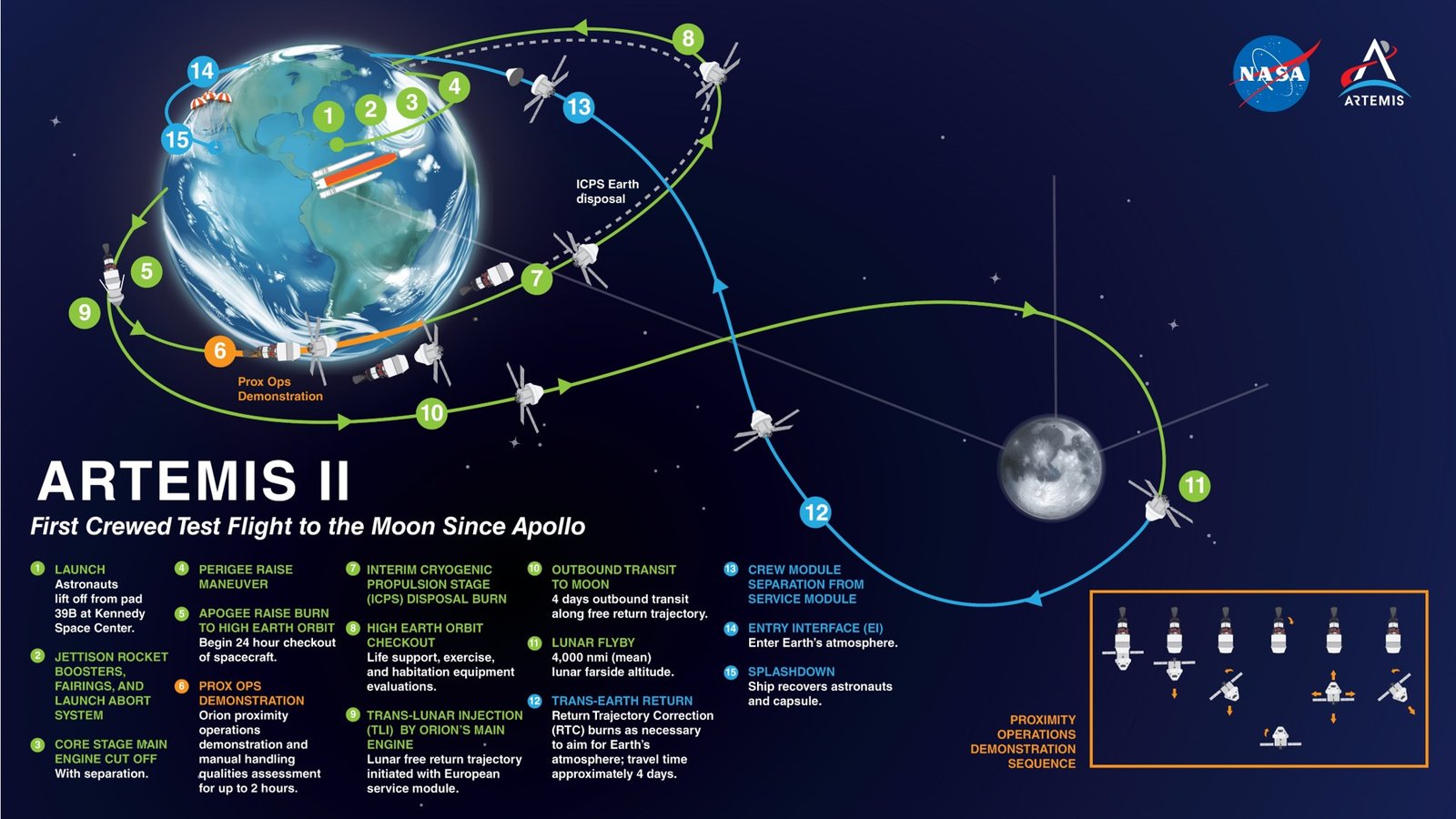
The crew launched aboard the Space Launch System rocket on April 3, 2026, at 6:35 p.m. EDT. Generating 8.8 million pounds of thrust, the SLS core stage propelled Orion into space before separation. Early activities included manual flight tests and a proximity operations demonstration around the jettisoned upper stage, simulating future docking maneuvers.
Overcoming Early Challenges in Orbit
Once in low-Earth orbit, the astronauts conducted essential checks. Christina Koch repaired a malfunctioning deep-space toilet, earning her the lighthearted title of “space plumber.” A brief issue with Orion’s Launch Abort System caused a hold, but teams resolved it swiftly. These steps ensured the spacecraft’s life support and navigation systems performed reliably.[1]
Flight controllers in Houston monitored every aspect. The crew practiced procedures like CPR in microgravity and inventoried the medical kit, which includes tools such as a thermometer and stethoscope. Such preparations highlight the mission’s role as a comprehensive test of human operations far from Earth.
The Pivotal Translunar Injection Burn
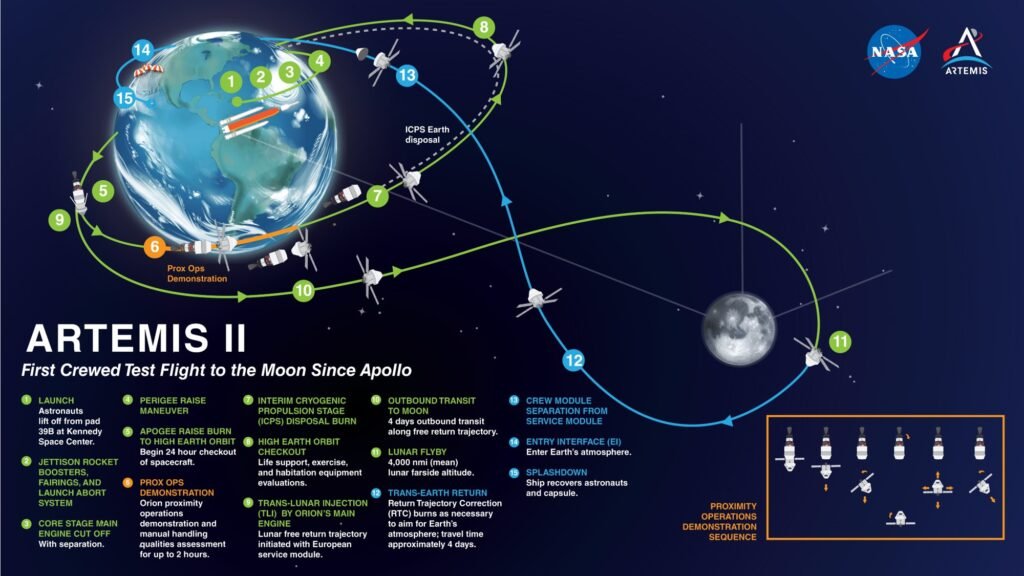
The mission’s defining moment arrived with the translunar injection, or TLI, burn. Orion’s service module engine fired for nearly six minutes, consuming about 1,000 pounds of fuel to generate 6,000 pounds of thrust. This maneuver boosted the spacecraft onto a figure-eight path covering 230,000 miles initially, committing it to the Moon’s gravitational influence.[1][2]
NASA’s acting associate administrator for exploration systems, Lori Glaze, described the burn as flawless. “Today, for the first time since Apollo 17 in 1972, humans have departed Earth orbit,” she stated. Controllers confirmed nominal performance in guidance, navigation, and propulsion, clearing a major hurdle known for its precision demands.[1]
Trajectory and Upcoming Milestones
Orion now follows a free-return trajectory, relying on Earth-Moon gravity for the loop back home. Three small trajectory correction burns will fine-tune the path. The four-day coast phase allows testing of communications via NASA’s Deep Space Network, exercise on a compact flywheel device, and photography of celestial targets.
- Flight Day 4: Moon’s gravity dominates; crew evaluates new orange survival suits.
- Flight Day 6: Closest lunar approach at 4,000 to 6,000 miles, shattering distance records.
- During flyby: Views of the farside, science experiments, and a brief communications blackout.
- Return: Reentry at 25,000 mph, splashdown in the Pacific around April 11.
A modified reentry profile addresses heat shield concerns from Artemis 1, aiming for a safer descent with parachutes and airbags.[1]
Objectives and Legacy of Artemis 2
This 10-day flight validates Orion for crewed deep-space use. Data on radiation sheltering, emergency protocols, and life support will inform Artemis 3 and beyond, including lunar landings. The crew will capture unique human-observed lunar imagery, spotting details robots miss, and observe a solar eclipse for meteoroid impacts.
Administrator Jared Isaacman celebrated the progress: “America is back in the business of sending astronauts to the Moon… This time, farther than ever before.”[1] The mission revives Apollo-era ambitions while paving the way for sustained lunar presence.
| Flight Phase | Key Activity | Distance Milestone |
|---|---|---|
| Launch to Orbit | SLS ascent, stage separation | Low-Earth orbit |
| TLI Burn | Service module engine fire | Departure from Earth orbit |
| Lunar Flyby | Photography, experiments | ~250,000 miles from Earth |
| Reentry | Heat shield test, splashdown | Earth return |
Key Takeaways
- First crewed lunar mission since 1972, testing SLS/Orion systems.
- Free-return path ensures safe loop without major propulsion.
- Breaks human distance record during flyby.
Artemis 2 stands as a bold reaffirmation of exploration’s pull, bridging past triumphs with future outposts. As Orion coasts silently toward the Moon, it carries not just technology but the enduring human drive to push boundaries. What do you think this mission means for the next era of space travel? Tell us in the comments.