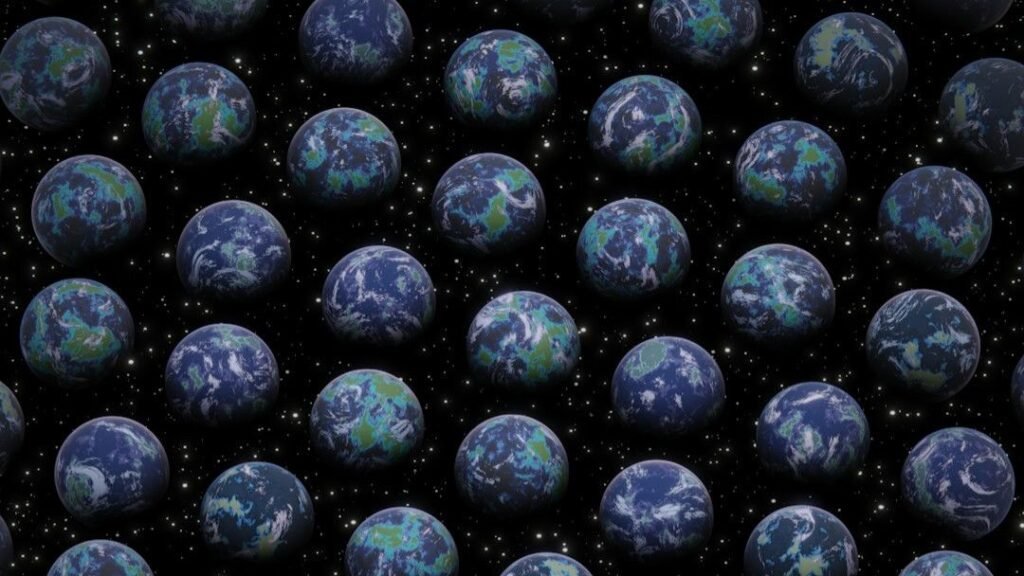

Imagine discovering that everything you know – your memories, this moment, even the universe itself – is just one version of reality among countless others. Not in a fantasy novel, but as a serious possibility that some of the world’s sharpest physicists actually take seriously. The idea sounds wild, almost like late-night dorm-room speculation, yet it keeps showing up wherever our best theories about the cosmos are pushed to their limits.
When I first dug into multiverse ideas, I honestly thought it was mostly hype. But the more I read actual physics papers and listened to how researchers talk about it, the more unsettling it became. The multiverse isn’t a random sci‑fi add‑on; it often appears as a side effect of theories that already explain real data remarkably well. So let’s walk through what scientists actually mean by “multiverse,” why it keeps showing up in serious discussions, and how close we are to knowing whether we really might share existence with an endless cosmic crowd.
The Strange Way Modern Physics Keeps Pointing to Other Universes
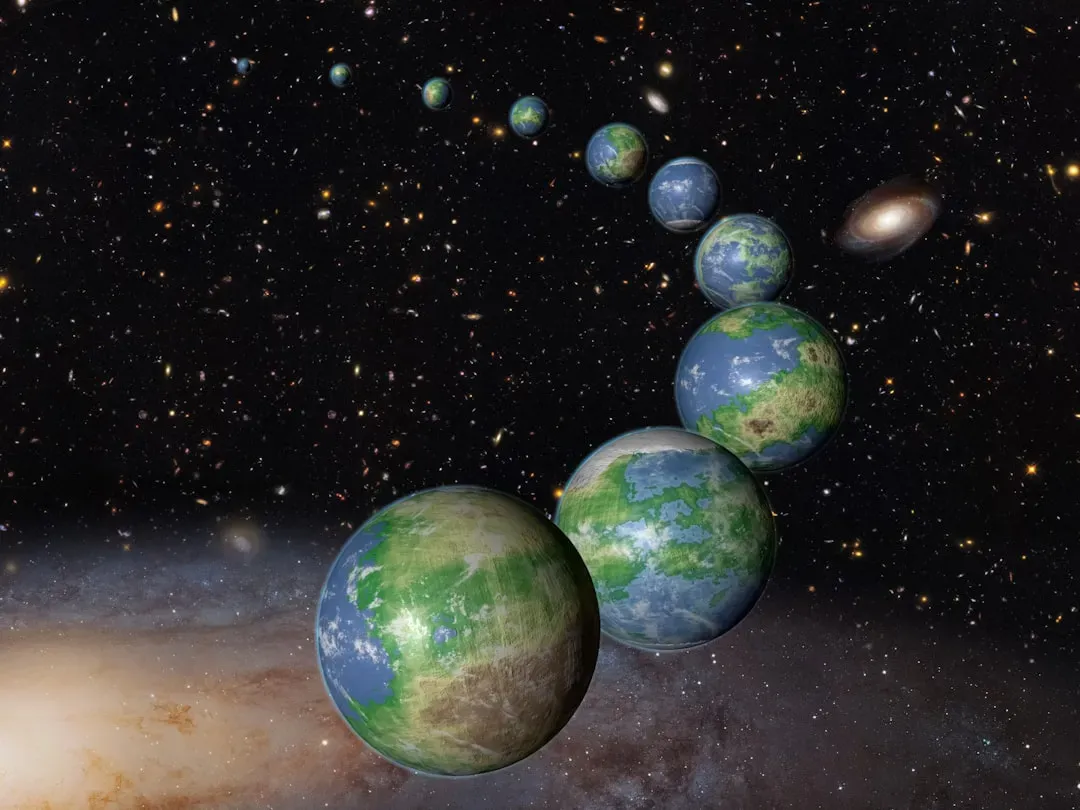
It’s almost embarrassing for physics that the multiverse idea isn’t something people went looking for; it kept sneaking in through the back door. When cosmologists tried to explain why our universe looks so smooth and uniform on huge scales, they arrived at cosmic inflation, a rapid burst of expansion in the first tiny fraction of a second after the Big Bang. Then, when they studied inflation more carefully, they realized that under many conditions, it doesn’t just stop neatly everywhere at once.
Instead, in a lot of inflation models, expansion keeps going in some regions while it ends in others, like bubbles forming in a pot of boiling water that never fully stops boiling. Each of these “bubbles” can become its own universe, with its own laws and constants, while the background space keeps inflating, spawning more bubbles without end. That kind of scenario is called eternal inflation, and it naturally produces something that looks very much like a multiverse – not because we like the idea, but because the math for inflation keeps pushing us there.
Many-Worlds: Quantum Mechanics’ Wildest Interpretation
Quantum mechanics is already strange enough: particles behave like waves, outcomes are described by probabilities, and you only get definite results when you measure something. The classic puzzle is that before a measurement, a particle isn’t here or there; it’s in a blend of possibilities, known as a superposition. The standard textbook story says the wave of possibilities “collapses” into one outcome when you measure it, but it never really explains how or why that collapse happens.
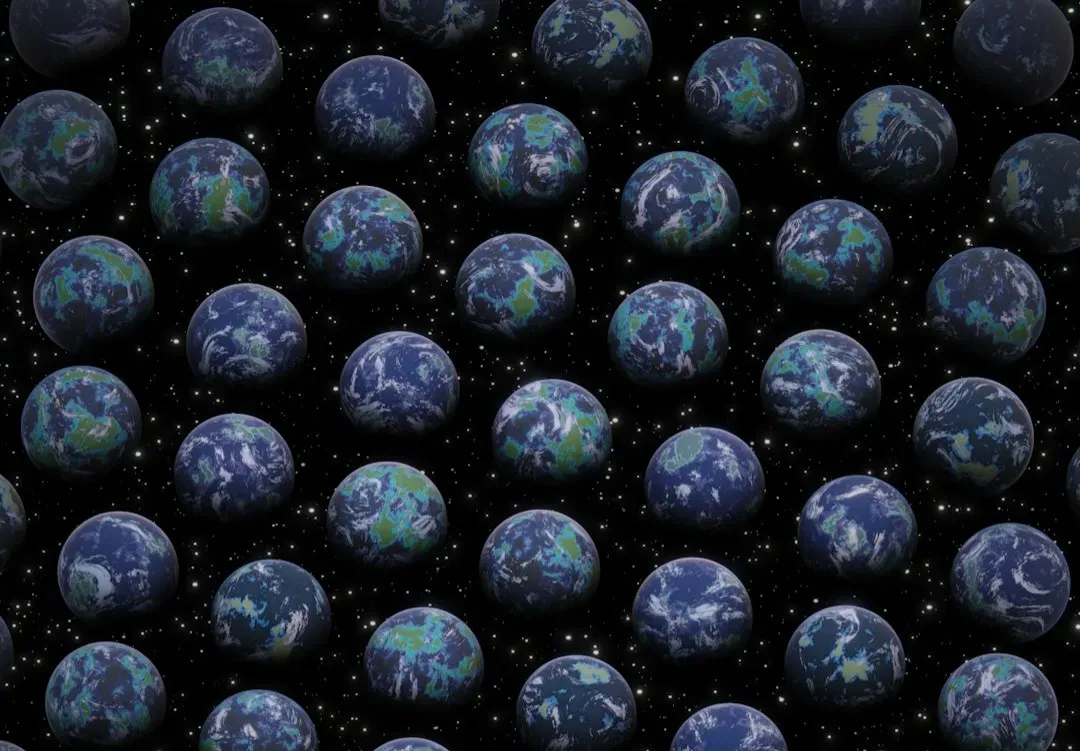
The many‑worlds interpretation takes a brutally direct approach: it simply says the wave function never collapses. Instead, every possible outcome actually happens, but in different branches of reality. When you measure a particle, the universe splits into versions: in one, the particle appears here; in another, it appears there; and each version continues evolving with its own consistent history. In this view, there is a branching multiverse where every quantum event produces new realities, and you’re constantly being copied into slightly different versions of yourself, whether you notice it or not.
Cosmic Inflation and the Bubble Universe Picture
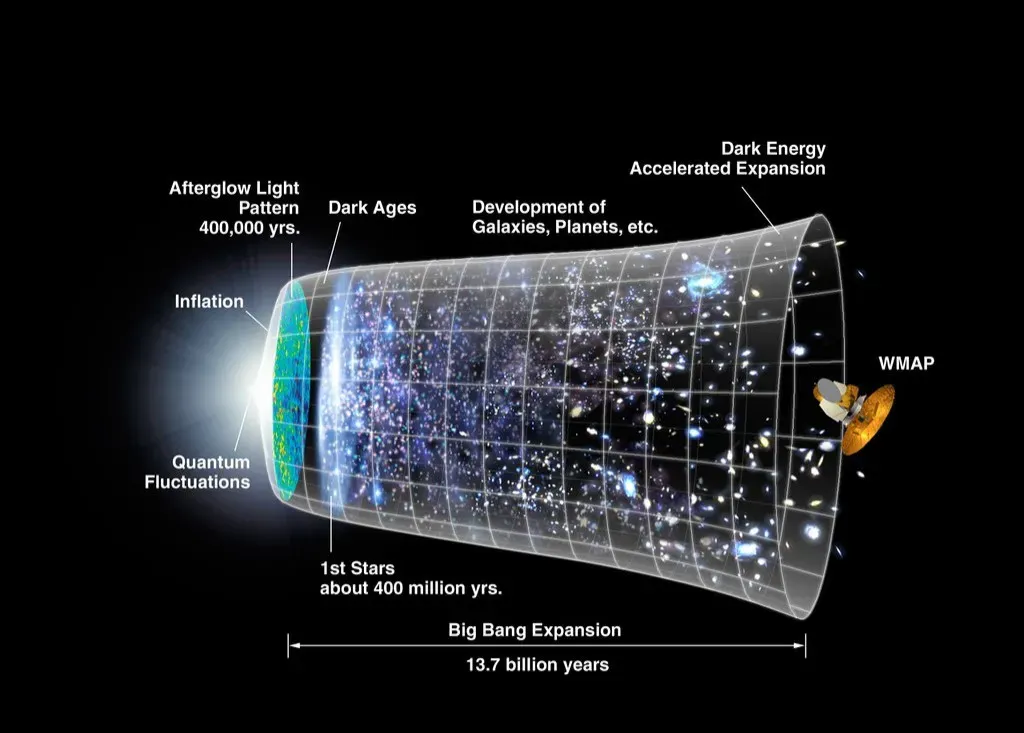
Inflation theory wasn’t invented to create a multiverse; it was introduced to solve specific puzzles about the early universe. For example, when we look at the cosmic microwave background – the faint afterglow of the Big Bang – the temperature is almost the same in opposite parts of the sky that never had time to “talk” to each other in ordinary Big Bang models. Inflation fixes this by stretching a tiny, uniform region to cosmic size in a fraction of a second, which matches what satellites like Planck and WMAP have actually measured.
But the same mechanism that makes inflation work can make it self‑reproducing. Quantum fluctuations can cause inflation to end in some regions while continuing in others, and those regions that stop inflating become “bubble universes” like ours. Each bubble is essentially cut off from the others by vast, expanding space that grows faster than light can cross. That means if there are other bubbles out there – and inflation theories say there might be – then they could be eternally unreachable, each with its own version of physics playing out forever.
The String Theory Landscape: A Universe Menu With Too Many Options
String theory tries to be a unified theory of everything, replacing point‑like particles with tiny vibrating strings and higher‑dimensional structures. One of its big challenges is that it doesn’t give a single, unique solution that says, “Here’s exactly how our universe must be.” Instead, when you start compactifying its extra dimensions in different ways, you get an enormous “landscape” of possible universes, each with its own physical constants and properties. The numbers are so huge that some estimates suggest there could be an almost unimaginable variety of distinct vacuum states.
That landscape leads to a strange combination with eternal inflation: if inflation constantly creates new bubble universes and string theory offers a massive menu of possible low‑energy configurations, then different bubbles could land in different points in that landscape. Some bubbles might have stronger gravity, some might have different particle masses, and many might not support complex structures at all. Our universe would then just be one habitable corner in a vast string theory multiverse, a place where the fundamental parameters just happened to line up in a way that allows galaxies, stars, planets, and eventually people to appear.
Anthropic Reasoning: Are We in a “Just Right” Universe by Necessity or Chance?
One of the weirdest pieces of this story is how finely tuned some of our universe’s properties seem to be. The cosmological constant, which affects how fast the universe expands, appears to be incredibly tiny – yet not exactly zero. If it were much larger, gravity might never pull matter together to form galaxies; if it were negative and large in magnitude, the universe could have collapsed back on itself long ago. Many other parameters, from the strength of fundamental forces to particle masses, sit in narrow ranges where complex chemistry and stable stars are possible.
The anthropic principle steps in and says something that sounds trivial but hits hard in a multiverse context: we can only observe a universe that allows observers to exist. If there really are countless universes with different physical constants, then it is not surprising that we find ourselves in one of the rare “Goldilocks” regions where the numbers work out for life. That doesn’t prove a multiverse is real, but it turns fine‑tuning from a deep mystery into something that might be explained statistically, like winning a lottery that was being played in infinitely many other towns at the same time.
Parallel Universes vs. Multiverse: Untangling the Terminology
People often use phrases like “parallel universe” and “multiverse” interchangeably, but they can mean different things depending on the context. In common language, a parallel universe usually suggests a copy of our world with small variations – another Earth where you chose a different career or where history took a slightly different turn. That image lines up more closely with the many‑worlds interpretation of quantum mechanics or with speculative ideas about “brane worlds” in higher dimensions. It’s the kind of thing you see in movies where characters literally step into an alternate timeline.
The term multiverse is broader and messier. It can include bubble universes from eternal inflation, quantum branching, string theory landscapes, or even mathematical universes where the laws themselves differ radically. Some of these universes might be similar to ours; others could be so alien that nothing resembling familiar matter or life could exist. When physicists talk seriously about a multiverse, they often mean a structured collection of possible universes emerging from specific, well‑defined theories, not just a random pile of sci‑fi “what ifs.”
Can We Ever Test the Multiverse? The Evidence Problem

The biggest criticism of the multiverse is brutally simple: if other universes are forever beyond our reach, how can this ever be science and not philosophy dressed in equations? The gold standard in physics is testability, and many forms of the multiverse seem to slam the door on any direct observations. You can’t send a probe outside the observable universe, and you can’t jump across a quantum branch to see what happened in “the other version” of a measurement. That makes people understandably wary of pushing multiverse talk too far.
Still, there are indirect ways to probe whether the theories that predict multiverses are on the right track. Inflation, for instance, makes specific predictions about patterns in the cosmic microwave background, which telescopes have already measured with high precision. Some researchers have looked for subtle features that might indicate collisions between bubble universes in the early universe, like strange circular patterns in the sky. So far, nothing has been confirmed, but the fact that people can even define what a “bubble collision signature” would look like shows that at least parts of the multiverse discussion can be framed in testable, falsifiable ways.
Black Holes, Baby Universes, and Other Speculative Pathways
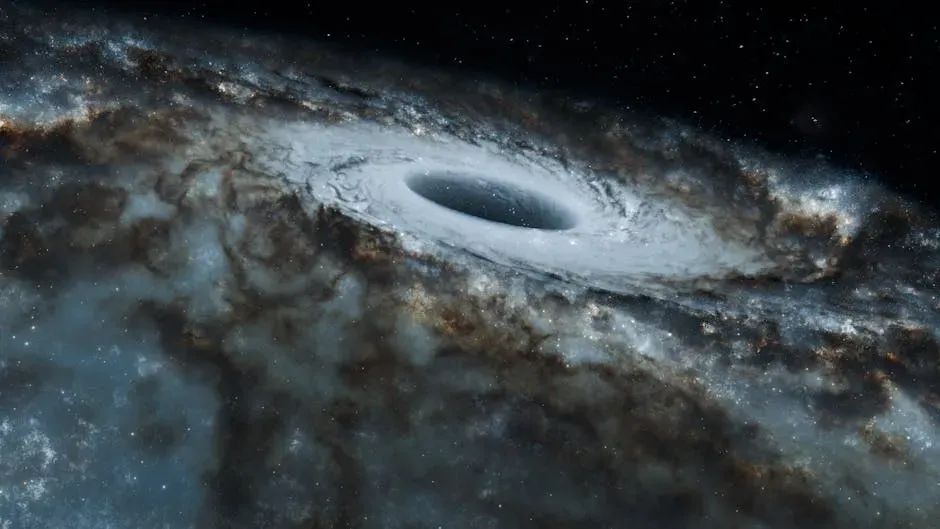
Once you start entertaining the idea of multiple universes, black holes suddenly become even more intriguing. Some speculative models suggest that the inside of a black hole could pinch off from our universe and form a new one, with its own space and time expanding on the other side of what we see as the event horizon. In that kind of picture, universes might give birth to new universes, each with slightly tweaked physical parameters. It also raises bizarre questions: could our universe itself have been born from a black hole in some larger “parent” cosmos?
These ideas are far from settled and live near the frontier where quantum gravity, cosmology, and sheer imagination collide. But they show the kind of creative pressure the multiverse concept exerts on our understanding of black holes, singularities, and the beginning of time. When you combine them with the hints from inflation and string theory, you start to see a pattern: whenever we push into extreme conditions – near the Big Bang, inside black holes, at very high energies – possibilities for branching, bubbling, or spawning other universes keep cropping up in the equations.
What It Would Mean for You If the Multiverse Is Real

It’s one thing to talk about distant, inaccessible universes in abstract physics language; it’s another to ask what it does to your sense of self. If many‑worlds is correct, there could be versions of you who made different choices, suffered different losses, or got luckier breaks, each thinking they’re the “real” one. That perspective can feel either haunting or strangely comforting, depending on your personality. It can make everyday decisions feel heavier, as if each fork in the road spins off an entire new reality where your life plays out differently.
On a deeper level, a multiverse might challenge traditional ideas about uniqueness and purpose. If there are countless universes, does that make ours less special or more miraculous? You could argue it either way: perhaps our universe is just one data point in a cosmic cluster, or perhaps the fact that conscious beings emerged at all – even in a tiny fraction of universes – is astonishing. I find it helpful to treat the multiverse as a reminder of humility: the cosmos might be vaster and stranger than we can comfortably grasp, and yet we’re here, able to ask questions about it at all.
So, Are We Actually Living in a Multiverse?
Right now, the honest answer is that the multiverse is a serious possibility, not an established fact. Several of our best theories – especially inflation and some versions of quantum mechanics and string theory – naturally tend to produce multiple universes when you follow them through to their logical conclusions. That makes the multiverse hard to dismiss as pure fantasy, even if the details vary and many proposals may turn out to be wrong or incomplete. At the same time, we don’t yet have direct evidence that other universes exist, and we might never get the kind of proof that feels as straightforward as seeing a new galaxy through a telescope.
Whether the multiverse turns out to be real or not, the question itself forces us to sharpen our ideas about what counts as science, what we mean by “reality,” and how far we’re willing to follow the math when it leads somewhere uncomfortable. It might turn out that there is only one universe and that the apparent fine‑tuning has a deeper underlying explanation we haven’t discovered yet. Or we may gradually accumulate more indirect support for theories that all but demand a multiverse in the background. Either way, the possibility that our universe is just one chapter in a much bigger cosmic library is going to stay with us for a long time.