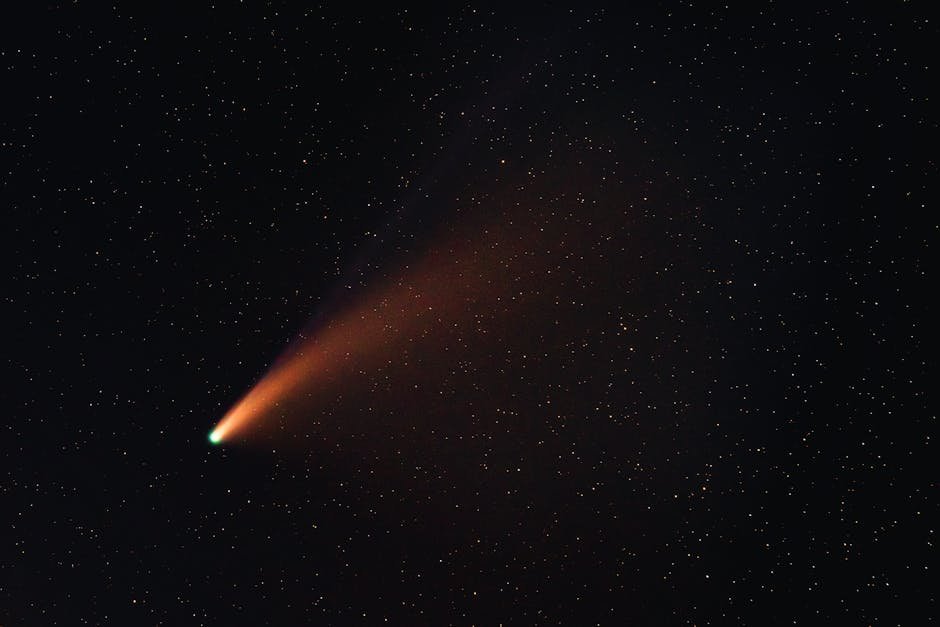
A Swift Discovery Ignites Global Interest (Image Credits: Pexels)
Astronomers recently analyzed data from an extraordinary visitor to our solar system, a comet named 3I/ATLAS that hurtled in from interstellar space. Observations suggest this icy wanderer formed up to 12 billion years ago, potentially predating our solar system by billions of years and offering a glimpse into the Milky Way’s formative era.[1][2] Scientists determined its interstellar origin through its hyperbolic trajectory and high speed, marking it as only the third such object confirmed after 1I/’Oumuamua in 2017 and 2I/Borisov in 2019.[3]
A Swift Discovery Ignites Global Interest
The ATLAS survey telescope in Río Hurtado, Chile, first spotted 3I/ATLAS on July 1, 2025, initially cataloged as A11pl3Z.[2] Precovery images extended detections back to May 7, 2025, revealing a faint object at magnitude 18 racing at 61 kilometers per second. Within days, telescopes worldwide confirmed cometary activity, including a subtle coma, leading the Minor Planet Center to designate it C/2025 N1 (ATLAS) and the interstellar label 3I on July 2.[4]
Unlike bound solar system comets, 3I/ATLAS followed a hyperbolic path with an eccentricity of about 6.14, ensuring it would pass through without orbiting the sun. Its hyperbolic excess velocity reached 58 kilometers per second, faster than prior visitors, hinting at a long, unbound journey.[2] This rapid detection spurred observations from Hubble, JWST, and Mars-orbiting spacecraft, capturing its evolution as it approached perihelion.
Pinpointing an Age from the Dawn of the Galaxy
Early kinematic analysis of its trajectory pointed to origins in the Milky Way’s thick disk, where stars average 7 to 14 billion years old. A July 2025 study by Matthew Hopkins and colleagues estimated a 68 percent chance of 3I/ATLAS falling in that range, while another by Aster Taylor and Darryl Seligman suggested 3 to 11 billion years.[2] These figures already positioned it as potentially the oldest comet observed, surpassing our 4.6-billion-year-old solar system.
James Webb Space Telescope observations in December 2025 refined this further. Isotopic ratios in outgassed water showed elevated deuterium and carbon-13 levels unlike any solar system comet, indicating formation 10 to 12 billion years ago in a colder, distinct stellar nursery around 30 kelvins.[1] Romain Maggiolo of the Royal Belgian Institute for Space Aeronomy noted, “3I/ATLAS isotopic composition is very different from solar system comets and suggest that it likely formed 10-12 billion years ago… at a much earlier time in the history of the Milky Way.”[1]
Unusual Chemistry from a Distant Birth
Spectroscopy revealed a nucleus likely under 1 kilometer across, shrouded in a reddish coma spanning hundreds of thousands of kilometers. Production rates included 129 kilograms per second of CO2 – far exceeding water at 6.6 kilograms per second – yielding an unprecedented CO2-to-water ratio of 8.[2] Traces of CO, OCS, methane, cyanide, and even atomic nickel vapor emerged, but carbon chains like C2 and C3 remained depleted.
This composition defied trends in local comets, suggesting either a CO2-rich core or prolonged radiation altering its ices over eons. High negative polarization in the coma evoked trans-Neptunian objects, while a sun-facing dust plume added intrigue. Such traits underscored its alien heritage, preserved through billions of years adrift.[2]
- CO2 dominant outgassing, highest ratio at heliocentric distance.
- Water ice in amorphous grains under 1 micrometer.
- Methane and OCS hint at complex organics from primordial disk.
- Nickel emission precedes cyanide, matching some solar analogs.
- No iron vapor, depleted hydrocarbons.
Charting Its Solar System Flyby
3I/ATLAS reached perihelion on October 29, 2025, at 1.36 AU between Earth and Mars orbits, peaking at 68 kilometers per second. It zipped 0.018 AU from Mars on October 3, visible to rovers like Perseverance. Closest Earth approach came December 19 at 1.8 AU, still distant but observable with telescopes.[3]
Spacecraft contributed richly: ExoMars imaged near Mars, Juice attempted flyby proximity in November, and Hubble monitored outbound. By March 2026, it passed Jupiter at 0.36 AU, now fading toward Saturn in July. Non-gravitational forces from outgassing slightly nudged its path, as expected.[4]
| Date | Event | Distance |
|---|---|---|
| Oct 3, 2025 | Mars flyby | 0.018 AU |
| Oct 29, 2025 | Perihelion | 1.36 AU |
| Dec 19, 2025 | Earth closest | 1.8 AU |
| Mar 16, 2026 | Jupiter flyby | 0.36 AU |
Lessons from a Fading Cosmic Messenger
3I/ATLAS challenges assumptions about interstellar visitors, proving they arise from diverse galactic regions, including the counterintuitive southern sky. Its endurance implies robust preservation of volatiles, fueling speculation on early prebiotic chemistry – Maggiolo highlighted potential “rich prebiotic chemistry… very early in the history of our Galaxy.”[1]
Key Takeaways
- Age of 10-12 billion years from JWST isotopes, oldest known comet candidate.
- CO2-rich, exotic makeup signals birth in ancient Milky Way disk.
- Hyperbolic path confirms one-way tour, no return visits.
This relic departs carrying irreplaceable data on lost worlds, reminding us the galaxy teems with ancient survivors. As it vanishes into the void, its story reshapes views of cosmic evolution – what secrets might the next visitor reveal? Share your thoughts in the comments.