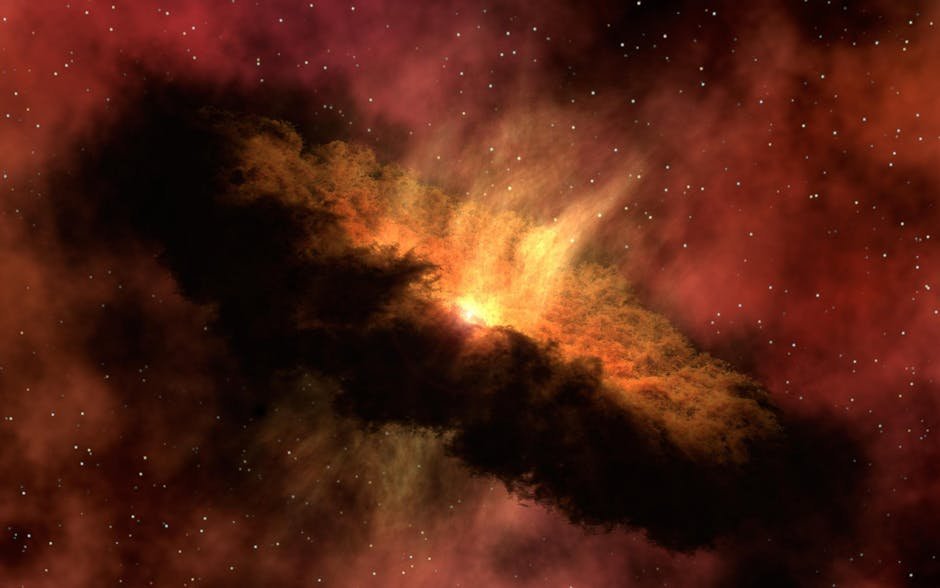
A Burst That Refused to Fade (Image Credits: Pexels)
Astronomers witnessed a cosmic spectacle on July 2, 2025, when NASA’s Fermi Gamma-ray Space Telescope registered GRB 250702B, a gamma-ray burst that endured for more than seven hours. This event outlasted previous records by a wide margin and prompted urgent observations from telescopes worldwide. The James Webb Space Telescope later pierced through interstellar dust to reveal the burst’s host galaxy, located 8 billion light-years away, offering vital clues to its extraordinary nature.[1][2]
A Burst That Refused to Fade
Gamma-ray bursts rank among the universe’s most violent eruptions, typically flashing for mere seconds or minutes before vanishing. GRB 250702B shattered this pattern with emissions spanning at least 25,000 seconds, nearly twice the length of the prior record holder, GRB 111209A. Fermi’s Gamma-ray Burst Monitor triggered repeatedly over three hours, while X-ray signals hinted at activity a day earlier via China’s Einstein Probe.[3]
Swift Observatory pinpointed the location in the constellation Scutum early on July 3. Ground-based facilities joined swiftly: Keck and Gemini in Hawaii, the Very Large Telescope in Chile, and Hubble Space Telescope provided initial images of a fading afterglow. The prolonged flares, detected up to two days later by Chandra and NuSTAR, suggested a power source that sustained itself far beyond standard models. No other event among 15,000 recorded GRBs approached this persistence.[1]
JWST’s Revelations on the Host Galaxy
James Webb Space Telescope observations on October 5 delivered the clearest portrait yet of GRB 250702B’s home. NIRCam imaging exposed a massive galaxy, over twice the Milky Way’s mass, bisected by a prominent dust lane. The burst emerged from near the lane’s edge in a star-forming region, 1,900 light-years from the core.[1] NIRSpec spectroscopy confirmed a redshift of 1.036, fixing the distance at roughly 8 billion light-years.
“The resolution of Webb is unbelievable. We can see so clearly that the burst shined through this dust lane spilling across the galaxy,” noted Huei Sears, a Rutgers University postdoctoral researcher who led the NIRCam work.[1] This galaxy stands out as the largest and dustiest GRB host identified, rare even among general populations. No ongoing emission or supernova signature appeared at the site, ruling out typical stellar collapse scenarios at detectable levels.
Energy Scale and Exotic Progenitors
The outburst unleashed energy equivalent to 1,000 Suns shining for 10 billion years, with isotropic gamma-ray output exceeding 2.2 × 10^54 erg. Such power from such distance demanded explanations beyond conventional GRB formation. Researchers favor black hole involvement, where accretion fueled the jets.
- Stellar-mass black hole merging with a helium star, consuming it over a day.
- Intermediate-mass black hole (hundreds to thousands of solar masses) tidally disrupting a passing star.
- Rare relativistic tidal disruption event near a supermassive black hole, though variability argues against it.
Spectroscopic data excluded a bright supernova, though dust might obscure fainter ones. The event’s rarity – over 1,000 times less frequent than high-luminosity long GRBs – points to unique environmental or progenitor conditions. “The burst was remarkably powerful,” stated Benjamin Gompertz of the University of Birmingham.[1]
Challenging Decades of Theory
GRB 250702B arrived amid refined models of these explosions, yet it defied them all. Traditional collapsars – massive stars imploding into black holes – predict short durations and supernovae, neither matching here. The narrow jet, high Lorentz factor, and subsecond variability echoed familiar GRBs, but the marathon length did not.
Teams published findings across journals, from Monthly Notices of the Royal Astronomical Society to Astrophysical Journal Letters. The helium merger model emerged as a frontrunner, predicting testable outcomes like late-time flares from ongoing accretion. This outlier underscores gaps in understanding extreme transients.
Key Takeaways
- GRB 250702B set the duration record at over 7 hours, detected by Fermi, Swift, and more.
- JWST unveiled a dusty, massive host galaxy at z=1.036, 8 billion light-years distant.
- No supernova observed; black hole-star interactions likely powered the event.
GRB 250702B compels a reevaluation of gamma-ray burst progenitors, hinting at hidden populations of mergers or disruptions in dusty realms. As telescopes like JWST continue probing, such enigmas may rewrite cosmic explosion lore. What explanation convinces you most? Share your thoughts in the comments.