A Crew Reflecting Today’s World (Image Credits: Flickr)
Kennedy Space Center, Florida — NASA stands on the cusp of history with Artemis II, its first crewed deep-space mission in over half a century. Scheduled for launch no earlier than April 1, this 10-day lunar flyby will test systems critical for future Moon landings and Mars journeys. Unlike the Apollo program’s short visits, Artemis II emphasizes sustainability, diversity, and cutting-edge technology to establish a lasting human presence beyond Earth orbit.[1][2]
A Crew Reflecting Today’s World
The Artemis II team marks a stark departure from Apollo crews. Four astronauts will venture around the Moon: NASA Commander Reid Wiseman, Pilot Victor Glover, Mission Specialist Christina Koch, and Canadian Space Agency Mission Specialist Jeremy Hansen. Glover becomes the first African American on a NASA lunar mission, Koch the first woman, and Hansen the first non-American.[3][4]
Apollo 8, the closest parallel, carried three all-male NASA astronauts: Frank Borman, Jim Lovell, and William Anders. That mission lasted six days and entered lunar orbit. Artemis II’s diverse lineup brings varied expertise in science, engineering, and piloting, honed through simulations, geology fieldwork in Iceland, and health monitoring training.[5]
Orion: A Leap in Spacecraft Design
At the heart of Artemis II lies the Orion spacecraft, a technological marvel far surpassing Apollo’s Command and Service Module. Orion accommodates four crew members in 9 cubic meters of habitable space, powered by expansive solar arrays spanning 18.6 meters with nearly 15,000 cells. Its service module, crafted by the European Space Agency, handles propulsion, air, water, and thermal control.[3][2]
Apollo’s module fit three astronauts in 5.95 cubic meters, relying on fuel cells. Orion’s computers offer 128,000 times more memory and operate 20,000 times faster than Apollo’s single unit, with quadruple redundancy. Crew survival suits in bright orange provide six days of protection during launch, reentry, and emergencies—a feature absent in Apollo’s multi-use white suits.[5]
| Feature | Apollo Module | Orion |
|---|---|---|
| Capacity | 3 crew | 4 crew |
| Habitable Volume | 5.95 m³ | 9 m³ |
| Power Source | Fuel cells | Solar arrays |
| Computers | 1 unit | 4 redundant |
Bold Trajectory Pushes Boundaries
Artemis II follows a free-return path, slingshotting around the Moon in a figure-eight loop with Earth and the Moon’s gravity, conserving fuel. The crew will travel up to 6,000 miles beyond the Moon’s far side—farther than any humans before—offering views of the full lunar disk, including polar regions unseen by Apollo astronauts.[4][5]
Apollo 8 orbited the Moon at about 150 miles altitude over 10 revolutions. Artemis II skips orbit for safety, staying at a greater distance during flyby. This path mirrors Apollo 13’s emergency route but extends the outbound leg, with one day in Earth orbit before lunar transit.[1]
SLS Rocket Outpowers Saturn V
The Space Launch System propels Orion skyward with 15% more liftoff thrust than the Saturn V. SLS stands 322 feet tall, featuring a 212-foot core stage with four RS-25 engines and two solid rocket boosters, plus an upper Interim Cryogenic Propulsion Stage.[2][3]
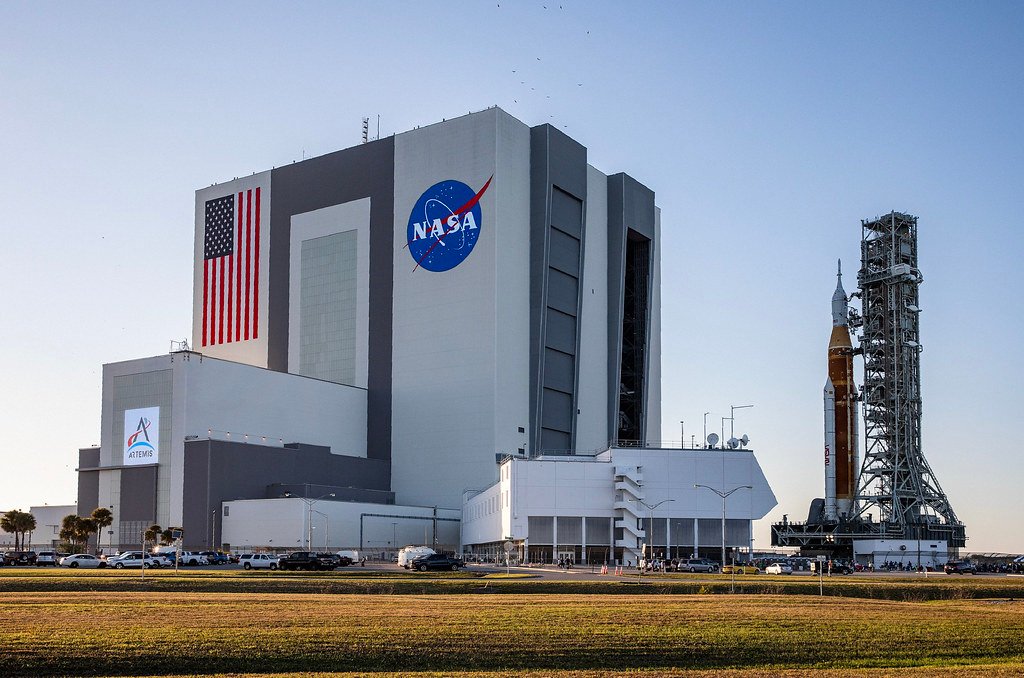
Saturn V, at 363 feet, used five F-1 engines on its first stage. Both assemble in Kennedy’s Vehicle Assembly Building, but SLS integrates modern testing like wet dress rehearsals. This power enables Artemis II’s extended profile and paves the way for heavier payloads in future missions.
- SLS thrust: 39.1 million newtons
- Saturn V thrust: 33.8 million newtons
- SLS height: 98 meters
- Saturn V height: 110.6 meters
- Both support deep-space human flight
Sustainable Goals Shape the Future
While Apollo achieved six landings in equatorial zones over short stays, Artemis targets the lunar South Pole for water ice and resources. The program fosters international ties via the Artemis Accords and commercial partners like SpaceX and Blue Origin for landers.[3]
Future missions plan longer surface operations with advanced rovers, dust-resistant suits, and the Gateway station. Artemis II validates these systems beyond Earth’s magnetosphere. As Pilot Victor Glover noted, “If we can contribute a little bit to hope for humanity, that is a huge thing.”[5]
Key Takeaways
- Artemis II features a diverse four-person crew, contrasting Apollo’s all-male teams.
- Orion’s advanced tech supports longer, safer deep-space travel.
- The mission reaches unprecedented distances, testing sustainability foundations.
Artemis II does not merely revisit the Moon; it reimagines exploration for enduring human outposts and Mars ambitions. This evolution honors Apollo’s triumphs while embracing a collaborative, innovative era. What aspects of Artemis II excite you most? Share in the comments.