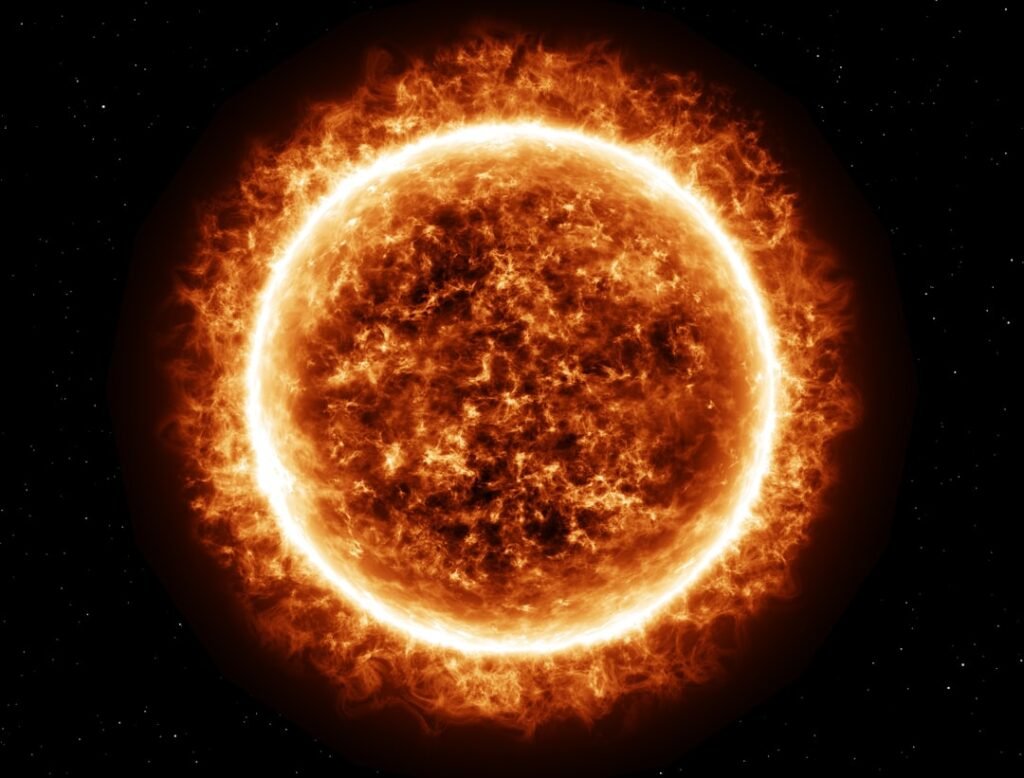
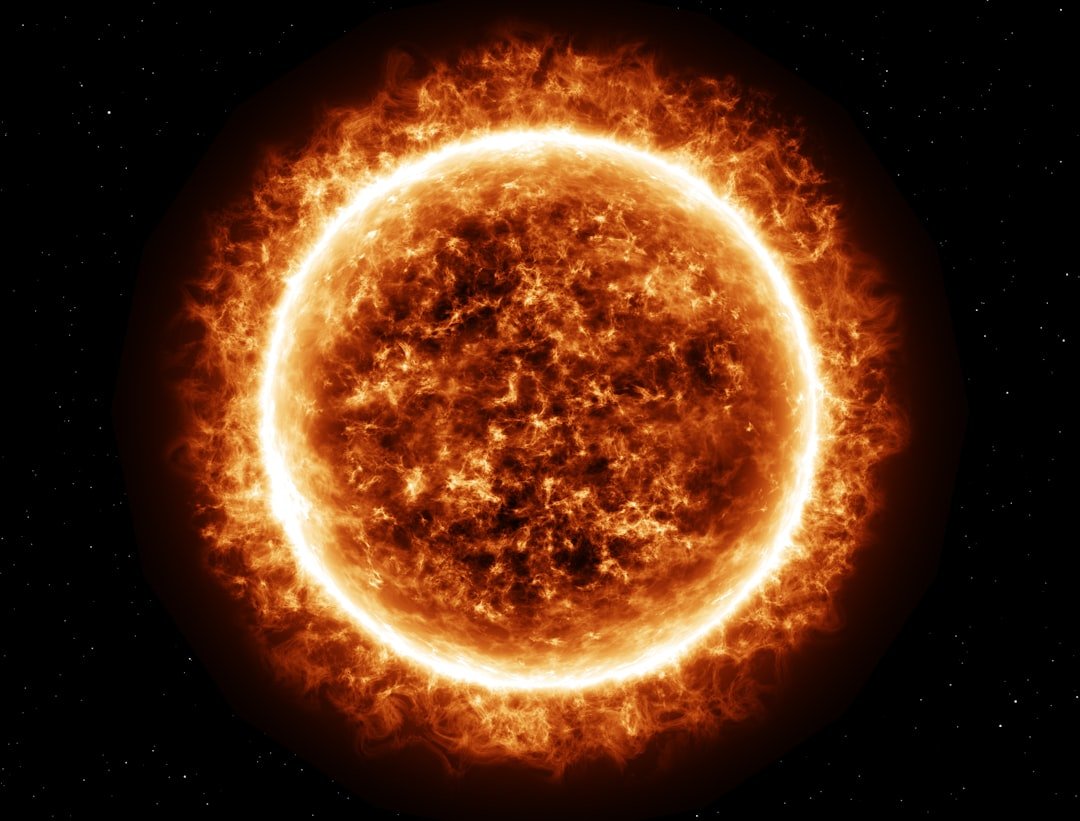
The Flare’s Fiery Display (Image Credits: Unsplash)
Cape Canaveral, Florida — A potent X1.4-class solar flare erupted from the sun late on March 29, 2026, casting a shadow over NASA’s final preparations for the Artemis 2 mission. Peaking at 11:19 p.m. EDT, the event triggered strong radio blackouts across parts of the globe and released a fast coronal mass ejection with a possible Earth-directed path. With liftoff now just two days away, space agencies heightened their monitoring to safeguard the crewed lunar orbit flight.[1][2]
The Flare’s Fiery Display
Active Region 4405 on the sun’s surface unleashed the X1.4 flare, marking one of the strongest eruptions in recent weeks during the ongoing solar maximum.[1] NASA’s Solar Dynamics Observatory and NOAA’s GOES satellites captured the brilliant burst in extreme ultraviolet light, revealing loops of superheated plasma twisting into space. The flare classified as R3-strong on NOAA’s scale, indicating significant interference with high-frequency signals.
Within minutes, the ionization of Earth’s upper atmosphere caused widespread degradation of radio communications on the sunlit side of the planet. Regions in southeast Asia and Australia reported the most severe disruptions, affecting aviation, maritime operations, and amateur radio enthusiasts. Solar physicist Tamitha Skov noted the timing’s sensitivity: “NASA is paying attention regarding the upcoming Artemis 2 launch. We need to pay attention to radio bursts now. Those can really impact HF/VHF as well as satellite radio communications during critical launch operations and early orbit maneuvers!”[1]
Coronal Mass Ejection Adds to the Threat
The flare did not occur in isolation. Imagery from the SOHO spacecraft’s LASCO instrument showed a billowing coronal mass ejection racing away from the sun at high speeds.[2] While analysis continued to confirm the exact trajectory, forecasters identified a potential Earth-impacting component that could spark geomagnetic storms.
NOAA’s Space Weather Prediction Center responded swiftly with a G2-moderate geomagnetic storm watch for March 31, alongside possible G1-minor conditions on March 30 and April 1.[1] Such events often enhance auroral displays at high latitudes but pose risks to power grids, satellites, and navigation systems. For space missions, the primary worry lies in radiation spikes from solar energetic particles.
Artemis 2: A Milestone Under Scrutiny
The Artemis 2 crew — NASA astronauts Reid Wiseman, Victor Glover, and Christina Koch, alongside Canadian Space Agency astronaut Jeremy Hansen — prepared for a 10-day journey around the moon, the first crewed lunar flight since Apollo 17 in 1972.[2] Launching aboard the Space Launch System rocket and Orion spacecraft from Kennedy Space Center’s Launch Complex 39B, the mission tests systems for future lunar landings and Mars exploration.
Teams rolled out the SLS stack to the pad on March 20 after weather delays, and recent checks confirmed no major technical hurdles. The astronauts entered quarantine on March 18, flying to Florida days before liftoff targeted at 6:24 p.m. EDT on April 1. This timing places the mission squarely in a period of elevated solar activity, amplifying the stakes.[2]
NASA’s Robust Space Weather Defenses
Teams at NASA’s Goddard and Johnson Space Centers, working with NOAA, maintained round-the-clock vigilance using data from satellites like the Solar Dynamics Observatory, SOHO, and GOES-19.[3] The Moon to Mars Space Weather Analysis Office evaluates flare and CME threats, forecasting particle events that could endanger crews beyond Earth’s magnetosphere.
Orion features the Hybrid Electronic Radiation Assessor with six sensors and personal dosimeters to track radiation in real time. If levels exceed thresholds, alarms prompt crews to shelter behind added mass like equipment bags. Ground controllers relay updates, enabling decisions on launch timing or maneuvers. These measures build on lessons from uncrewed tests, ensuring astronaut safety amid solar maximum’s unpredictability.[3]
- Radiation monitoring via embedded sensors triggers automated alerts.
- Crew sheltering protocols use spacecraft mass for shielding.
- Real-time forecasts from multiple observatories guide mission ops.
- Collaboration with NOAA provides geomagnetic storm predictions.
- Historical data informs risk assessments for deep-space travel.
Key Takeaways
- The X1.4 flare highlights solar maximum risks during critical mission windows.
- Artemis 2 demonstrates advanced radiation protection for lunar voyages.
- Space weather monitoring remains essential for safe human spaceflight.
As the CME approaches and launch countdown proceeds, this solar event underscores the delicate balance between cosmic wonders and exploration hazards. Enhanced auroras may light northern skies, but for NASA, the focus stays on mission success. What do you think about the interplay of solar activity and space travel? Tell us in the comments.