
There’s something deeply unsettling about a world that doesn’t look the way it should. Asteroid Psyche was supposed to be a dense, gleaming metallic body – a kind of exposed planetary core drifting through the asteroid belt. What scientists are now finding, however, is far more complicated and honestly far more fascinating.
New data from NASA’s Psyche spacecraft is rewriting what we thought we knew about this strange world. The giant craters pockmarking its surface are telling a story of violent cosmic history, and that story suggests the metal that once defined Psyche may be buried far deeper than anyone expected. Let’s dive in.
The Mystery at the Heart of Asteroid Psyche
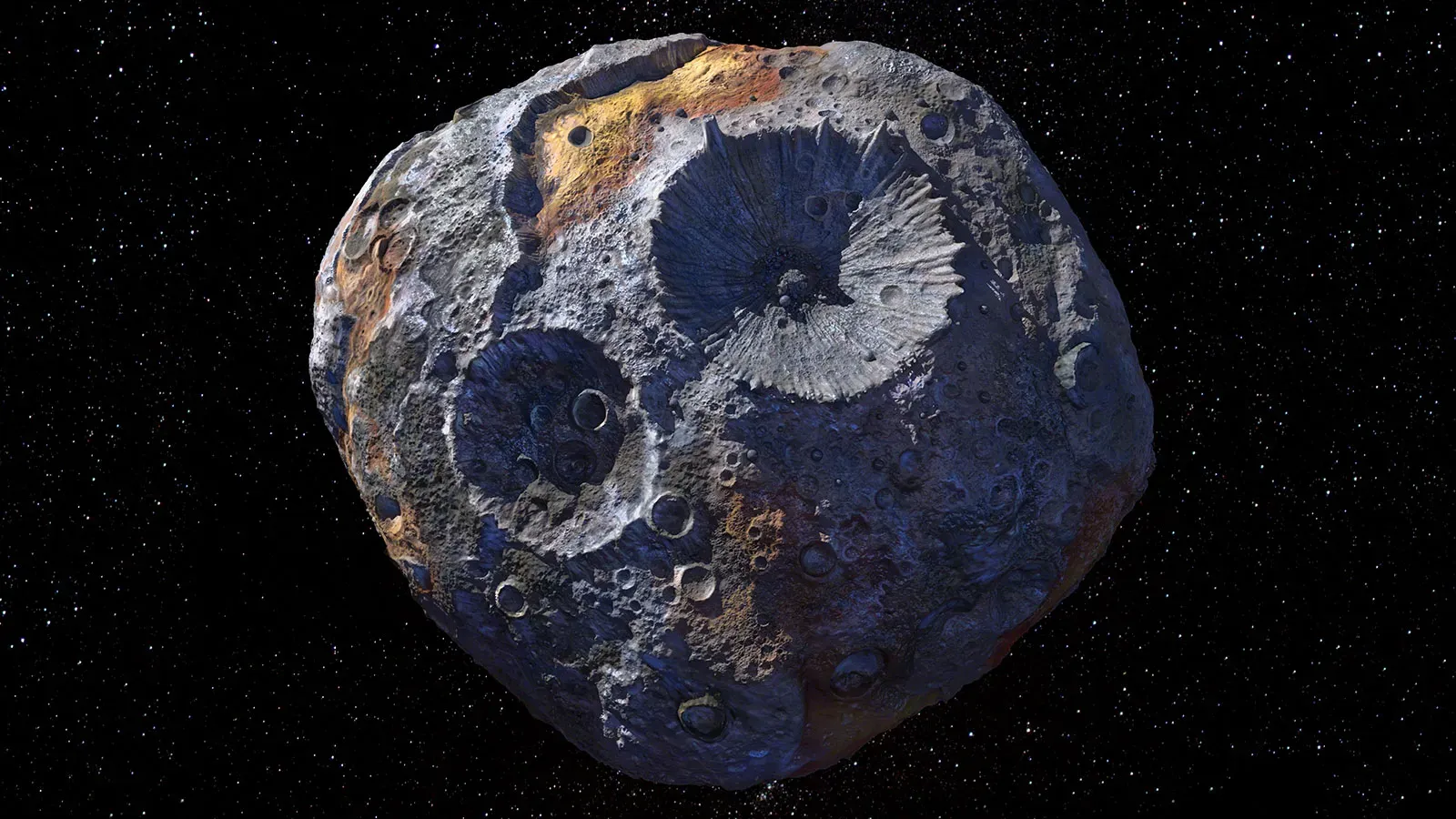
Here’s the thing – Psyche has puzzled scientists for decades. It sits roughly in the middle of the main asteroid belt, orbiting the Sun between Mars and Jupiter, and it was long assumed to be the bare metallic core of a protoplanet that had its rocky mantle stripped away by ancient collisions. That assumption made it uniquely exciting. A metallic core, exposed and orbiting in space, would be like getting a free look at the inside of a planet without having to drill through thousands of kilometers of rock.
The problem is that when NASA’s Psyche spacecraft began sending back detailed data, the surface didn’t exactly match those expectations. The asteroid appears less reflective than a pure iron-nickel body should be, and the craters reveal something unexpected lying beneath. It’s hard to say for sure, but the evidence is increasingly pointing toward a surface that has been fundamentally altered over billions of years.
What the Giant Craters Are Actually Telling Us
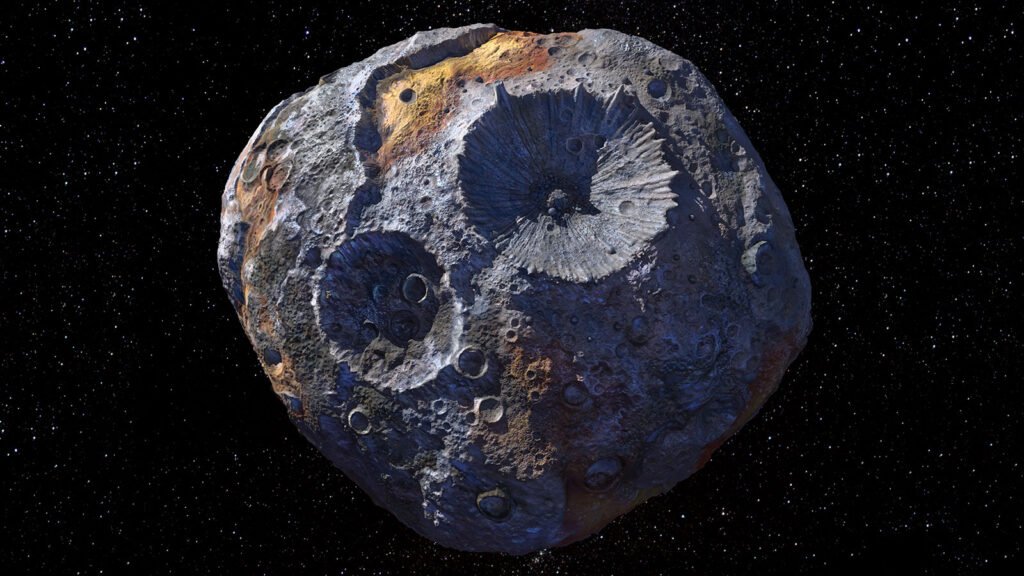
Let’s be real – craters are basically nature’s excavation tools. When a large impactor slams into a planetary body, it digs deep, ejecting material from below the surface and exposing what was once hidden. On Psyche, the largest craters should be windows into a glorious metallic interior if the original theory held true. Instead, researchers studying the crater morphology and ejecta patterns are finding signs of a surface composed of mixed materials, not pure shining metal.
The craters also behave differently than expected. Their shapes and depths suggest the surface has a lower density and different mechanical strength than solid iron-nickel would provide. Think of it like biting into what you thought was a solid chocolate truffle, only to find it’s hollow or filled with something softer inside. The crater data is essentially doing the same thing – revealing a texture and composition that breaks the old model wide open.
The Theory of a Lost Metallic Surface
So where did all the metal go? One leading idea gaining traction among researchers is that Psyche’s metallic surface was gradually covered or replaced over time through geological and space weathering processes. Volcanic activity early in the solar system’s history may have erupted silicate material from the interior, effectively coating the metallic core with a rocky veneer. Over billions of years, that veneer could have thickened, mixed, and evolved into something that looks nothing like raw iron.
Another possibility involves the bombardment history of the early solar system. Repeated, massive impacts over billions of years could have gardened the surface so thoroughly that a thick layer of fragmented rock and mixed regolith now blankets whatever metallic material lies beneath. Honestly, both explanations could be partially true at the same time, and that complexity is what makes planetary science so endlessly interesting.
NASA’s Psyche Mission and What It Has Found So Far
NASA launched the Psyche spacecraft in October 2023, and after a successful journey it entered orbit around the asteroid in 2023, marking a major milestone in deep space exploration. Since then, the spacecraft has been mapping the surface, measuring the gravitational field, and analyzing the elemental composition using onboard instruments. The data coming back has been genuinely surprising to the science team in ways both thrilling and humbling.
The spacecraft’s gamma-ray and neutron spectrometer has been working to detect iron, nickel, and other elements on the surface. Early indications suggest that the iron signature is lower than models predicted for an exposed metallic core, which strongly supports the idea that the outer layers are dominated by something else entirely. The mission is still ongoing, and with each new orbit the picture becomes sharper and more detailed.
Craters as Clues to Psyche’s Violent Past
Some of the craters observed on Psyche are enormous, stretching tens of kilometers across. Craters of that scale don’t just scratch the surface – they punch deep, sometimes excavating material from several kilometers down. If anything purely metallic was going to show up anywhere, it would be at the bottoms or rims of these massive impact features. The fact that the crater interiors still don’t reveal the expected metal-rich composition is a significant finding.
Researchers are also looking at the distribution and age of craters to understand the timeline of impacts. Older, heavily eroded craters suggest Psyche has been battered for a very long time, while fresher craters hint at more recent events. This layered impact history complicates the picture even further, because each major collision would have mixed and redistributed surface material in unpredictable ways.
Could Psyche Actually Be Something Entirely Different?
This is the question that keeps planetary scientists up at night. What if Psyche isn’t a stripped planetary core at all? Some researchers have proposed that it could be a primitive body that simply accumulated a lot of metallic material during its formation, rather than being the exposed heart of a demolished protoplanet. That would completely change its scientific significance, though it would make it no less fascinating.
There’s also a model suggesting Psyche could be a mixture of metal and silicate rock that was never fully differentiated, meaning it never fully separated into distinct layers of core and mantle the way Earth did. Roughly speaking, it might be more like a marble cake than a hard-boiled egg – metal and rock swirled together rather than neatly separated. The crater evidence currently being analyzed could help settle this debate once and for all.
Why This Discovery Changes How We Think About Planetary Formation
Understanding Psyche isn’t just about one weird asteroid. It’s about reconstructing the earliest chapter of our solar system’s history, when raw planetary building blocks were colliding, melting, and differentiating into the worlds we know today. If Psyche lost its metallic surface through volcanic resurfacing or relentless impacts, that tells us something profound about how energetic and chaotic that early period truly was.
The implications ripple outward too. If even a body as apparently simple as Psyche turns out to have a complex geological history, it suggests that other asteroids we’ve classified as straightforward may also be hiding surprises. Every crater, every unexpected density reading, every mismatched composition is a reminder that the solar system is still full of secrets. I think that’s one of the most inspiring things about planetary exploration – the universe keeps proving us gloriously wrong.
Conclusion: A World That Rewrites Its Own Story
Psyche arrived in our scientific imagination as a simple answer – a metallic core, exposed and waiting to tell us about planetary interiors. What the craters are revealing instead is a world with a turbulent past, a buried or altered metallic nature, and a surface shaped by billions of years of processes we are only beginning to understand.
The giant craters don’t just scar the surface of this asteroid. They open a window into deep time and remind us how messy and dynamic the formation of worlds really is. Psyche didn’t lose its metal quietly – it did so through fire, impact, and time, and unraveling that story may tell us more about Earth’s own hidden interior than we ever expected. What do you think – does it change the way you see that patch of sky between Mars and Jupiter? Tell us in the comments.