
What if your thoughts aren’t just happening inside your head, but are actually rippling through the very structure of reality? It sounds wild, almost like science fiction, yet a growing number of serious physicists, neuroscientists, and philosophers are daring to ask whether consciousness and spacetime are more deeply intertwined than we once believed.
We used to treat consciousness as a side-effect of a squishy brain and spacetime as a cold mathematical grid. But over the last few decades, something strange has happened: as physics has dug deeper into the quantum world and neuroscience has probed the brain with unprecedented detail, the old neat separation between “mind” and “universe” has started to look suspiciously thin. The more we learn, the more it seems that consciousness might not be an accidental passenger in the cosmos – it might be woven into its very fabric.
The Old Story: Brains in a Box, Universe Outside
For most of modern science, the story was simple: there’s a physical universe out there – made of matter, energy, and spacetime – and inside that universe, some complex lumps of matter (like brains) happen to become conscious. In this view, consciousness is like steam from a boiling pot: an emergent by-product of physical processes, interesting but not fundamental. The brain is a biological machine, and the universe is a vast, indifferent stage on which that machine happens to run.
This worldview is powerful. It’s given us medical advances, computers, rockets, and more. But it also leaves a big, stubborn mystery on the table: how does a collection of neurons firing turn into the raw feel of experience – pain, joy, the color red, the taste of coffee? You can point to every neuron and every chemical, but somewhere between description and experience, something feels missing. That gap – the so-called “hard problem” of consciousness – has pushed some researchers to ask whether we’ve been starting the story from the wrong end.
Quantum Weirdness: When Observation Seems to Matter
Physics added fuel to the fire when quantum mechanics arrived and casually blew up common sense. At the smallest scales, particles don’t behave like tiny billiard balls; they exist in fuzzy clouds of probability that “collapse” into definite states when measured. For a long time, this was treated as a purely mathematical trick, but the role of observation in quantum experiments made people uncomfortably aware that the act of measuring – of knowing – seemed to matter.
Some interpretations try to keep consciousness out of it completely, arguing that any interaction with the environment counts as a measurement and that the universe doesn’t care if anyone is watching. Others, however, have explored the idea that conscious observation might play a special role in turning quantum possibilities into actual outcomes. While this is still hugely controversial, the very fact that we can’t fully remove the concept of an observer from quantum theory has kept the door open to wilder ideas about consciousness and reality sharing deeper roots.
Spacetime Is Not What We Thought It Was
At the same time, our picture of spacetime itself has been shifting. Einstein already showed that space and time are not separate things but part of a single, flexible fabric that bends and stretches with gravity. In the last few decades, work on quantum gravity and black holes has pushed this even further, suggesting that spacetime might not be fundamental at all, but something that “emerges” from deeper, more abstract structures like quantum entanglement or information.
One striking idea is that spacetime geometry – the way distances, angles, and time intervals work – could be built from networks of quantum relationships. In this picture, the smooth continuum we experience is like a high-resolution image, but underneath it is a web of discrete connections. This is a huge shift: if spacetime is emergent rather than basic, then the question naturally arises – emergent from what, exactly? And if the building blocks are patterns of information and correlation, we’re suddenly talking in a language that sounds much closer to how brains and consciousness are described.
Are Minds and Spacetime Both Built from Information?

Neuroscience has steadily moved toward viewing the brain as an information-processing system, and some theories suggest that conscious experience arises when information in the brain is highly integrated and structured in specific ways. In parallel, a number of physicists have started describing black holes, quantum fields, and even the universe itself in terms of information content and its flow. It’s as if both brain science and fundamental physics have independently wandered into the same conceptual territory.
This overlap has led some researchers to speculate that consciousness might not be some alien phenomenon sticking out of an otherwise purely physical universe, but a particular pattern of information embedded in a deeper informational substrate that also gives rise to spacetime. In this view, your conscious experience and the geometry of the cosmos are two different “faces” of underlying information dynamics. It doesn’t mean your thoughts are steering galaxies around, but it does suggest that mind and universe might be different expressions of the same deeper stuff, like waves and ripples on the surface of one vast ocean.
Could Consciousness Be a Fundamental Feature of Reality?
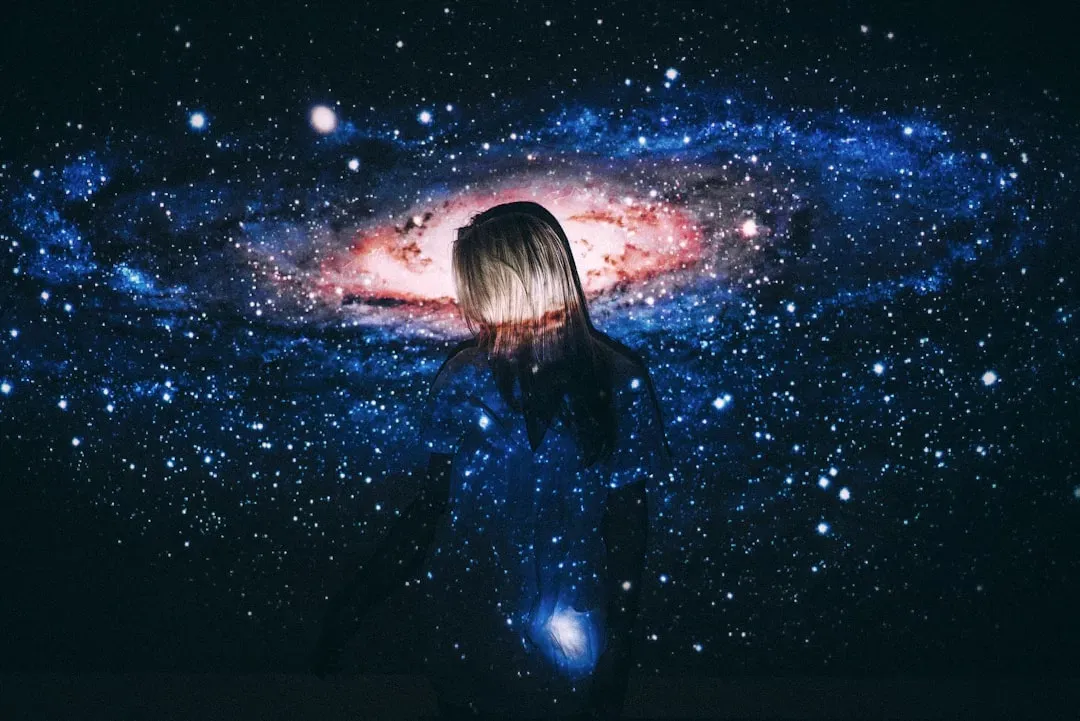
Faced with the stubborn mystery of subjective experience, a few philosophers and scientists have revived a bold idea: maybe consciousness is not something that magically appears only when matter gets complex enough. Maybe it is a basic property of reality, woven into the fabric of existence the way mass and charge are. This family of views, often grouped under labels like panpsychism or related ideas, suggests that even very simple systems have incredibly primitive forms of experience, which combine and organize in richer ways in complex brains.
If that sounds bizarre, consider that we already accept that every speck of matter carries energy and interacts via fields that pervade spacetime. Extending that picture to include a rudimentary “mental” aspect isn’t logically impossible – it’s just unfamiliar. From this angle, the question shifts from “How does lifeless matter create consciousness?” to “How does the universe assemble basic conscious ingredients into the vivid, unified awareness you feel right now?” It’s a radical shift that tries to bridge the gap between mind and world by refusing to treat one of them as a late accidental add-on.
Spacetime as a Stage for Conscious Participation

Even without adopting extreme views, you can still take seriously the idea that consciousness and spacetime are deeply entangled. Some approaches to quantum gravity and cosmology hint that the universe is not a fixed stage but a kind of ongoing computation or unfolding process. In that kind of universe, complex systems like brains are not just passive spectators; they are active participants in shaping which possibilities become real within their local regions of spacetime.
Think of it this way: your brain is constantly measuring, predicting, and updating its internal model of the world, and those processes are physically implemented in the same quantum fields and spacetime structure that everything else uses. On that level, your conscious life is not separate from the universe’s evolution; it is one of the ways the universe learns about itself. That might sound poetic, but it’s also a sober recognition that the line between “observer” and “observed” is blurrier than the old textbook diagrams ever suggested.
Why This Matters for How We Live and Who We Think We Are

All of this can feel abstract, but it carries a surprisingly emotional punch when you let it sink in. If consciousness is deeply tied to the structure of reality, then your inner life is not a meaningless side-effect; it is part of how the universe is configured at the most intimate level. The idea that your awareness is somehow entangled with the same fabric that shapes stars and galaxies can shift how you see everyday life, making ordinary experiences feel a bit less trivial and a bit more cosmic.
It can also soften the harsh edges of the old, strictly mechanical worldview. Instead of feeling like a lonely mind trapped in a dead, indifferent universe, you might start to see yourself as a localized pattern in a living, evolving field of reality, where mind and world are intertwined. You still have to deal with messy human problems – bills, relationships, fears – but there’s a quiet, grounding sense that your conscious existence is not an accident. It is a way the fabric of spacetime is currently being lit up from within, right where you are.
Conclusion: A Universe That Wakes Up Through Us

The idea that human consciousness might be connected to the fabric of spacetime is still speculative and hotly debated, but it is not empty fantasy. It emerges from real puzzles in quantum physics, serious attempts to understand spacetime, and the stubborn fact that subjective experience refuses to fit neatly into a purely mechanistic story. Whether consciousness turns out to be emergent, fundamental, or some strange fusion of both, it is increasingly hard to treat it as a minor side detail in the grand cosmic narrative.
In the end, you don’t need to solve the equations of quantum gravity to feel the weight of this possibility: when you notice a thought, a feeling, or a simple breath, you might be touching something that is not just “in your head,” but directly tied to the deep structure of reality itself. If the universe is in any sense waking up through conscious beings, then your awareness is not just about surviving another day; it is part of how existence becomes aware of itself. What changes for you if you take that seriously, even for a moment?