The ocean is the last great frontier on our own planet. You might find it strange that we have mapped more of the surface of Mars than the depths of our own ocean floor. Scientists know more about the moon than this remote oceanic habitat. Think about that for a second. The place teeming with life, right here on Earth, is more mysterious to us than a barren rock floating in space.
The ocean covers more than seventy percent of our planet, yet remains largely unexplored. The surface sparkles with sunlight and life, but as you descend, light fades, pressure intensifies, and warmth gives way to an icy darkness. What lives down there has spent millions of years evolving into something science barely has words for. You are about to meet five of the most mind-bending creatures hiding in those black, crushing depths. Let’s dive in.
The Barreleye Fish: The Deep-Sea Creature That Can See Through Its Own Head
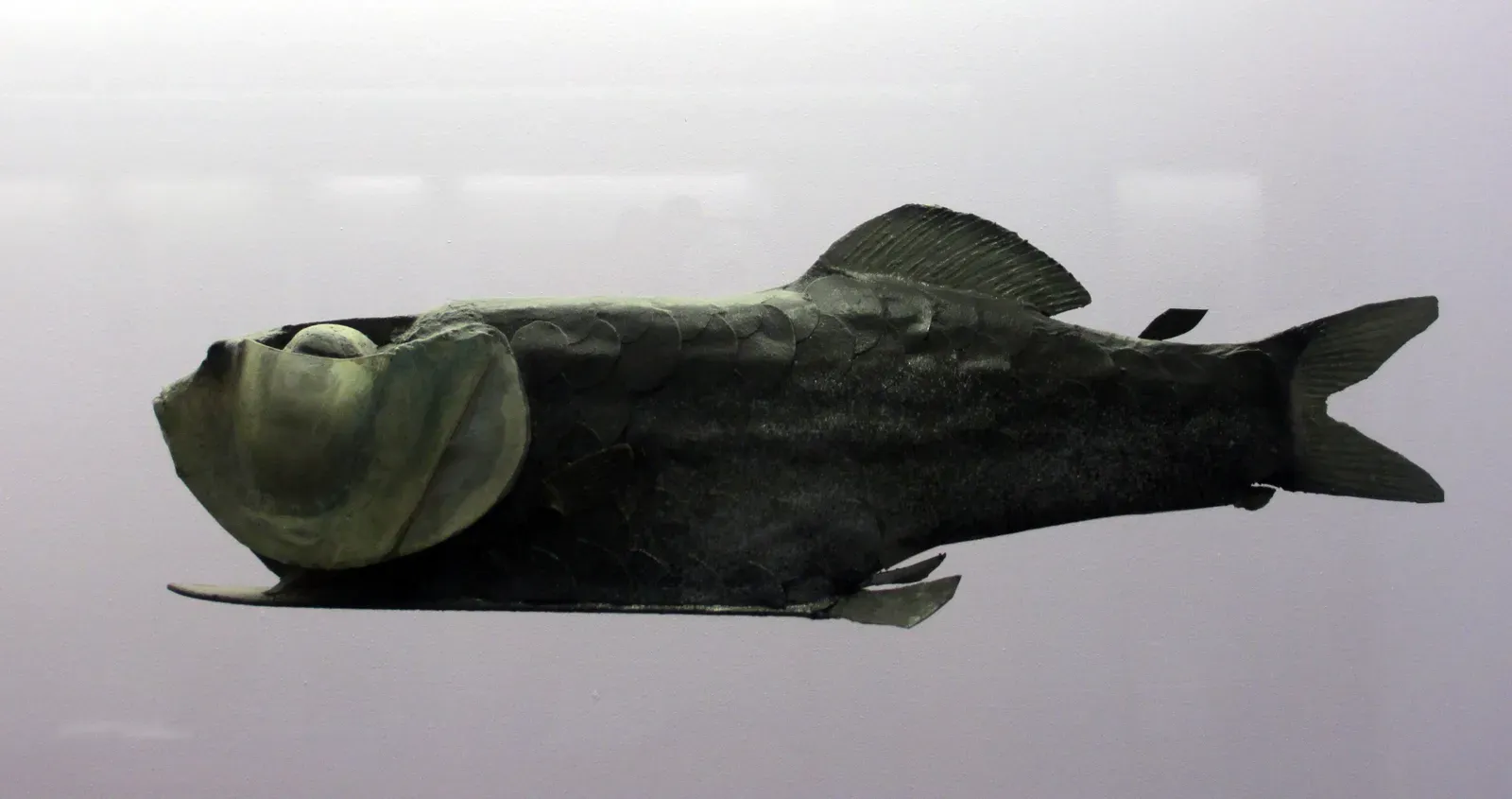
Honestly, if someone described this fish to you without showing a photo, you would assume they were making it up. The barreleye fish is known for its strange eyes and transparent dome of a head, features that make it look more like a creature from science fiction than reality. You can literally peer through the top of its skull and see the organs inside. It is one of those animals that makes you realize evolution has a much wilder imagination than any science fiction writer.
All species have large, telescoping eyes, which dominate and protrude from the head, but are enclosed within a large transparent dome of soft tissue. Here is the part that really gets you: two small indentations where eyes might normally appear on a fish are actually the barreleye’s olfactory organs, and its eyes are two glowing green orbs behind its face that gaze up towards the top of its head. What you assume are its eyes are actually its nose. The real eyes are the eerie green tubes inside that dome.
In 2008, scientists discovered that its eyes were able to rotate both up and forward within its transparent dome. This feature allows it to observe prey while keeping its eyes protected from the stinging tentacles of jellyfish-like organisms it feeds on. Before that discovery, researchers believed the eyes were fixed, offering only tunnel vision above the head. A half-century old mystery, solved in one breakthrough moment.
Barreleyes remain just below the limit of light penetration and use their sensitive, upward-pointing tubular eyes, adapted for enhanced binocular vision, to survey the waters above. Think of it like a submarine hovering motionless in the dark, scanning upward with its periscope. The green pigments in its eyes may filter out sunlight coming directly from the sea surface, helping the barreleye spot the bioluminescent glow of jellyfish or other animals directly overhead. It is a biological night-vision scope, refined over millions of years.
The Vampire Squid: Hell’s Lantern That Is Actually Harmless
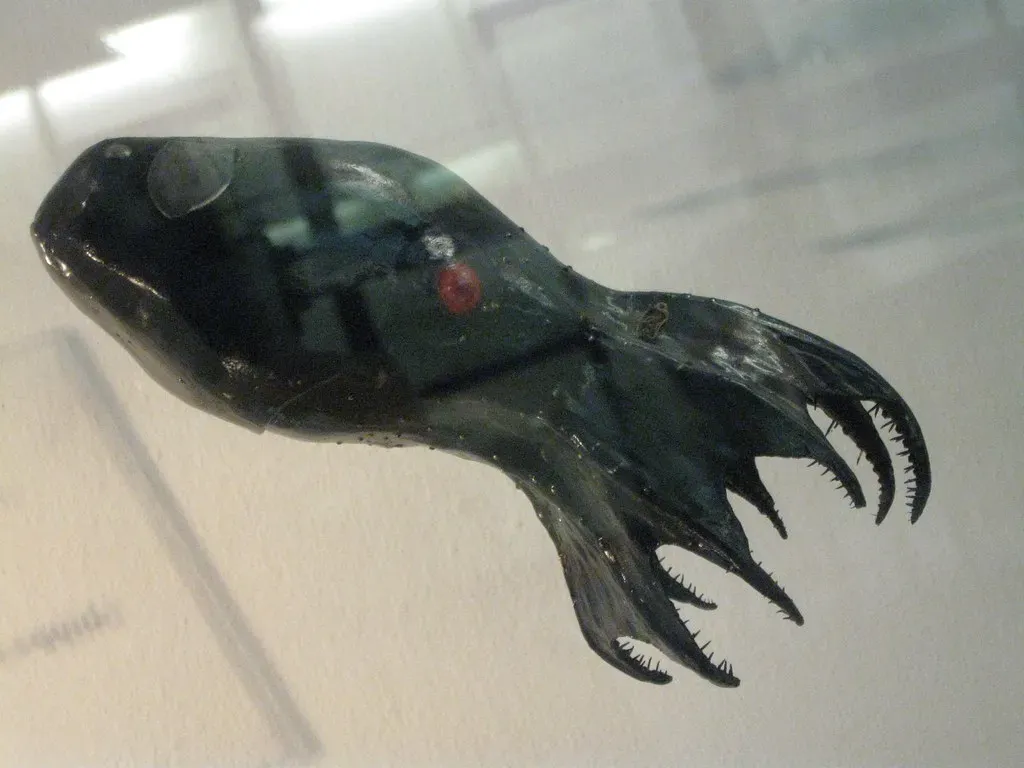
The name alone sounds terrifying. Vampyroteuthis infernalis literally translates to “vampire squid from hell.” It has a cloak of eight webbed arms lined with spikes, dark-red skin, and large, pale blue eyes. You would assume this creature is one of the ocean’s most fearsome predators. You would be completely wrong. Honestly, the gap between its name and its actual lifestyle is one of the funniest things in all of marine biology.
The vampire squid does not feed by draining fellow deep-sea dwellers of their blood. Food is limited in the vastness of the twilight zone, which covers roughly three fifths of the Earth’s surface. Many animals in this habitat are opportunistic, tending to feed on whatever might fall from more productive upper layers. The vampire squid mainly eats “marine snow,” consisting of small clumps of dead plankton, fecal matter, and mucus that fall from the top of the ocean to the deep. So the terrifying vampire squid from hell is essentially a gentle scavenger living off ocean debris. Beautiful.
Its defenses, however, are nothing short of spectacular. If threatened, this defensive deep-sea creature does not eject ink, as do most of its cephalopod cousins. Nor can it change color to confuse intruders the way its shallow-water cousins can. Instead, the vampire squid squirts a copious cloud of sticky, bioluminescent mucus toward would-be predators. Imagine firing glowing slime at someone chasing you through total darkness. Effective and, let’s be real, deeply weird.
To cope with life in the suffocating depths, vampire squids have developed several remarkable adaptations. Their blue blood’s hemocyanin binds and transports oxygen more efficiently than in other cephalopods, aided by gills possessing an especially large surface area. The vampire squid is a “living relic” that evolved from an ancestor of the octopus, and its lineage goes back roughly 165 million years in the fossil record. It was swimming through the dark when dinosaurs still roamed the land above.
The Giant Isopod: A Roly-Poly the Size of a House Cat
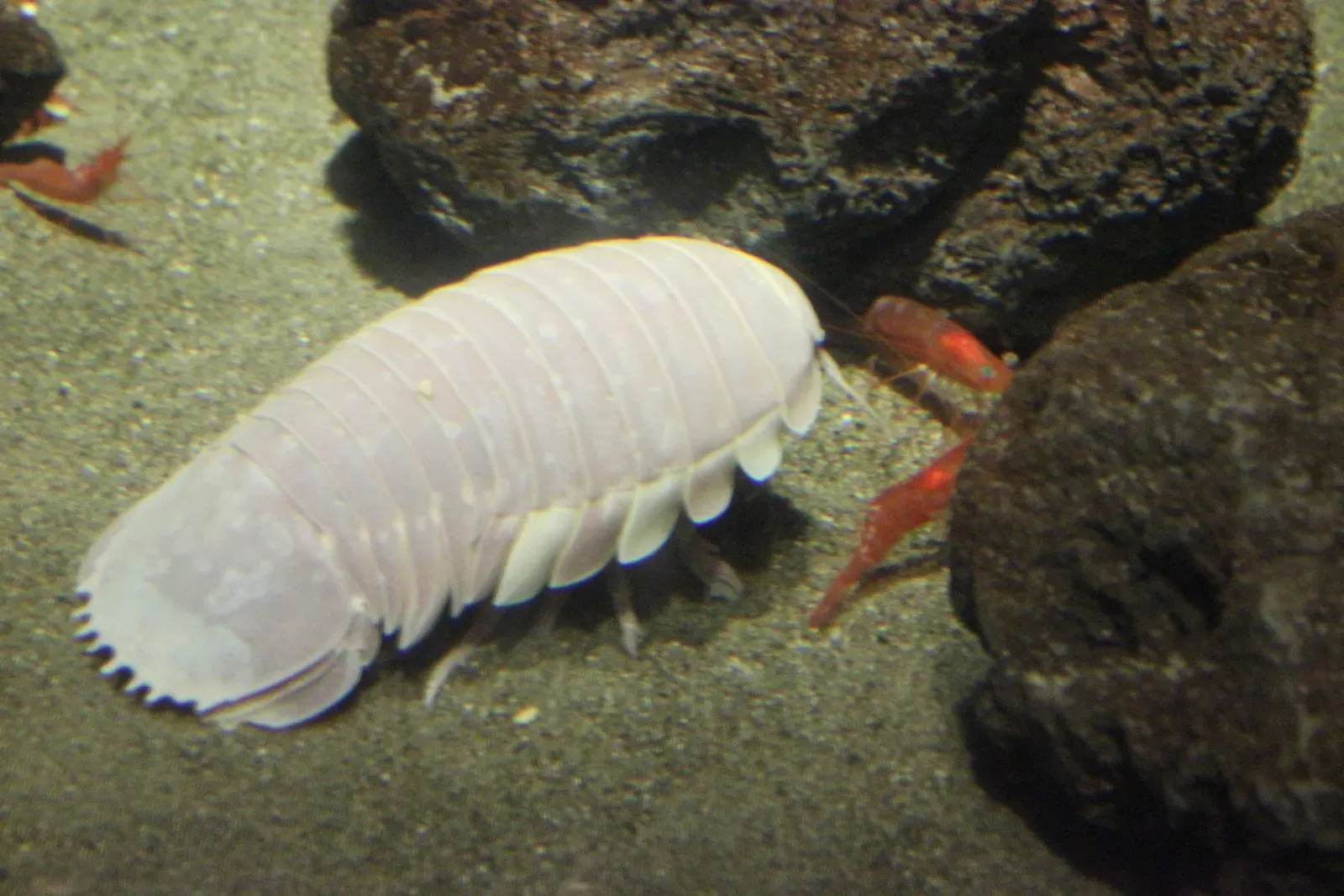
You have almost certainly seen a roly-poly bug curled up in your garden. Now picture that exact creature, armored and alien, but roughly the size of a house cat crawling across the pitch-black seafloor. Their enormous size is an example of “deep-sea gigantism,” a phenomenon where deep ocean creatures grow much larger than their shallow-water relatives. Science has a name for it, but that doesn’t make it any less unsettling.
Giant isopods may live as deep as thousands of feet below the ocean’s surface. They often scavenge on the carcasses of fish, squid, and crustaceans, and may even accidentally cannibalize their own kind. They crawl along the deep seafloor using their 14 legs and can swim using their fan-like tail and the fluttering appendages found on their stomachs. Fourteen legs. Fourteen. At that point, maybe leave it in the abyss where it belongs.
Giant isopods survive by scavenging the remains of dead whales, fish, and squid that sink to the bottom. They can go years without food, entering a state of near hibernation. That is a survival trick that makes every human complaint about skipping lunch feel embarrassing. Years without food, thriving in crushing cold and darkness, unbothered.
Even more astonishing is how recently a new species was formally identified. Bathynomus vaderi, the first member of the deep-sea isopod genus Bathynomus described from Vietnam, was named after the Sith Lord Darth Vader because of the resemblance of its head to the helmet of that Star Wars character. This giant isopod was discovered in the seafood markets of Quy Nhơn City. The fact that such a large animal was hiding in plain sight, unknown to science but part of a growing culinary trend for deep-sea crustaceans, highlights the critical need for the study of marine biodiversity.
Iskra’s Glitter Worm: The Sparkling Thief of the Seafloor
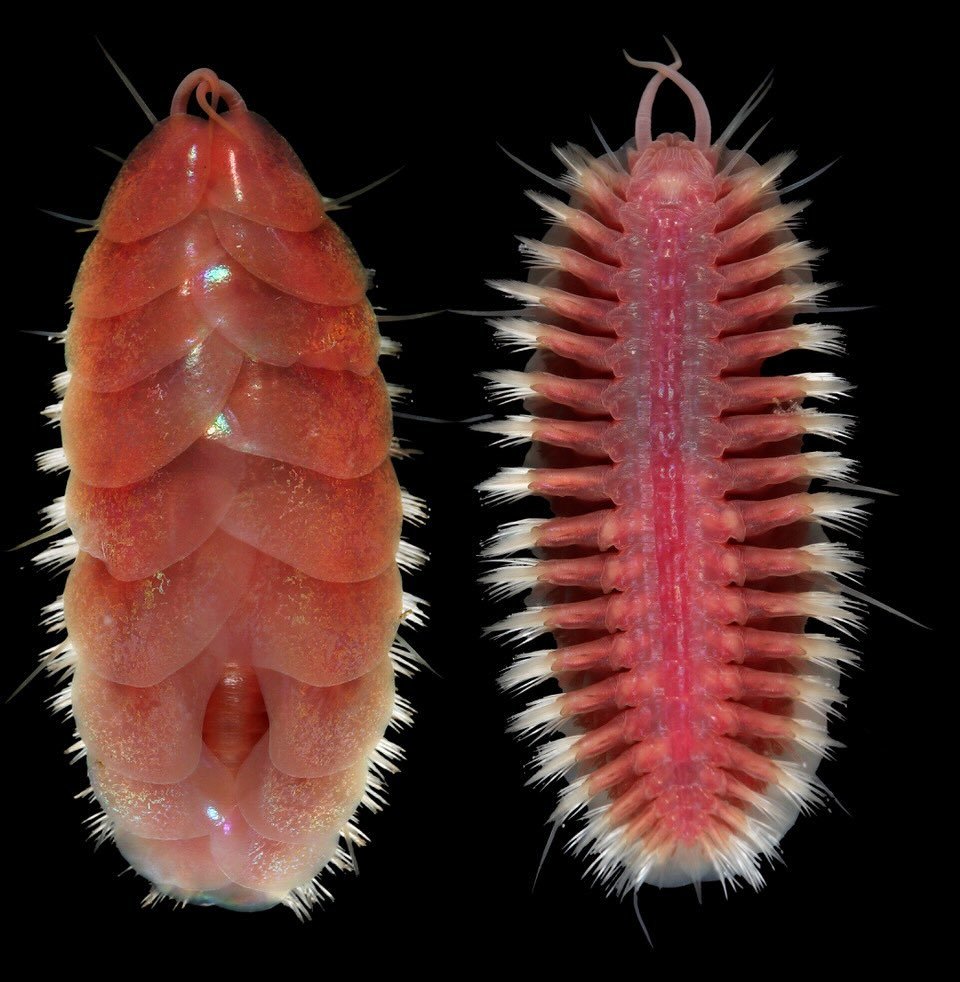
When you hear “glitter worm,” you might picture something delicate and pretty. Scientists exploring the seafloor off the coast of California discovered a new species of shimmering, scale-covered worm, named Iskra’s glitter worm. The name Iskra, meaning “spark,” was chosen not by a marine biologist, but by a high school student. Maja Young from the American School in Warsaw had the opportunity to name this new species after winning the “Inspired by the Deep” competition. She named the species after her childhood dog, a fitting tribute for a creature that glitters so brightly.
Iskra’s Glitter Worm has been found in several unusual habitats: whale falls, where the bodies of sunken whales become entire ecosystems; wood falls, formed by drifting trees that sink to the seafloor; and methane seeps, patches of seafloor where gas leaks out from deep in the Earth’s crust. This worm doesn’t just pick one extreme environment. It seems to collect them like trophies.
What makes this creature particularly striking is how recently it entered the scientific record, despite living in a habitat as dramatic and hostile as anything on the planet. To study these animals, researchers used remotely operated vehicles to collect specimens from the bottom of the Pacific. Without those ROVs, Iskra’s glitter worm would still be entirely unknown to us, glittering in the dark for no human audience whatsoever.
According to WoRMS, discoveries like Iskra’s glitter worm offer just a glimpse of the more than 2,500 new marine species identified in 2025 alone. That number is staggering. Think about it like discovering a new country every single week and still barely scratching the surface of what is actually there.
The Elven Abyss Tunicate: A Lord of the Rings Creature That Actually Exists
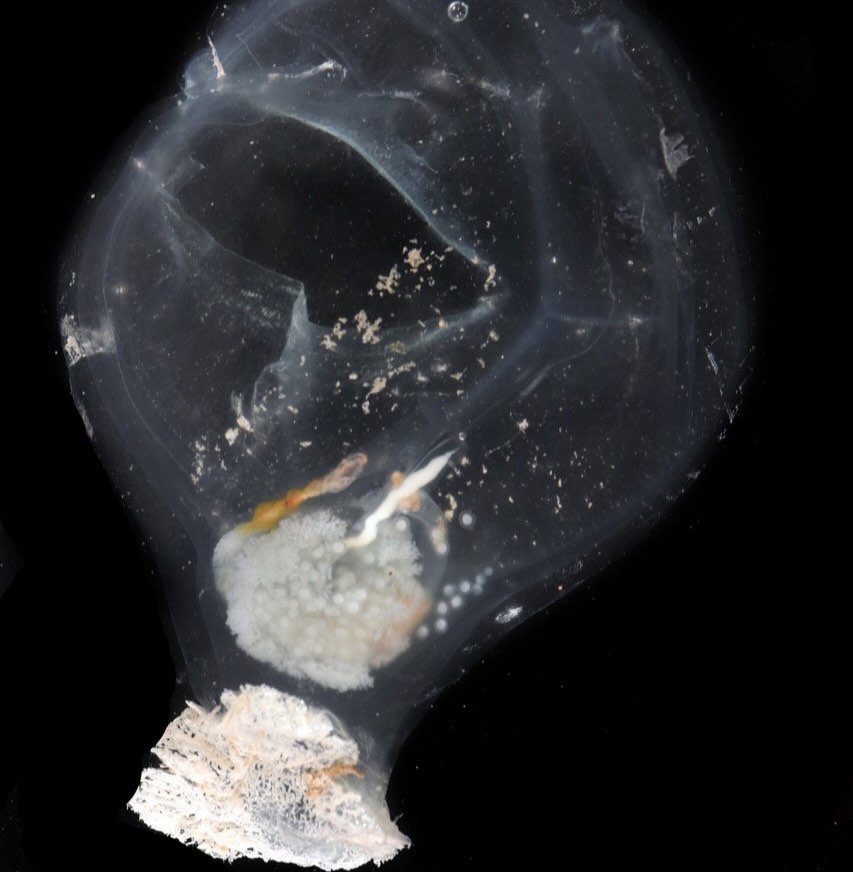
Glittery sea worms and sea squirts fit for a Lord of the Rings universe might sound like pure fantasy, but they are very real creatures living in the deep sea. The Elven abyss tunicate, known formally as Kaikoja undume, is one of those organisms that makes you feel like the natural world is quietly outdoing every fantasy novelist who ever lived. The species name comes from the Elvish language of Middle-earth, from a phrase translating to “abyss yawning,” because the tunicate’s oral siphon is typically open, yawning in the dark abyss while waiting for prey.
Specimens of the Elven abyss tunicate were collected from depths of roughly 2,000 to 4,000 meters off northern Western Australia. Imagine drifting at that depth, in complete blackness, your mouth permanently open, waiting for tiny creatures to drift in. It is a patience strategy taken to its absolute extreme. Copepods and small animals drifting in the deep shall not pass the creature easily.
The tunicate belongs to a group of animals called Octacnemidae, deep-sea predatory creatures that are among the least studied on Earth. Researchers often use remotely operated vehicles to explore deep-sea environments and collect specimens, which are then preserved in museums or repositories such as the renowned Scripps Oceanographic Collections. Without that extraordinary technology and painstaking work, this creature would remain forever invisible to science.
What is genuinely moving about the Elven abyss tunicate is not just the creature itself, but what it represents. In a remarkable deep-sea breakthrough, researchers have discovered 24 new species of amphipods in the Pacific’s Clarion-Clipperton Zone, including a rare, entirely new superfamily. Every single expedition pulls back the curtain a little further on a world that has been evolving quietly, spectacularly, without us, for hundreds of millions of years.
Conclusion: The Deep Ocean Is Rewriting Science, One Creature at a Time
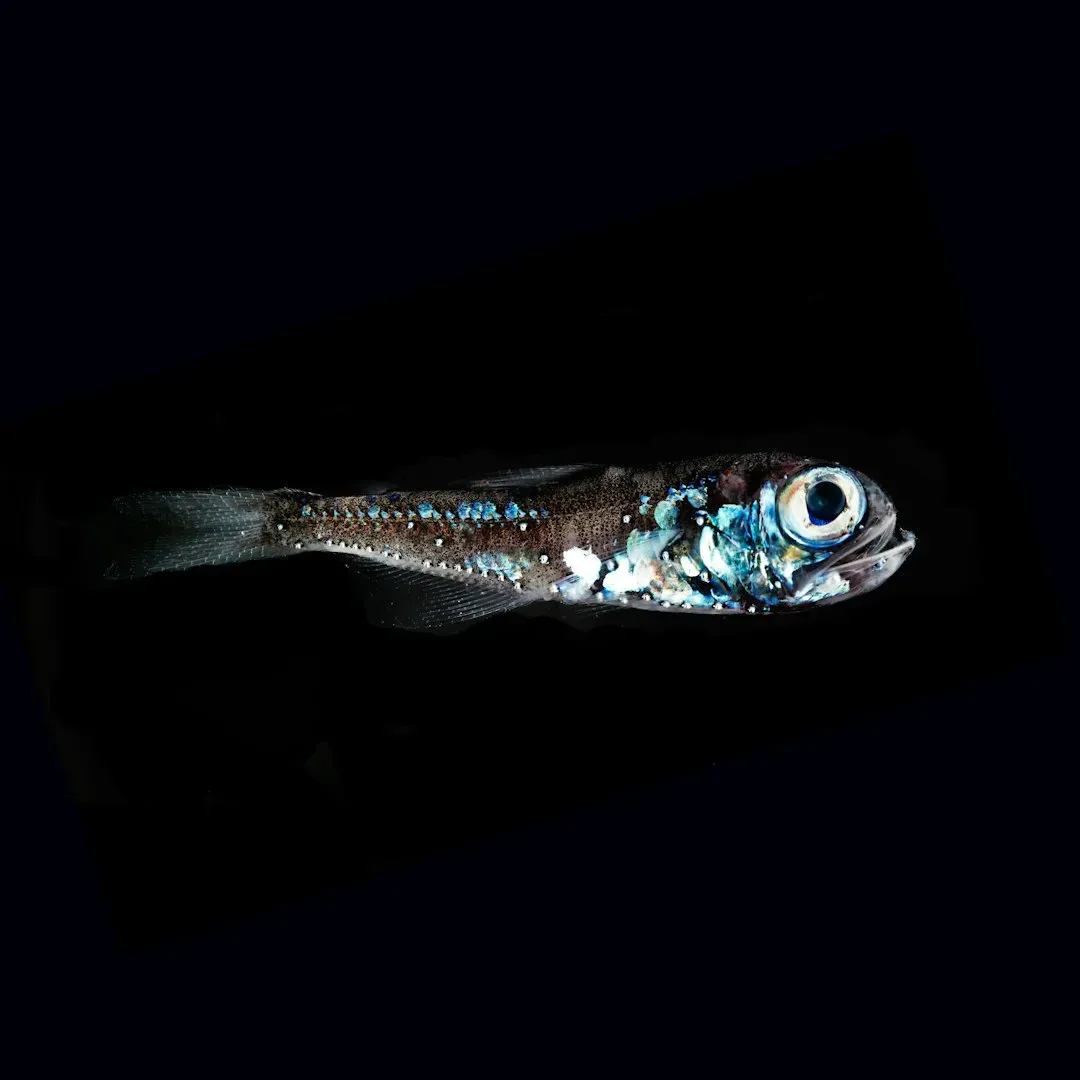
Every creature on this list has one thing in common. They survived, thrived, and evolved in conditions that would kill a human being in seconds. No light. Crushing pressure. Near-freezing temperatures. And yet, life found a way, spectacularly and repeatedly. What researchers have discovered so far about the animals that inhabit this dark realm is that they have evolved into strange shapes, deploy special camouflage for protection, and sometimes even produce their own light via bioluminescence to attract mates or trick prey into becoming an easy meal.
The humbling truth is that we are still in the opening chapters of understanding what lives in the deep. Scientists say their recent discoveries show how much remains to be learned about the sea life of the deep ocean. So far in many expeditions, researchers have studied only about thirty percent of the samples they collected. They expect to discover many more new species in the future. Roughly seven in ten specimens are still waiting to be examined. The ocean is not just unexplored, it is overflowing with creatures we have not even named yet.
Somewhere, right now, in the absolute darkness several kilometers beneath the ocean’s surface, something extraordinary is swimming, glowing, hunting, or simply drifting, completely indifferent to the fact that we have no idea it exists. Doesn’t that change how you think about the world beneath your feet?