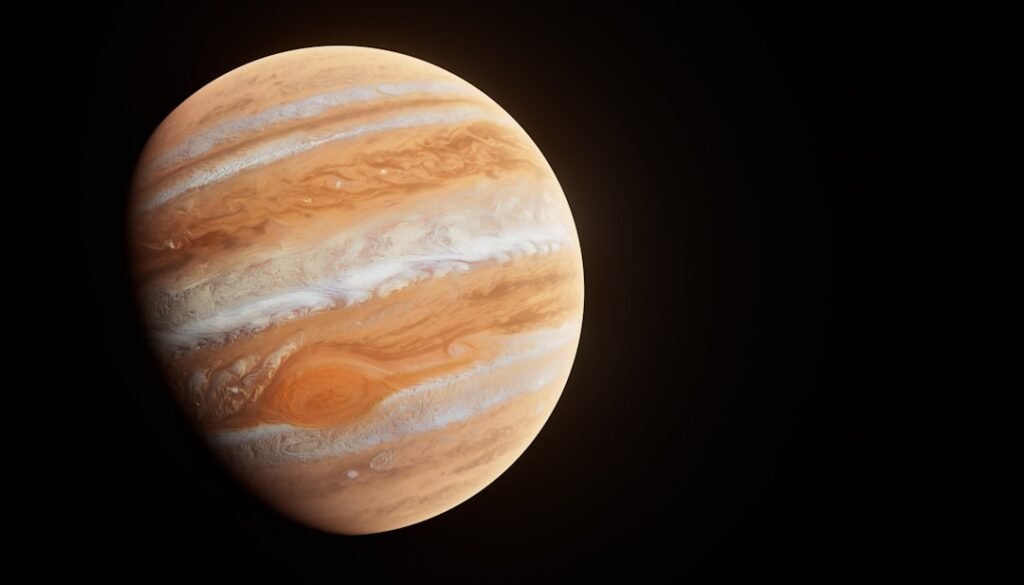
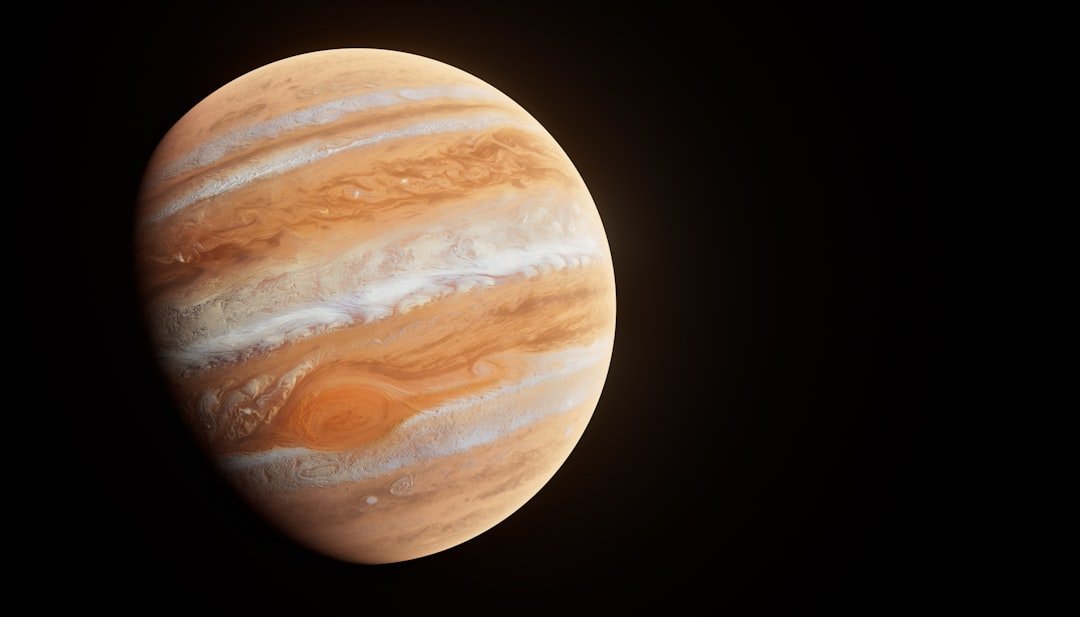
Juno Detects Unprecedented Power in Jovian Bolts (Image Credits: Unsplash)
NASA’s Juno spacecraft has peered into the turbulent depths of Jupiter’s atmosphere, revealing lightning flashes that dwarf those on Earth. Researchers analyzed radio pulses from isolated storms and found powers ranging from comparable to terrestrial bolts to potentially a million times greater.[1][2] These discoveries, drawn from data collected during close flybys, highlight the gas giant’s ferocious weather and offer clues to storm dynamics across planets.
Juno Detects Unprecedented Power in Jovian Bolts
Scientists calculated that some Jupiter lightning pulses reached at least 100 times the power of Earth’s typical strikes, with upper estimates climbing dramatically higher. The team examined 613 microwave bursts captured by Juno’s instruments, including one flyby that logged 206 separate pulses at a rate of about three per second.[1] Lead author Michael Wong of UC Berkeley noted the precision of these measurements: “Because we had a precise location, we were able to just say, ‘OK, we know where it is. We’re directly measuring the power.’”[3]
Median pulse powers in Juno’s detection band hovered between 27 and 214 watts across different storms. Yet uncertainties in pulse duration and radio emission spectra pushed estimates toward extremes – possibly 500 to 10,000 times Earth’s energy release, or even a millionfold in one calibration.[2] This range challenged earlier views that equated Jupiter’s lightning solely to Earth’s rare superbolts.
Stealth Superstorms Fuel the Fury
Jupiter’s North Equatorial Belt quieted unusually in 2021 and 2022, spawning isolated “stealth superstorms” that persisted for months. These plumes, lacking the downdraft clearings of larger systems, rose modestly but transformed global cloud patterns nearby.[1] One such storm, imaged on January 12, 2022, featured a white head of frozen ammonia crystals atop deeper reddish clouds.
The isolation proved crucial. Previous observations struggled to separate pulse strength from location due to overlapping storm activity. Here, researchers pinpointed sources using Hubble images, Juno’s camera, and even amateur astronomer photos, enabling accurate power assessments.[4]
Decoding Signals from Juno’s Flybys
Juno, orbiting since 2016, scanned the planet during 12 passes over these storms, with four yielding strong microwave data from perijoves 38, 39, 44, and 47.[2] The Microwave Radiometer detected emissions at around 600 megahertz, akin to radio static from Earth lightning. Downward-pointing antennas flagged anomalies exceeding detection thresholds.
Co-author Ivana Kolmašová emphasized the challenges: “Translating microwave power in a lightning bolt into total power is not straightforward.”[1] Teams corrected for biases like sensitivity limits and antenna angles, fitting distributions to lognormal models that captured typical pulses rather than outliers. Pulse rates aligned with prior nightside studies but revealed rarer superbolts exceeding a kilowatt.
Atmospheric Differences Drive Extreme Discharges
Jupiter’s hydrogen-rich air complicates convection compared to Earth’s nitrogen-oxygen mix. Moist parcels there weigh more, demanding greater energy to rise and spark lightning from charged ammonia and water ice crystals – possibly forming dense “mushballs.”[1] Wong reflected, “This is where the details start to get exciting… Could the key difference be hydrogen versus nitrogen atmospheres, or could it be that the storms are taller on Jupiter?”
| Aspect | Jupiter Lightning | Earth Lightning |
|---|---|---|
| Typical Pulse Power | 27-214 W (median, detected band) | Comparable baseline |
| Peak Estimates | 100x to 1,000,000x stronger | 1 gigajoule per bolt |
| Storm Context | Stealth superstorms, 3 pulses/sec | Varied thunderstorms |
These contrasts extend to emissions across radio, optical, and other wavelengths, complicating direct apples-to-apples math.
Key Takeaways
- Juno’s data shows Jupiter lightning from Earth-like to vastly superior in power, hinging on spectral assumptions.
- Stealth superstorms provided a rare window for precise measurements during NEB’s calm phase.
- Findings bridge gaps in understanding planetary convection and lightning generation.
This study, detailed in the March 20 AGU Advances paper, underscores Juno’s enduring value despite mission uncertainties.[2] As Wong put it, “There’s so much we don’t know about lightning on Earth.” Insights from Jupiter could illuminate our own skies. What surprises you most about these cosmic storms? Share in the comments.