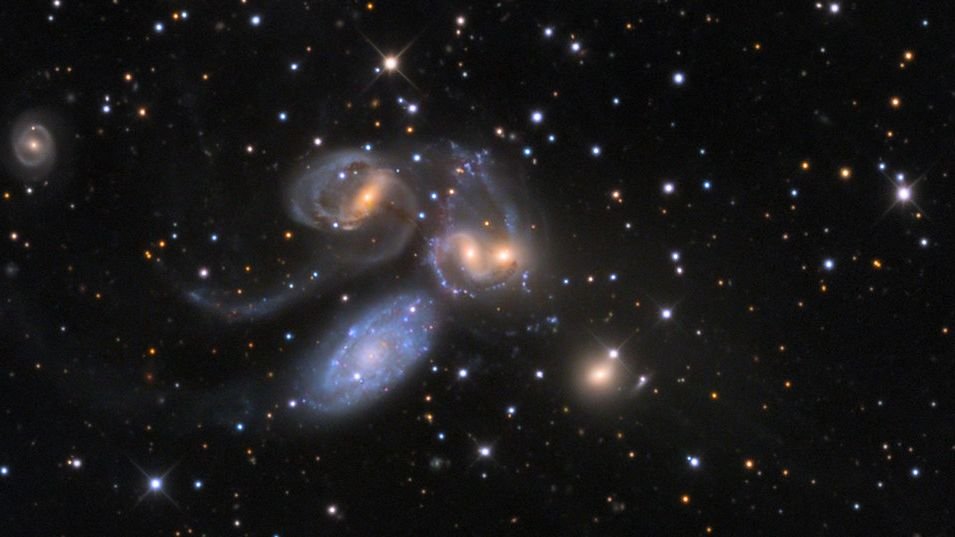

Imagine looking up at a crystal-clear night sky and realizing that most of what’s really out there is completely invisible. That’s the unsettling, slightly mind-bending reality behind dark matter. We can’t see it, touch it, or bottle it in a lab, but everything we do see seems to move to its hidden rhythm.
When I first learned that the visible universe is basically the cosmic garnish and not the main dish, it felt like someone had told me gravity was only half of the story. Dark matter forces us to admit we’re still in the early chapters of understanding the universe. Scientists have uncovered some surprisingly solid facts about this invisible stuff, yet the most basic question – what is it, actually? – is still wide open.
The Strange Clue: Galaxies Spinning Too Fast
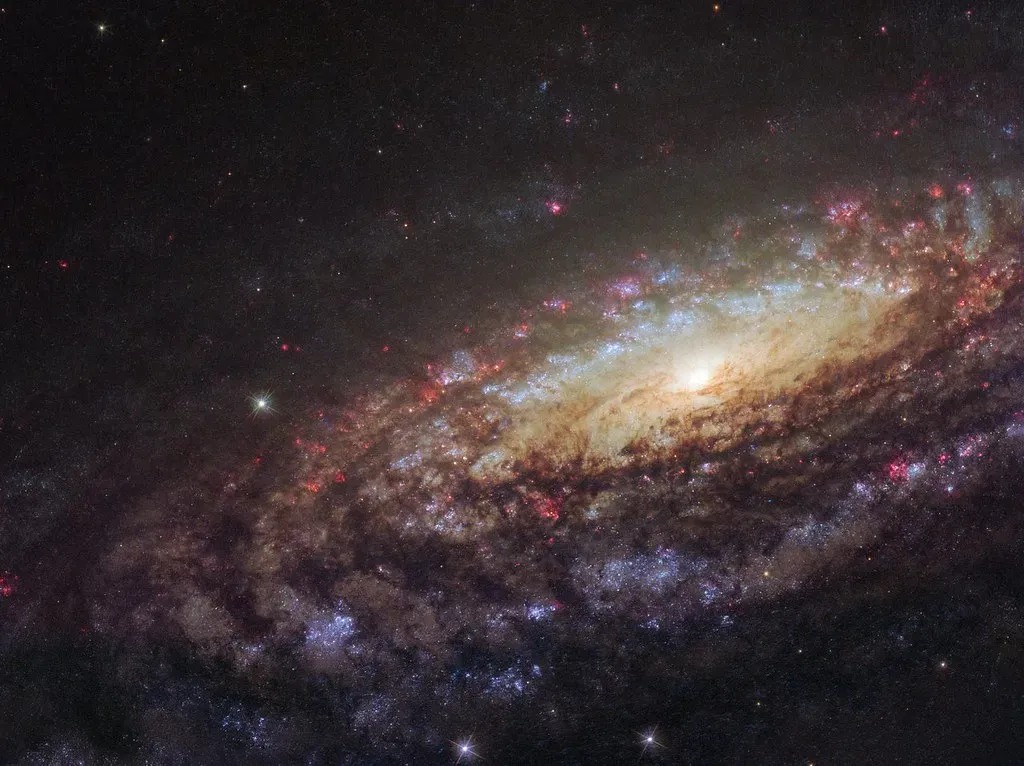
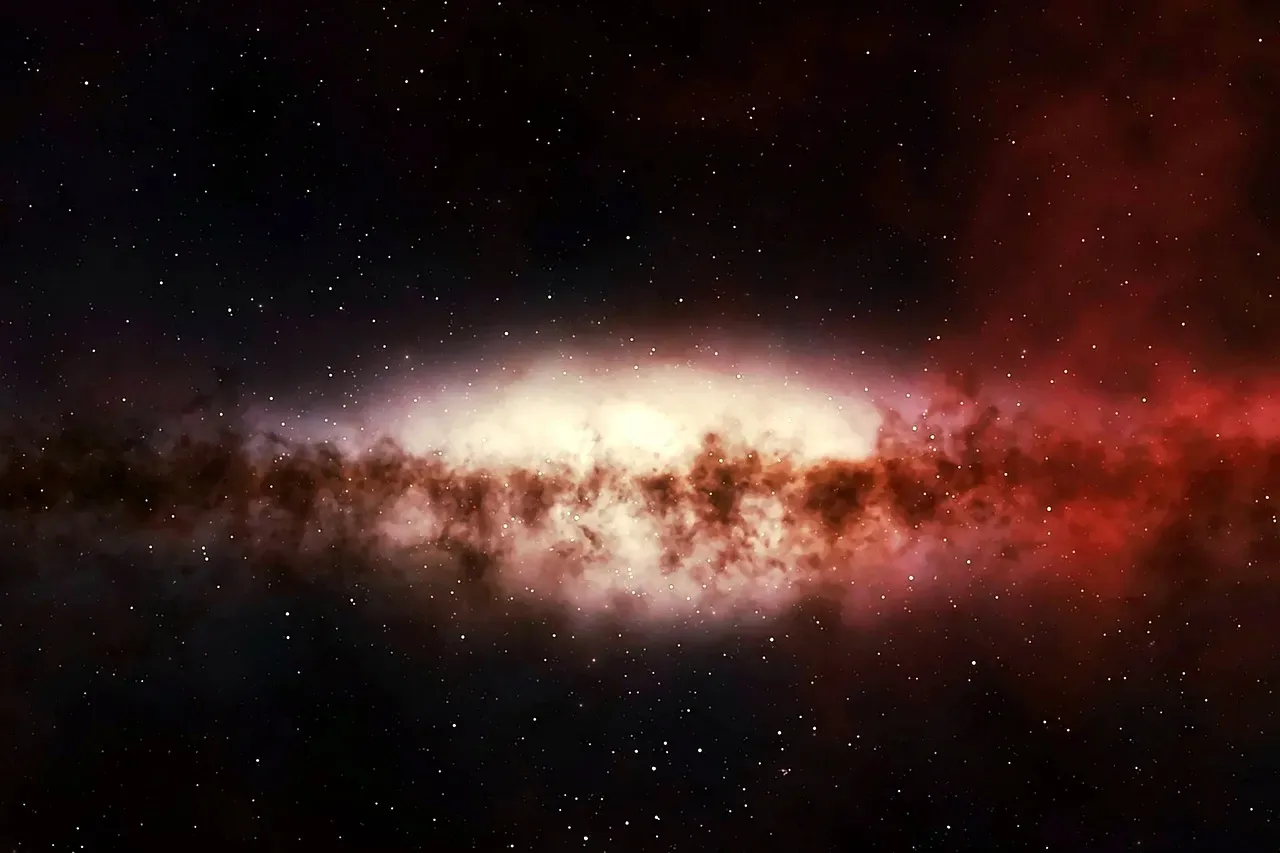
One of the most shocking hints that dark matter exists came from watching galaxies spin. If you only count the visible stars, gas, and dust, galaxies are rotating so fast that their outer stars should be flung out into space, like mud flying off a spinning tire. But they’re not. Those stars stay neatly in orbit, as if something extra is silently holding everything together.
When astronomers map how fast stars and gas move at different distances from a galaxy’s center, they get what’s called a rotation curve. Instead of dropping off at the edges, those curves flatten out, staying stubbornly high. The simplest way to explain this is that there’s a huge amount of unseen mass – dark matter – providing extra gravity. If dark matter weren’t there, a lot of the beautiful spiral galaxies we love looking at simply couldn’t exist in their current form.
Gravitational Lenses: When Invisible Matter Bends Light
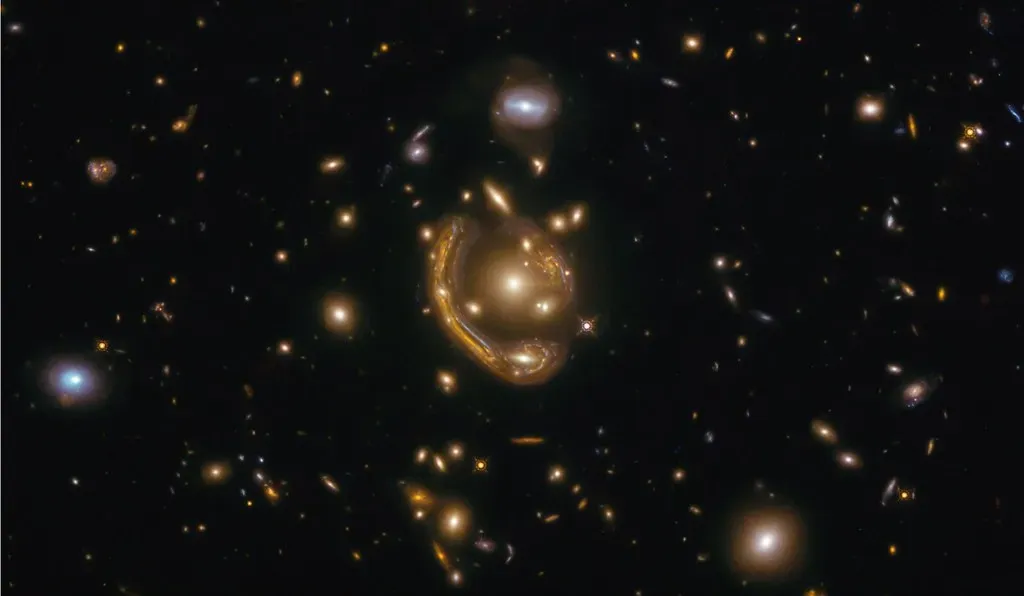
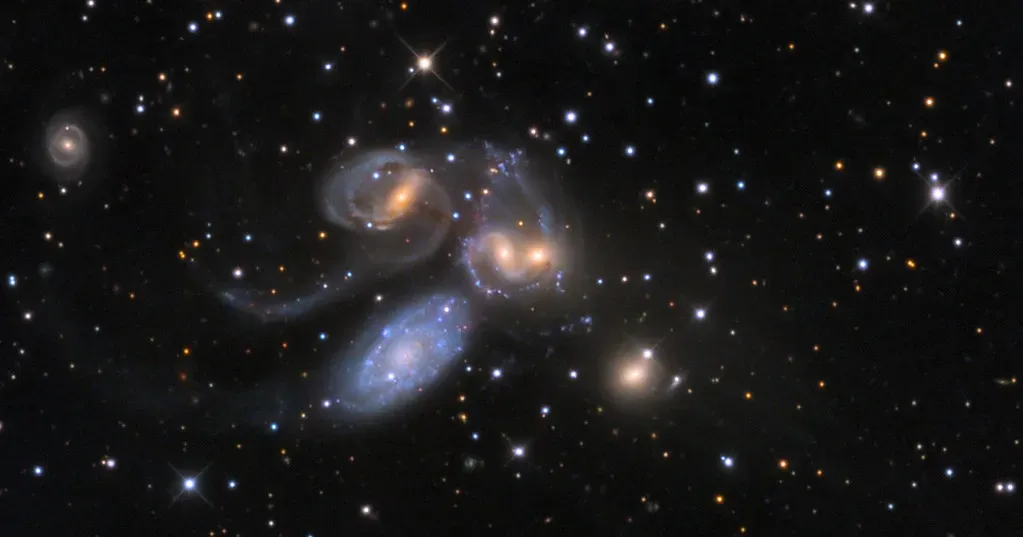
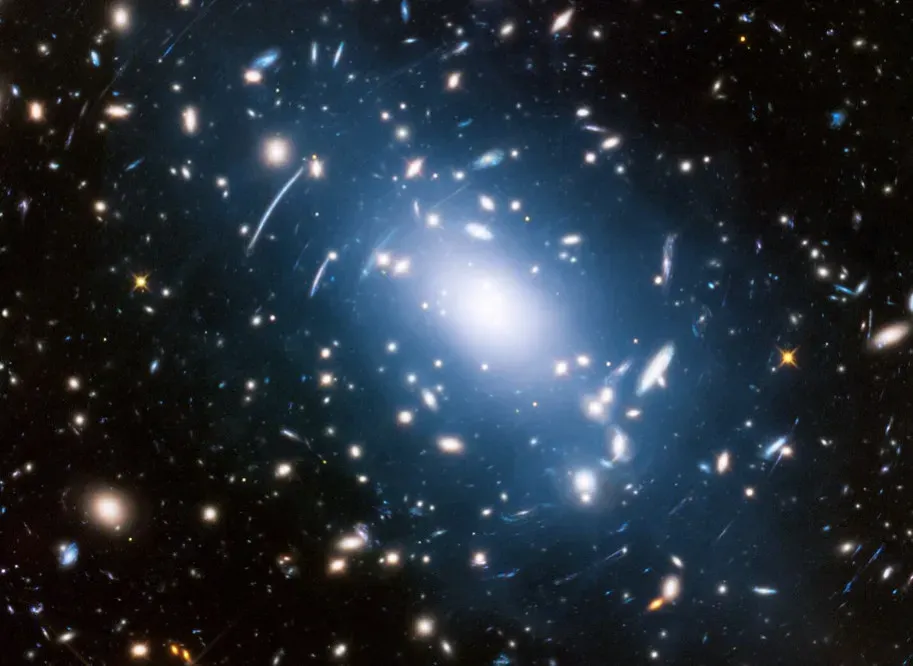
Another powerful piece of evidence for dark matter comes from a strange phenomenon: gravity bending light. According to general relativity, massive objects curve the space around them, and light follows that curvature. When there’s a massive cluster of galaxies between us and something even farther away, the foreground mass can warp and magnify the background light, like a giant cosmic magnifying glass.
Here’s the twist: when scientists carefully calculate how much visible matter is in those clusters, it’s nowhere near enough to explain how dramatically the light is being bent. The lensing is far stronger than it “should” be if only stars, gas, and dust were involved. The only way to make the math work is to add a large halo of invisible mass around the cluster. That hidden mass behaves exactly like you’d expect dark matter to behave – heavy, widespread, and unseen.
How Much Dark Matter Is Out There (and Where Is It)?
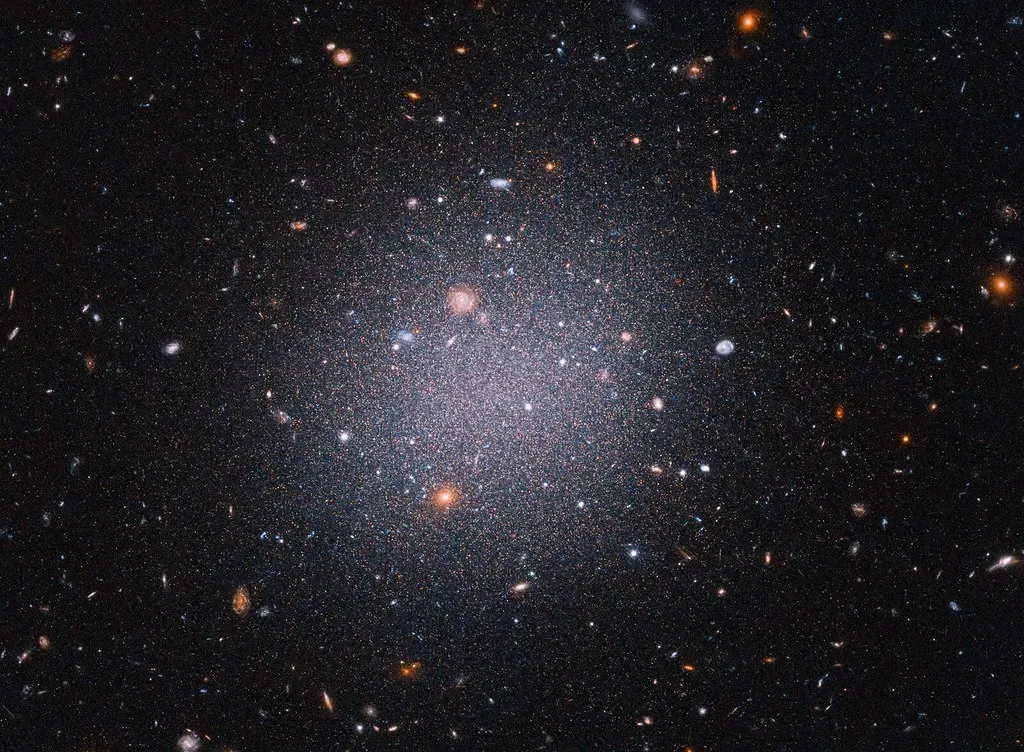
Cosmologists now think that dark matter makes up roughly about one quarter of the total energy content of the universe, while normal matter is only a small single-digit slice. Put differently, almost all the matter in existence is dark; the stuff that makes planets, people, and pizza is the exception, not the rule. That’s a humbling thought: we’re made of the rare kind of matter, living in a universe dominated by something we’ve never directly detected.
Dark matter isn’t clumped into little pellets floating around randomly – it forms gigantic halos surrounding galaxies and galaxy clusters. Our own Milky Way is thought to sit inside a vast, roughly spherical dark matter cloud that extends far beyond the visible disk of stars. We can’t see that halo, but we can infer its shape and size from how stars move and how satellite galaxies orbit us. In a way, we’re swimming in dark matter all the time and only noticing it indirectly, through the subtle gravitational patterns it leaves behind.
What Dark Matter Probably Is (and Definitely Is Not)
Scientists are fairly sure about one key thing: dark matter is not just ordinary matter that happens to be dim or hidden. It’s not clouds of cold gas, swarms of faint stars, or black holes sprinkled everywhere. Those possibilities have been tested again and again, and they simply cannot add up to the amount of missing mass we see in gravitational effects. If they did, we’d notice their radiation, microlensing, or other signatures, and we just don’t.
The leading idea is that dark matter consists of some kind of particle, or perhaps a family of particles, that doesn’t interact with light and only very weakly with normal matter. People have proposed candidates like weakly interacting massive particles (WIMPs), ultralight axions, sterile neutrinos, or even more exotic things. The frustrating part is that many of these ideas are clever, fit some theories nicely, and still have no clear experimental confirmation. It’s like having a list of suspects and no reliable fingerprints.
How Scientists Are Hunting for Dark Matter
The search for dark matter is one of the most ambitious detective stories in modern science, and it’s happening on several fronts. Deep underground, in mines and caverns shielded from cosmic rays, enormous detectors filled with super-pure liquids or crystals sit waiting for the faintest possible nudge from a dark matter particle. These experiments are so sensitive that they need to account for things like tiny natural radioactivity in the surrounding rock or even individual stray neutrons.
At the same time, particle accelerators like the Large Hadron Collider smash protons together at enormous energies, hoping to produce dark matter particles in the debris. Researchers scour the data for signs of “missing energy,” as if something invisible carried momentum away. In space, telescopes watch for unusual gamma rays or other signals that might hint at dark matter particles annihilating each other. So far, the results have been mostly silence and a few intriguing, but inconclusive, hints – enough to keep the hunt alive, but not enough to declare victory.
What If Dark Matter Is Something Else Entirely?
Not everyone is convinced that unseen particles are the whole answer. A smaller but persistent group of scientists argues that maybe our understanding of gravity itself needs an upgrade. They propose modified gravity theories, where the rules change subtly on very large scales or at very low accelerations. In those models, galaxies can rotate the way we observe without needing a huge halo of invisible matter.
These alternative ideas are bold and intellectually tempting, but they face a tough challenge: they have to explain not just galaxy rotation, but also gravitational lensing, the structure of galaxy clusters, the cosmic microwave background patterns, and the formation of large-scale structure. Dark matter, as a concept, does a remarkably good job stitching all those observations together. Modified gravity approaches can sometimes solve one puzzle and then struggle with another, which is why most cosmologists still lean strongly toward dark matter as a real substance, even if its nature remains mysterious.
Why Dark Matter Matters for the Future of Cosmology
Dark matter isn’t just some obscure side quest for physicists; it sits right at the heart of how the universe came to look the way it does. Without it, the early universe’s tiny clumps of matter would have taken far longer to grow into galaxies and clusters. Dark matter acted like scaffolding, letting structures form quickly while normal matter cooled, condensed, and eventually lit up as stars and galaxies. When you look at a deep-space image packed with galaxies, you’re really staring at the visible frosting on a dark matter cake.
Over the next decade, massive sky surveys and new telescopes are expected to map the distribution of dark matter more precisely than ever, by tracking how it subtly warps the light from distant galaxies. Each new dataset is a chance to stress-test our theories and maybe catch dark matter behaving in some unexpected way. The tension between what we know and what we don’t keeps theorists and experimentalists pushing forward, because solving this puzzle would reshape our understanding of both the smallest particles and the largest structures in the cosmos.
Conclusion: Living in a Universe We Barely See
Dark matter is a reminder that the universe is under no obligation to be easily understandable or conveniently visible. We’ve built whole models of cosmology around a component we can’t directly detect, relying on its gravitational fingerprints scattered across the sky. That might sound outrageous, but the consistency of those fingerprints – from galaxy rotation to gravitational lensing to cosmic structure – makes the case hard to ignore.
At the same time, the failure to find dark matter particles in the lab keeps everyone slightly uneasy and wide awake. Maybe we’re closing in on the right answer and just need more sensitive detectors, or maybe some crucial insight is still missing. Either way, we’re living through a moment when one of the biggest open questions in science is still genuinely open, right above our heads every night. How often do we get to say we know so much and yet so little, all at the same time?