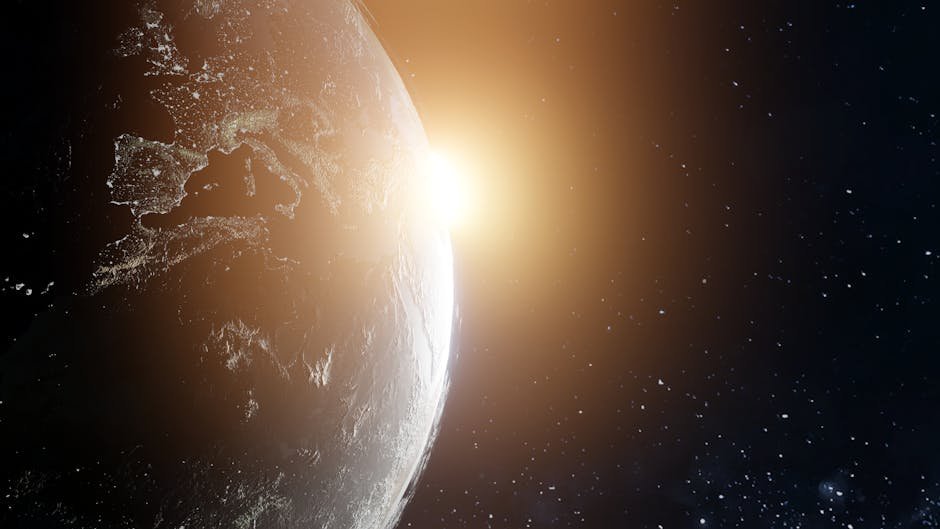
Something fundamental about our planet is quietly changing, and most people have absolutely no idea it’s happening. The ground beneath your feet, the oceans around you, the very rhythm of day and night – all of it is slowly, almost imperceptibly, shifting. It’s not dramatic. You won’t feel it tomorrow morning. Yet it’s real, it’s measurable, and honestly, it’s one of the more mind-bending things happening on Earth right now.
Scientists have confirmed that Earth’s days are actually getting longer, and the cause isn’t some cosmic collision or mysterious force from deep space. It’s something far closer to home. Let’s dive in.
The Earth Is Literally Slowing Down
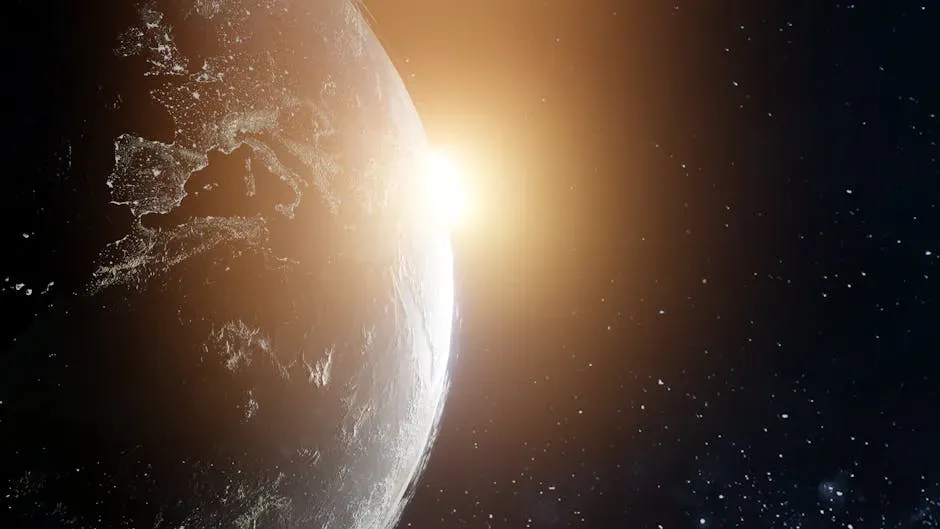
Here’s the thing – Earth has been spinning since its formation roughly four and a half billion years ago, and it has never spun at a perfectly constant speed. In the very early days of our planet, a single day lasted only about six hours. Over billions of years, that rotation has slowed considerably, and it continues to slow today, even if the change is almost laughably small on a human timescale.
Scientists measure the lengthening of Earth’s day in milliseconds per century. That sounds trivial, right? Like something you’d never notice in a lifetime. Yet over geological time, these tiny increments stack up into something genuinely enormous.
The slowdown is real, it’s ongoing, and it raises fascinating questions about what’s actually driving it right now. Spoiler: it’s not just one thing.
The Moon’s Gravitational Pull Is the Main Culprit
If you want to point a finger at the biggest cause of Earth’s slowing rotation, look up at night. The Moon exerts a gravitational tug on Earth’s oceans, creating tidal friction. This friction acts like a very gentle brake on Earth’s spinning motion, gradually transferring rotational energy away from our planet and into the Moon’s orbital momentum.
The result is a kind of cosmic trade-off. As Earth loses rotational energy, the Moon slowly drifts farther away from us, at a rate of roughly about an inch and a half per year. It’s a slow dance that has been going on for billions of years, completely indifferent to anything happening on the surface.
What’s remarkable is that this tidal braking effect has been operating consistently across Earth’s entire history, even long before humans existed to measure it. Ancient coral fossils have actually helped scientists reconstruct past day lengths by revealing growth patterns tied to historical tidal cycles. Nature keeps its own records.
Climate Change Is Now Playing a Role Too
Here’s where it gets genuinely surprising. Beyond the Moon’s ancient influence, scientists are now identifying a more modern contributor to the lengthening day: climate change. Specifically, the melting of polar ice sheets is altering how Earth’s mass is distributed across the planet.
Think of it like a spinning figure skater. When a skater pulls their arms inward, they spin faster. When they extend their arms outward, they slow down. As ice melts at the poles and water redistributes toward the equator through ocean currents, Earth’s mass effectively spreads outward from the axis of rotation. That redistribution acts like the skater extending their arms, slowing the spin ever so slightly.
This is not a distant hypothetical. It’s happening now, and researchers believe the contribution of ice melt to day length changes will only grow as global temperatures continue rising. I find it quietly unsettling that our industrial habits are literally altering the rotation of the planet, even in the most microscopic way imaginable.
How Scientists Actually Measure This
You might wonder how anyone even detects changes this small. After all, we’re talking about fractions of a millisecond added to a day. The answer lies in extraordinarily precise atomic clocks and a technique called Very Long Baseline Interferometry, which uses radio signals from distant quasars to track Earth’s orientation in space with stunning accuracy.
These tools allow scientists to detect rotational changes that would be completely invisible to any ordinary measurement method. The precision required is honestly staggering. It’s the scientific equivalent of measuring the width of a human hair from across a city.
Beyond modern instruments, researchers also study ancient geological records like tidal rhythmites, which are layered sedimentary deposits that preserve the rhythm of ancient tides. These natural archives have revealed that roughly a billion years ago, a day on Earth lasted only about nineteen hours.
The Leap Second Controversy
Earth’s irregular rotation has a very practical consequence for our digital world. For decades, scientists have occasionally added what’s called a “leap second” to atomic clocks in order to keep official timekeeping synchronized with the actual rotation of Earth. It sounds harmless, but in our hyper-connected technology infrastructure, a single second can cause significant disruption.
Tech giants like Google, Meta, and Amazon have reportedly struggled with the complications that leap seconds introduce into their systems, since computer networks depend on precise, uninterrupted time signals. A rogue second can trigger unexpected errors or even system crashes in sensitive software environments.
The debate over whether to continue using leap seconds or adopt an alternative timekeeping approach has become surprisingly heated in certain scientific and engineering communities. In 2022, an international agreement was reached to eventually phase out the leap second by 2035, though the details of what replaces it are still being worked out. It turns out even time itself needs a committee.
What This Means for Life on Earth
Longer days, even by microscopic amounts, have implications that ripple through biology, climate science, and even space exploration planning. Organisms that evolved under specific day length conditions may face subtle pressures over very long timescales as those conditions shift. It’s not an overnight crisis for any species, but it’s part of the broader picture of a planet in constant, slow flux.
For space agencies, precise knowledge of Earth’s rotation rate is critical for calculating satellite trajectories, navigation systems, and interplanetary missions. A tiny error in rotation data can translate into meaningful positional errors across millions of kilometers of space travel.
There’s also something philosophically provocative here. The very unit of time we’ve built civilization around, the 24-hour day, is not a fixed constant. It’s a moving target, shaped by gravity, geology, and now, human activity. That’s either deeply humbling or deeply fascinating, depending on your mood.
Will Days Keep Getting Longer Forever?
Let’s be real, the natural instinct is to ask whether this process will just keep going indefinitely. The honest answer is: mostly yes, but with complications. Tidal friction will continue slowing Earth’s rotation over billions of years. Ultimately, in the far distant future, Earth could become tidally locked to the Moon, meaning one side would permanently face the Moon and a single “day” would equal a lunar month. That’s a wild thought.
However, Earth’s rotation doesn’t slow in a perfectly smooth, linear way. Other factors, including shifts in Earth’s liquid outer core, atmospheric pressure changes, and even large earthquakes, can cause brief speedups or slowdowns that temporarily counteract the long-term trend.
In the near term, the changes remain so small that no living person will ever notice a longer day in any direct, sensory way. The world will keep turning, alarms will keep going off at the usual miserable hour, and most people will never give a single thought to the fact that today is ever so slightly longer than a day was a million years ago.
A World That’s Changing in Ways We Can Barely Perceive
There’s something quietly profound about the fact that Earth’s rotation, one of the most basic rhythms of our existence, is not fixed. It never was. The planet we live on is dynamic down to its very spin, shaped by forces both ancient and surprisingly modern.
What strikes me most is that climate change, something we tend to discuss in terms of temperature and sea level, is now measurably nudging the rotation of an entire planet. That level of planetary-scale impact from human activity is both remarkable and sobering. It raises the question: how many other fundamental Earth systems are we subtly altering without fully realizing it?
The day is getting longer. Not fast enough to lose sleep over, literally or figuratively. Still, the science behind it is a reminder that Earth is never truly static, and neither is our relationship with it. What other changes are happening right beneath our feet that we haven’t even begun to measure yet? That’s the question worth sitting with.