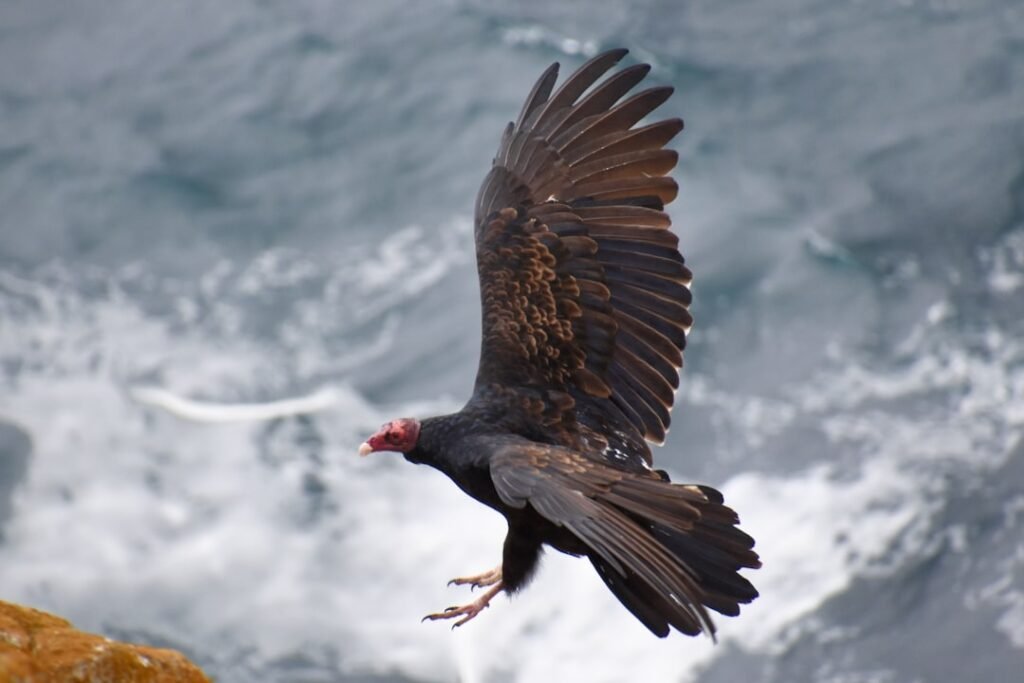
A Pioneering Pair Steps Into Parenthood (Image Credits: Unsplash)
Northern California – A pioneering pair of California condors has established the region’s first nest in more than 100 years, offering a beacon of hope for wildlife restoration efforts on Yurok ancestral territory. Biologists detected the development through behavioral changes and satellite telemetry data from wing-mounted transmitters.[1][2] The female, known as Ney-gem’ ‘Ne-chween-kah or “She carries our prayers,” likely laid an egg in early February inside a cavity of a remote old-growth redwood tree along Redwood Creek drainage.[3] Her mate, Hlow Hoo-let or “At last I fly,” shares incubation duties in this milestone for the Northern California Condor Restoration Program.
A Pioneering Pair Steps Into Parenthood
Condors A0 and A1, both nearly seven years old, represent the oldest survivors from the initial 2022 release cohort. Captive-bred at the Oregon Zoo and World Center for Birds of Prey, they achieved sexual maturity just in time for this breeding attempt.[4] Program staff noted reduced flight activity and alternating visits to the site, hallmarks of incubation. The egg, if present, weighs about 10 ounces and requires 55 to 58 days of careful tending by both parents.
“This is a huge moment for our Northern California flock,” stated Chris West, NCCRP program manager and Yurok Wildlife Department senior biologist. “It is important to remember that these are wild birds… with as little interference from us as possible.”[1] The remote location prevents direct confirmation, but field observations and GPS data provide strong evidence. Staff considered drone surveillance to check progress without disturbance.
Sacred Symbols Return to Yurok Lands
The California condor, or prey-go-neesh in the Yurok language, holds profound cultural value. Tribal elders prioritized its restoration in 2003 as the top land-based species effort, viewing it as a carrier of prayers in World Renewal ceremonies.[5] Feathers and songs from the bird feature prominently in these rituals aimed at balancing the world.
Tiana Williams-Claussen, Yurok Wildlife Department director, expressed long-awaited joy. “I have been waiting for this moment since the first condors arrived in 2022,” she said.[2] This nesting revives a connection severed by historical declines, underscoring the tribe’s role as stewards of ancestral territory in Humboldt and Del Norte counties.
Decades of Dedication Behind the Comeback
The Yurok Tribe launched feasibility studies in 2008 after securing U.S. Fish and Wildlife Service funding, culminating in the first releases in Redwood National and State Parks in May 2022. Nearly two decades of habitat assessments and contaminant evaluations paved the way.[1] Today, 24 condors roam free in the area, part of a global population of 607 as of late 2025.
The NCCRP partnership unites key players:
- Yurok Tribe
- Redwood National and State Parks
- U.S. Fish and Wildlife Service
- Peregrine Fund
- Ventana Wildlife Society
- PG&E and others
From a low of 22 birds in 1982, captive breeding saved the species, with reintroductions expanding across California, Arizona, and Baja California since 1991.[5]
Persistent Threats Test the Flock’s Resilience
Lead poisoning from ammunition fragments in carrion remains the primary killer, claiming young condor Pey-noh-pey-o-wok’ in January 2025. Avian influenza has also struck other flocks. First-time parents like A0 and A1 face added risks, as inexperience often dooms initial eggs.
Condors reproduce slowly, laying one egg every other year with chicks needing over a year of care. Williams-Claussen noted the devastation of preventable losses: “That he was brought down by something human caused and preventable is devastating.”[1] Monitoring continues to track feeding patterns and health.
Toward a Self-Sustaining Future
Program leaders plan annual releases for at least 20 years to build a viable flock. Success here could inspire pairings among younger birds like A2 and A7. Drones and transmitters will aid non-invasive oversight.
Biologists remain cautious yet encouraged. If the egg hatches in early April, fledging might follow by late fall. This attempt marks undeniable progress in healing ecosystems and cultures.
Key Takeaways
- First potential condor nest in Pacific Northwest since early 1900s, on Yurok land.
- 24 wild condors now in area; global population at 607.
- Tribal-led effort highlights cultural restoration alongside ecological recovery.
From the brink of extinction to nesting in ancient redwoods, these condors embody resilience and renewal – what lessons can their story offer for broader conservation? What do you think about this condor comeback? Tell us in the comments.