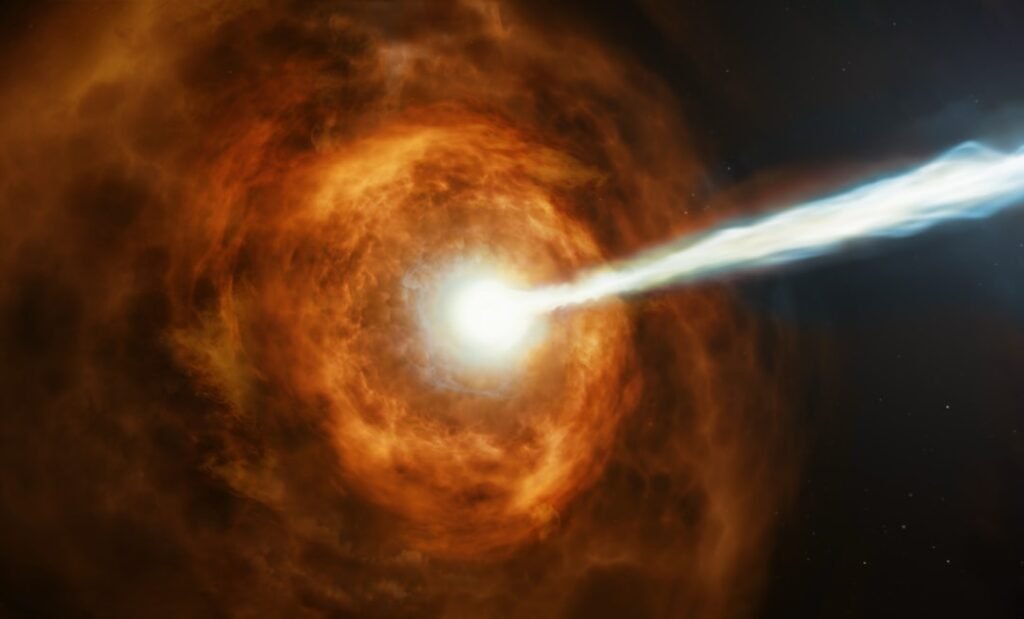
Sudden Brightening in the Radio Darkness (Image Credits: Unsplash)
Astronomers have captured the faint radio whisper of one of the universe’s most ferocious explosions, a gamma-ray burst whose initial fury escaped detection. This event, packing the energy output of billions of suns, manifested only as a lingering afterglow years after it occurred. The discovery highlights how advanced radio telescopes now unearth cosmic secrets long hidden from traditional observations.[1][2]
Sudden Brightening in the Radio Darkness
A routine sky survey unveiled an extraordinary signal that defied expectations. The Australian SKA Pathfinder telescope picked up ASKAP J005512.2-255834, a radio source that surged in brightness by a factor of 20 within less than 250 days. It then settled into a gradual decline, remaining visible for over 1,000 days.[2]
This behavior set it apart from typical cosmic transients. Most such events flare repeatedly or fade rapidly, but this one persisted steadily. Researchers noted its peak radio luminosity reached about 1039 erg per second, a torrent equivalent to 1032 joules released each second – matching the combined radio output of billions of suns.
Unraveling the Mystery of Orphan Afterglows
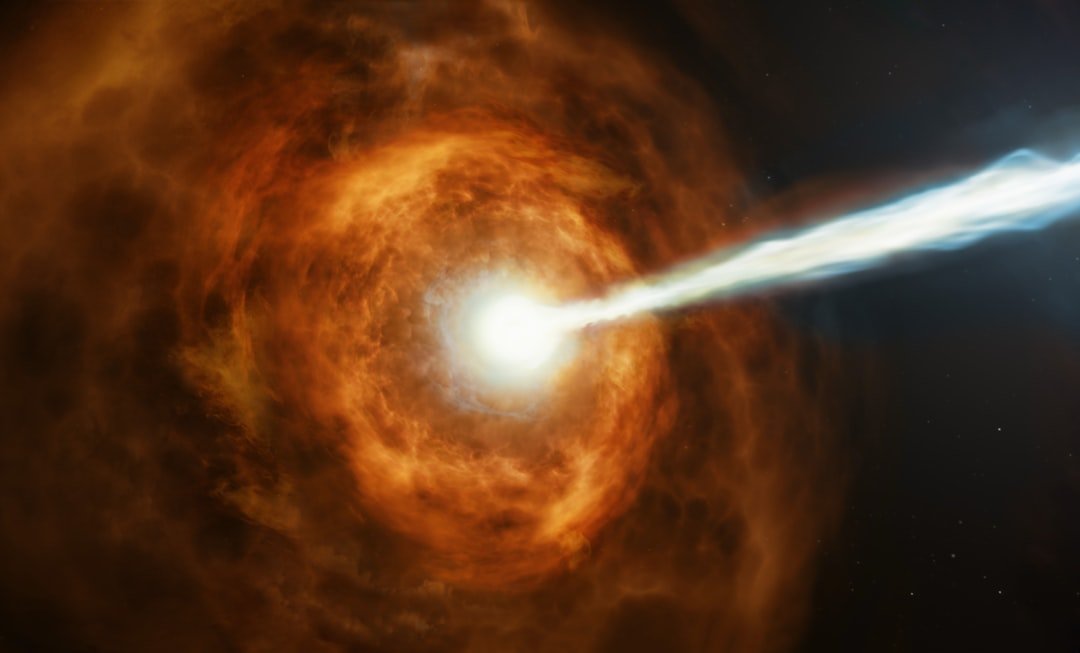
Gamma-ray bursts rank among the cosmos’s most energetic phenomena, born from the death throes of massive stars collapsing into black holes. These explosions unleash narrow jets of radiation, but only those aimed directly at Earth trigger alerts from gamma-ray satellites. When jets point elsewhere, known as off-axis events, the initial blast goes unseen, leaving just a spreading afterglow as the shockwave interacts with surrounding gas.
ASKAP J005512.2-255834 fits this profile perfectly. No gamma-ray prompt emission appeared in archives, nor did optical or X-ray counterparts emerge. Its synchrotron emission spectrum evolved as predicted for such an afterglow, with the jet’s glow widening over time to become detectable at radio wavelengths. Scientists described it as the most convincing example yet of an orphan gamma-ray burst afterglow.[1]
- Rapid initial rise, unlike steady supernovae remnants.
- No repeating pulses, ruling out magnetars.
- Slow decay over years, distinct from fast radio bursts.
- Absence of high-energy signals, confirming off-axis origin.
- Compact host environment, favoring star-forming regions.
Pinpointing the Explosion’s Host Galaxy
Follow-up observations locked in the source’s position. The Magellan Telescope in Chile revealed alignment with 2dFGRS TGS143Z140, a compact, star-forming galaxy at redshift z=0.116, roughly 1.7 billion light-years away. The blast site sat offset from the nucleus, within a dense star cluster ideal for massive star deaths.
Additional radio data came from the Giant Metrewave Radio Telescope in India, confirming the signal’s properties across frequencies from 0.3 to 9 GHz. The galaxy’s irregular shape and active star formation supported a gamma-ray burst scenario, though researchers considered an alternative: a tidal disruption event where an intermediate-mass black hole shredded a star off-center.
| Telescope | Role | Key Contribution |
|---|---|---|
| Australian SKA Pathfinder (ASKAP) | Discovery & Monitoring | Detected brightening in RACS survey starting 2022 |
| Magellan Telescope | Optical Identification | Linked to host galaxy 2dFGRS TGS143Z140 |
| Giant Metrewave Radio Telescope | Multi-frequency Follow-up | Confirmed synchrotron spectrum |
Challenging the Limits of Cosmic Detection
This find emerged from a targeted hunt for radio echoes tied to gravitational wave events, though no such link held. The paper, led by Ashna Gulati of the University of Sydney and colleagues, detailed the analysis in a study accepted for publication in The Astrophysical Journal. It underscored radio surveys’ power to reveal “ghosts” in the sky – explosions that announce themselves only belatedly.[2]
Such orphans could represent a vast, undetected population of gamma-ray bursts. They offer insights into jet structures, host environments, and rare black hole interactions. Future surveys with telescopes like the Square Kilometre Array promise more discoveries, filling gaps in our map of extreme astrophysics.
Key Takeaways
- First clear orphan GRB afterglow, validating long-predicted off-axis events.
- Energy rivals billions of suns, yet missed initial detection.
- Expands understanding of hidden cosmic explosions and their radio signatures.
The detection of ASKAP J005512.2-255834 reminds us that the universe holds violence beyond our immediate gaze. As radio astronomy advances, more echoes will surface, rewriting histories of stellar cataclysms. What other silent blasts lurk in the radio sky, waiting to be heard? What do you think about this hidden cosmic event? Tell us in the comments.