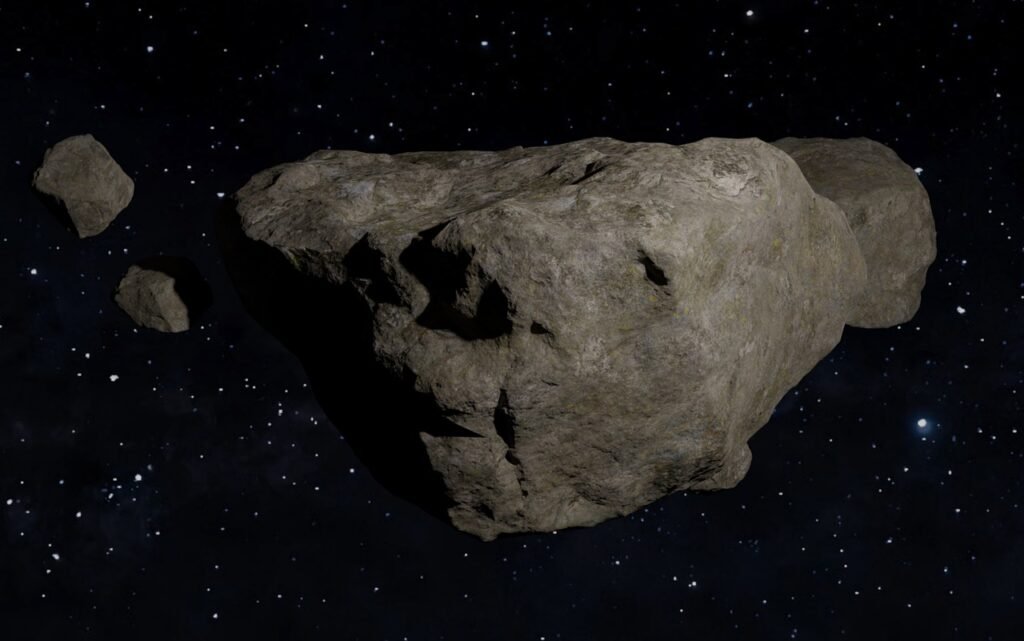

Hayabusa2’s Journey to the Spinning Top Asteroid (Image Credits: Pixabay)
Scientists examining tiny samples from the asteroid Ryugu have identified all five canonical nucleobases that form the foundation of genetic material on Earth. The discovery, detailed in a study published this week, marks a significant step in understanding how life’s building blocks might have reached our planet. Returned by Japan’s Hayabusa2 spacecraft in 2020, these pristine extraterrestrial materials continue to reveal organic compounds linked to prebiotic chemistry.[1]
Hayabusa2’s Journey to the Spinning Top Asteroid
The Hayabusa2 mission launched in 2014 and reached the near-Earth asteroid Ryugu in 2018. This carbonaceous C-type asteroid, roughly 900 meters across with a distinctive spinning top shape, proved an ideal target for studying primitive solar system materials. The spacecraft executed two touchdowns in 2019, firing a projectile during the second to collect subsurface material free from space weathering.[1]
Samples arrived on Earth in December 2020 after a six-year round trip. Researchers have since analyzed them under strict cleanroom conditions to avoid contamination. Earlier examinations detected amino acids, vitamins, and in 2023, the RNA nucleobase uracil. The latest work builds on these findings with advanced analytical techniques.[2]
Advanced Analysis Reveals the Full Nucleobase Set
A team led by Toshiki Koga from the Japan Agency for Marine-Earth Science and Technology processed two Ryugu samples: A0480 weighing 11.9 milligrams and C0370 at 8.3 milligrams. They performed sequential extractions using water at room temperature followed by hot hydrochloric acid to release bound compounds. High-performance liquid chromatography paired with electrospray ionization high-resolution mass spectrometry then identified the molecules.[1]
The analysis confirmed adenine and guanine, the purine nucleobases, alongside cytosine, thymine, and uracil, the pyrimidines. Tandem mass spectrometry verified guanine and cytosine structures, while capillary electrophoresis provided additional corroboration. No signs of terrestrial contamination appeared, as procedural blanks showed negligible levels.[1]
Concentrations and Striking Comparisons Across Space Rocks
Total nucleobase abundances reached 507 picomoles per gram in sample A0480 and 1,577 picomoles per gram in C0370. Guanine stood out at 445 picomoles per gram in one extract, with uracil at up to 199 picomoles per gram. Notably, purine-to-pyrimidine ratios hovered around 1.1 to 1.2, indicating balanced distributions unlike other samples.[1]
Ryugu’s profile differs from meteorites and another asteroid. The Murchison meteorite favors purines with a ratio near 3.4, while Bennu and Orgueil lean toward pyrimidines at 0.55 and 0.099, respectively. These variations correlate negatively with ammonia content across samples, hinting at formation pathways tied to parent body environments.[1]
| Sample | Total Nucleobases (pmol/g) | Pu/Py Ratio |
|---|---|---|
| Ryugu C0370 | 1,577 ± 35 | 1.2 ± 0.1 |
| Ryugu A0480 | 507 ± 21 | 1.1 ± 0.2 |
| Bennu | 3,404 ± 256 | ~0.55 |
| Murchison | Enriched purines | ~3.4 |
What This Means for Life’s Cosmic Origins
The presence of all five nucleobases bolsters theories that carbonaceous asteroids seeded Earth with prebiotic molecules during its early bombardment phase. These compounds likely formed abiotically in interstellar ices or asteroid interiors, then survived delivery to planetary surfaces. Koga emphasized, “This does not mean that life existed on Ryugu. Instead, their presence indicates that primitive asteroids could produce and preserve molecules that are important for the chemistry related to the origin of life.”[2]
Experts hailed the result. Morgan Cable noted its implications for how such molecules sparked life on Earth. The balanced ratios in Ryugu suggest diverse chemical environments shaped organic inventories across the solar system. While assembly into functional genetic systems occurred on Earth, asteroids provided the raw materials.[2]
- Adenine (A) and guanine (G): Purines forming DNA/RNA pairs.
- Cytosine (C), thymine (T), uracil (U): Pyrimidines completing the set.
- Equal abundances challenge prior models of nucleobase synthesis.
- Ammonia link points to new formation pathways.
- Reinforces extraterrestrial delivery hypothesis.
Key Takeaways
- All five nucleobases present in pristine Ryugu samples at ppb levels.
- Balanced purine-pyrimidine ratios unique to Ryugu.
- Supports asteroids as sources of life’s precursors on early Earth.
This discovery underscores the solar system’s potential to generate life’s essentials far from any planet. As analysis of Ryugu and Bennu samples continues, each revelation draws clearer connections between cosmic chemistry and biology’s beginnings. What implications do these findings hold for searching life elsewhere? Share your thoughts in the comments.