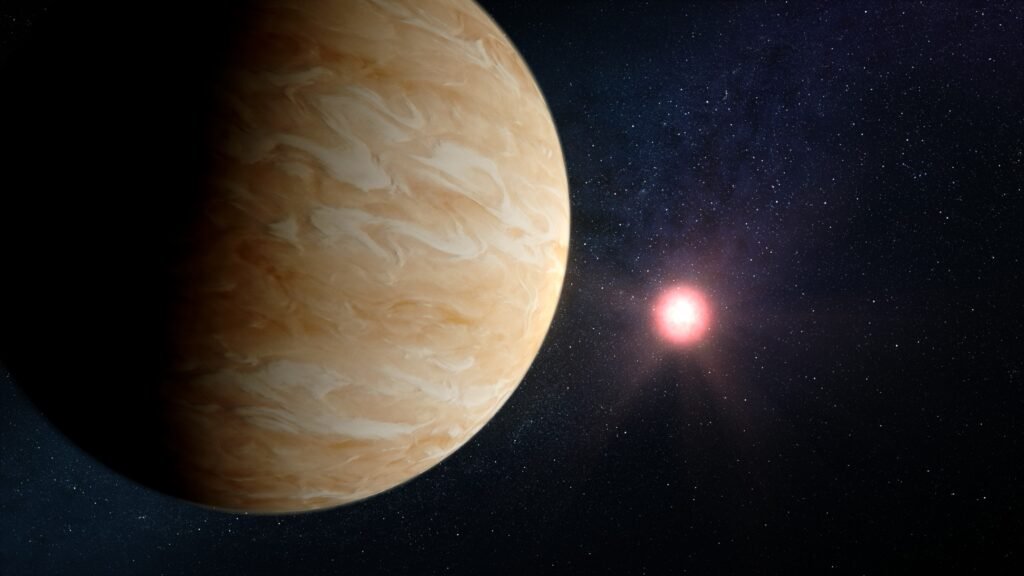
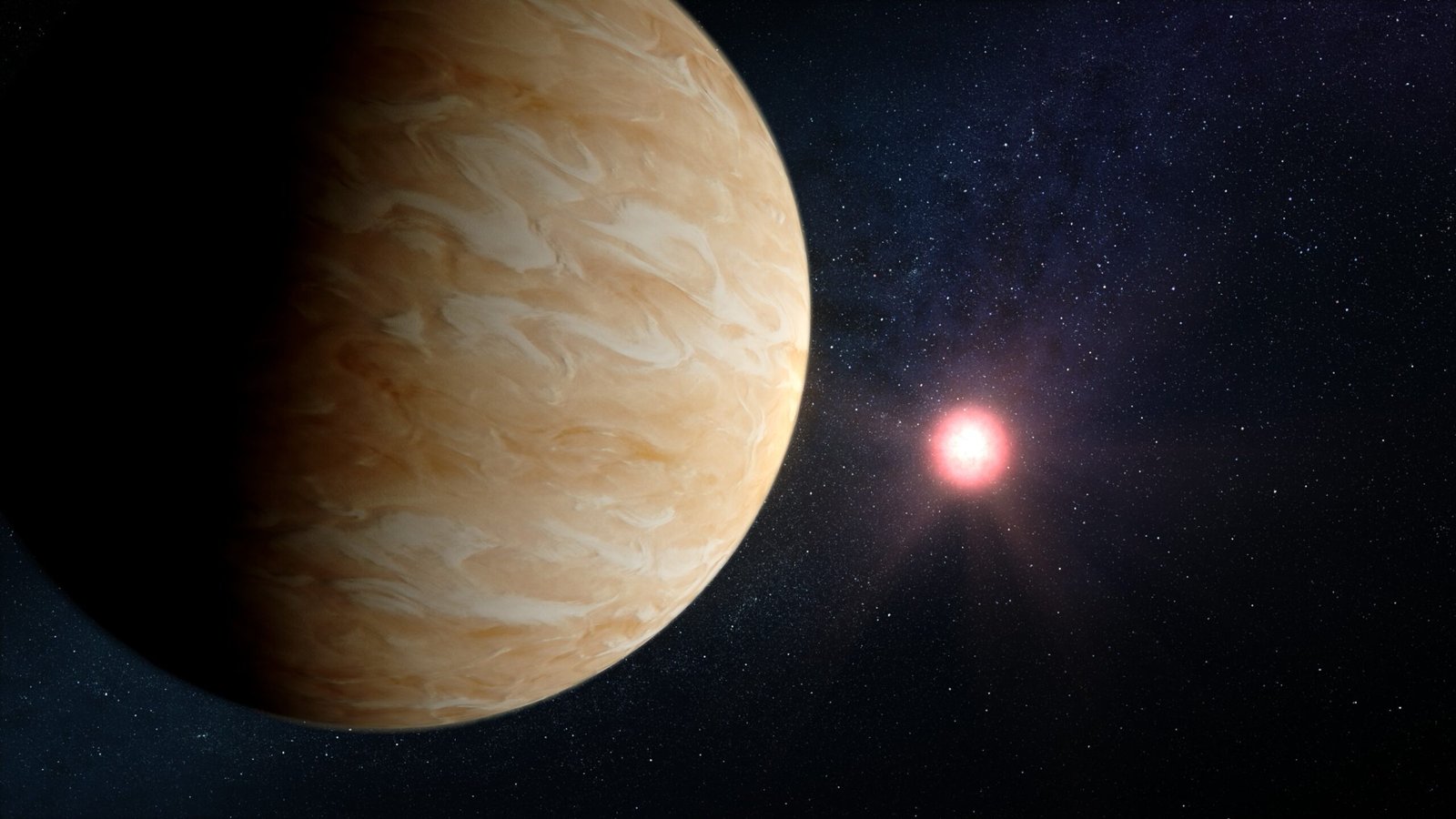
A World Lighter Than Expected (Image Credits: Upload.wikimedia.org)
Astronomers have encountered a cosmic puzzle in the form of Kepler-51d, an unusually lightweight giant world orbiting a distant star. Recent observations from the James Webb Space Telescope highlighted a remarkably thick atmospheric haze enveloping the planet, thwarting efforts to probe its inner makeup. This discovery challenges long-held assumptions about how such ethereal planets endure in their harsh environments.
A World Lighter Than Expected
Kepler-51d stands out as a prime example of a super-puff planet, a class of celestial bodies known for their enormous size paired with remarkably low density. These worlds resemble oversized cotton candy balls more than the rocky or gaseous giants familiar in our solar system. Scientists first identified the planet through data from NASA’s Kepler mission, which spotted its transit across its host star.
The planet’s fluffiness arises from its minimal mass relative to its vast radius, making it one of the least dense exoplanets confirmed to date. This configuration raises immediate questions about structural integrity under gravitational forces. Researchers noted that such low-density profiles typically prove unstable over time, yet Kepler-51d persists.
JWST Peers Into the Obscurity
Equipped with unprecedented infrared sensitivity, the James Webb Space Telescope turned its gaze toward Kepler-51d in hopes of piercing its atmosphere. Instead, the instrument detected an exceptionally dense haze layer that scatters and absorbs light across multiple wavelengths. This veil proved so impenetrable that direct analysis of the planet’s composition remained elusive.
Measurements suggested the haze extends to extraordinary widths, potentially rivaling the diameter of Earth itself. Such a scale marks it among the thickest hazes ever observed on an exoplanet. The findings emerged from spectroscopic data, which typically reveals chemical signatures but here yielded only muted signals.
Defying Formation Theories
Kepler-51d orbits perilously close to its star, completing a revolution in mere days, a position that subjects it to intense stellar radiation. Conventional models predict that gas giants in such proximity either lose their atmospheres or migrate outward during formation. Yet this super-puff maintains its delicate balance, prompting a reevaluation of those frameworks.
The mismatch between observed traits and theoretical expectations leaves experts grappling with formation mechanisms. Did internal heating or external accretion play outsized roles? Alternative scenarios, such as rapid envelope contraction, might explain the survival, but evidence remains scant amid the haze.
Unanswered Questions Shape Future Probes
Beyond immediate observations, the haze’s persistence hints at exotic chemistry, possibly involving photochemical reactions or high-altitude clouds. These elements could shield the planet from erosion, preserving its super-puff status. Astronomers now prioritize multi-wavelength campaigns to circumvent the blockage.
Comparative studies with similar worlds in the Kepler catalog may illuminate patterns. For instance:
- Low-density envelopes correlate with short-period orbits.
- Hazes often feature in hot, irradiated atmospheres.
- Spectroscopy limitations underscore the need for advanced modeling.
- Super-puffs represent less than 1% of known exoplanets.
- Future missions could target haze-free analogs for contrast.
These insights guide telescope time allocations and simulation refinements.
Key Takeaways
- Kepler-51d’s haze rivals Earth’s size, blocking JWST views.
- Its ultra-low density challenges gas giant stability models.
- Close stellar orbit amplifies the formation enigma.
The enigma of Kepler-51d underscores the universe’s capacity for surprises, even under the most powerful telescopes. As analysis continues, this super-puff may redefine planetary diversity. What mysteries might the next observation unveil? Share your thoughts in the comments.