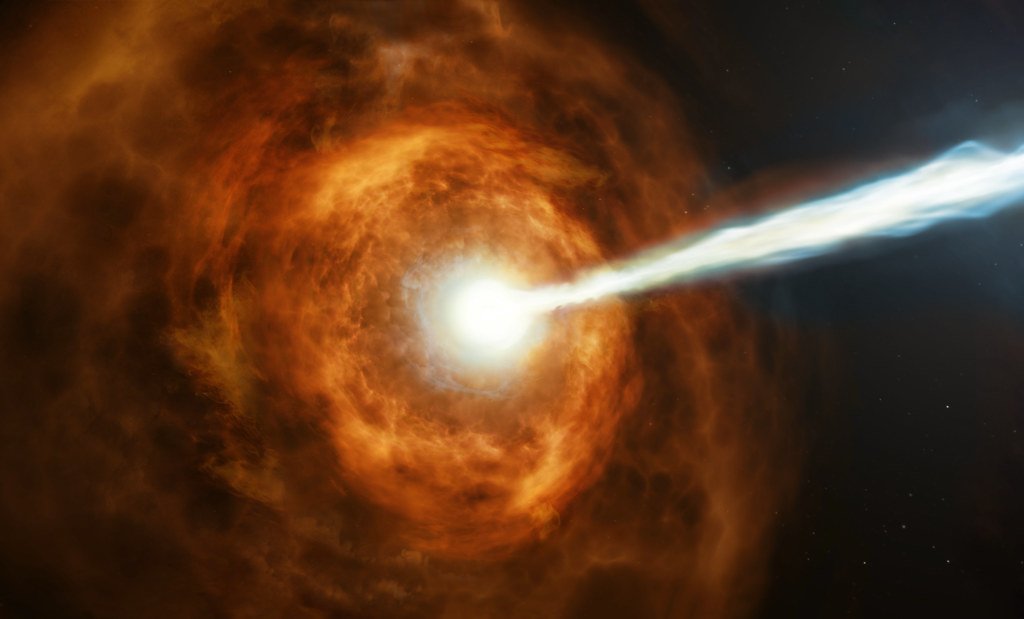
A Cosmic Flash That Outshone Everything (Image Credits: Flickr)
Astronomers pinpointed the origin of the most luminous fast radio burst ever recorded, locating it within a galaxy much closer than many expected.
A Cosmic Flash That Outshone Everything
The detection marked a milestone in radio astronomy. This burst, labeled RBFLOAT, erupted with unprecedented intensity. It endured for mere milliseconds yet dominated the radio sky of its host galaxy during that instant. No other radio emission from that galaxy could compete with its brilliance.
Telescopes captured the event amid routine observations. The sheer power of the signal immediately drew attention from experts worldwide. Such potency raised questions about the mechanisms behind these enigmatic phenomena.
Precision Tracking with Cutting-Edge Networks
A network of CHIME Outrigger telescopes played the pivotal role in localization. These instruments provided the sharp resolution needed to tie the burst directly to its galactic home. Follow-up efforts confirmed the position through additional scrutiny.
The James Webb Space Telescope then entered the picture. Its infrared observations revealed a subtle glow precisely at the burst’s coordinates. This alignment strengthened the case for the identification. Researchers hailed the synergy of ground- and space-based tools.
FRBs Defy Expectations Once More
Fast radio bursts have puzzled scientists since their discovery over a decade ago. They appear as brief, powerful radio pulses from deep space. Most originate far beyond our Milky Way, often in distant galaxies billions of light-years away.
This latest event stood apart due to its one-off nature. Unlike many repeating FRBs, RBFLOAT showed no recurrence. That trait complicates prevailing models linking bursts to magnetars or neutron star collisions. Theories must now account for such isolated, ultra-bright outbursts in nearer environments.
Unraveling the Enigma Step by Step
Understanding FRBs demands piecing together rare clues. Here are core characteristics that define them:
- Duration: Typically milliseconds long.
- Energy: Equivalent to a sun’s output over seconds, packed into a flash.
- Distance: Often from remote galaxies, though exceptions emerge.
- Repetition: Some repeat predictably; others vanish after one pulse.
- Sources: Likely compact objects like neutron stars or black holes.
Each new detection refines these profiles. The RBFLOAT case pushes boundaries further.
Key Takeaways
- The burst’s home lies in a nearby galaxy, defying distance norms.
- CHIME Outriggers and JWST enabled precise localization.
- Its non-repeating profile challenges FRB origin theories.
This breakthrough illuminates one of the universe’s most elusive signals. It promises to reshape our grasp of extreme cosmic events. What insights might future observations yield? Share your thoughts in the comments.