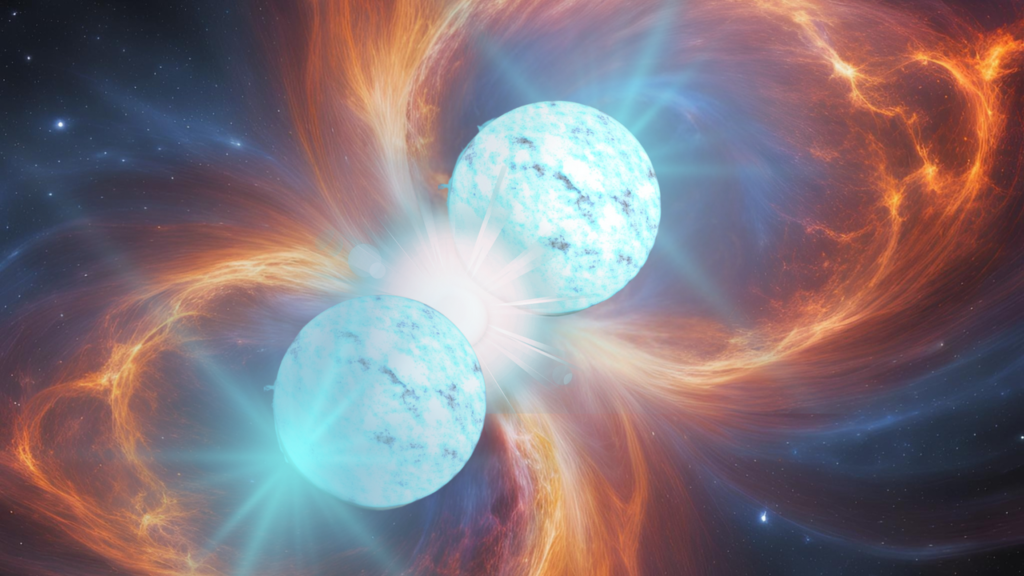
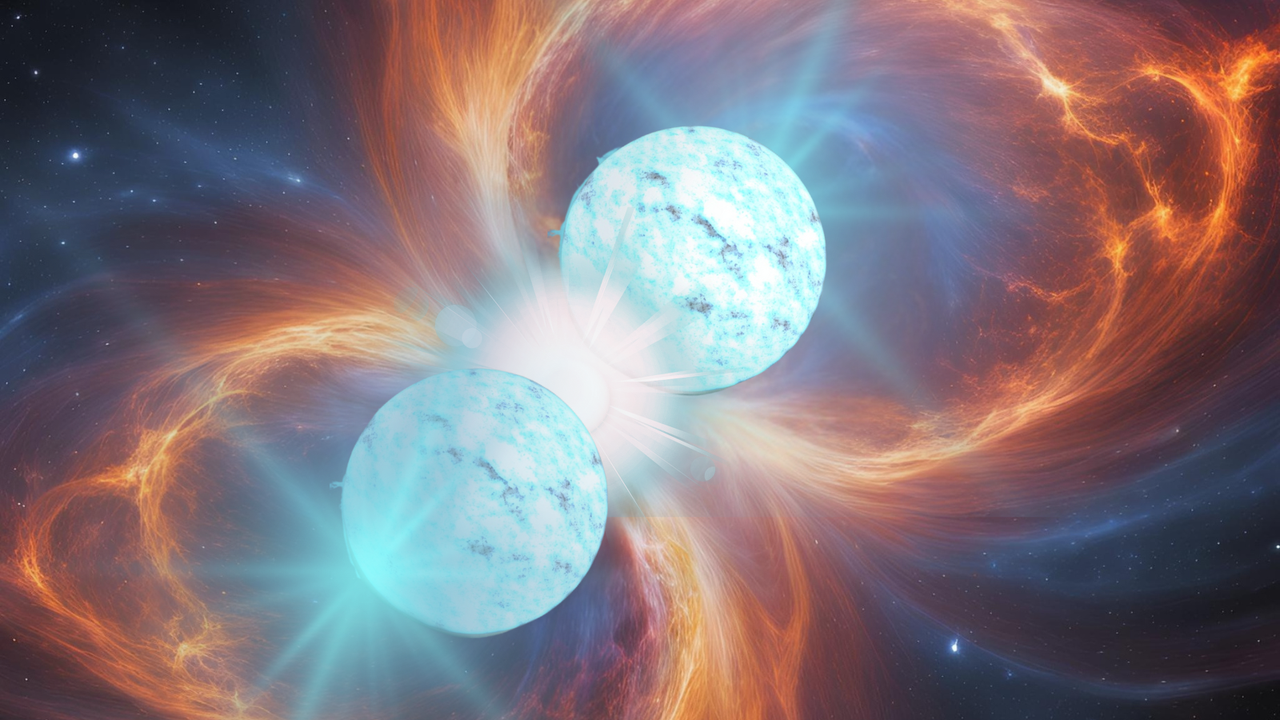
The Enigma of Ultra-Dense Interiors (Image Credits: Cdn.mos.cms.futurecdn.net)
Binary neutron stars hurtle toward collision under gravitational pull, their tidal forces stretching and squeezing each other to reveal hints of exotic matter deep inside.
The Enigma of Ultra-Dense Interiors
Neutron stars represent the universe’s densest laboratories outside black holes. These remnants of massive stellar explosions cram one to two solar masses into spheres roughly 20 kilometers across. A teaspoon of their material would weigh billions of tons on Earth.[1][2]
At such extremes, protons and neutrons might dissolve into free quarks and gluons, forming a quark-gluon plasma. This state dominated the cosmos microseconds after the Big Bang, when temperatures exceeded trillions of degrees. Unlike particle accelerators that recreate it at high heat, neutron stars offer cold, dense versions inaccessible in labs.[1]
Researchers long debated whether these quark cores exist. Recent analyses suggest they do, particularly in the heaviest neutron stars approaching two solar masses.
Tidal Distortions During Cosmic Spirals
When neutron stars orbit in pairs, they lose energy through gravitational waves, spiraling closer over millions of years. Tidal forces from one star bulge the other, much like the Moon deforms Earth’s oceans.
These deformations excite internal oscillations, or modes, that ripple through the stars. The waves carry imprints of these vibrations to detectors like LIGO. The 2017 GW170817 event provided the first measurement of tidal deformability, a key constraint on the stars’ equation of state.[3]
Stiffer interiors resist distortion less, altering the waveform. Softer quark matter would produce distinct signatures, potentially confirming its presence during mergers.
- Mass-radius data from X-ray observatories like NICER
- Gravitational wave signals from LIGO/Virgo mergers
- Pulsar timing for precise masses up to 2 solar masses
- Bayesian modeling of equations of state
Strong Evidence for Quark Matter Cores
Studies combining observations with theoretical models place the odds of quark cores in massive neutron stars at 80 to 90 percent. A 2020 analysis in Nature Physics used model-independent methods to show that maximally stable neutron stars exhibit deconfined quark traits.[3] Follow-up work refined this with Bayesian inference across 12 neutron star observations. The results favor quark matter over purely nuclear compositions, unless extreme phase transitions intervene.[4][2]
“It is fascinating to concretely see how each new neutron-star observation enables us to deduce the properties of neutron-star matter with increasing precision,” said Aleksi Vuorinen of the University of Helsinki.[4] Quark cores could span half a star’s radius in two-solar-mass objects, influencing merger dynamics and even black hole formation if phase changes destabilize the structure.
Advanced Models Pave the Way Forward
A February 2026 study introduced a relativistic framework for tidal responses in merging neutron stars. Researchers proved that oscillations form a complete set of harmonic modes, even accounting for gravitational radiation.[1][5] This matched-asymptotic approach divides the star into gravity regimes, enabling precise waveform predictions. Future detectors could detect high-frequency imprints, distinguishing quark phases from nuclear matter.
Nicolás Yunes noted, “One hope is that we’ll be able to get some information about the neutron-star equation of state at densities found in the inner core… Is there really a quark core?”[1] Though current signals lack resolution, upgrades promise breakthroughs.
Key Takeaways
- Massive neutron stars likely harbor quark-matter cores with 80-90% probability.
- Tidal effects in mergers constrain the equation of state via gravitational waves.
- New 2026 models enhance detection of internal oscillations signaling exotic matter.
Neutron star mergers thus serve as cosmic probes, bridging early universe physics with modern observations. What do you think these stellar remnants reveal about the cosmos? Tell us in the comments.