Fermi Catches the Initial Flash (Image Credits: Cdn.mos.cms.futurecdn.net)
Astronomers pinpointed a dramatic neutron star merger billions of light-years away through coordinated observations by NASA’s space telescopes.
Fermi Catches the Initial Flash
NASA’s Fermi Gamma-ray Space Telescope detected GRB 230906A on September 6, 2023. The burst belonged to a class of short gamma-ray explosions that briefly rival the brightness of entire galaxies.[1][2]
These events typically arise when two ultradense neutron stars spiral together and smash. The collision unleashes immense energy, including gamma rays, X-rays, and potentially gravitational waves. Follow-up efforts quickly mobilized other observatories to trace the source. Chandra’s precise X-ray data proved crucial in localizing the burst’s origin.[3]
An Unlikely Hideout in Galactic Wreckage
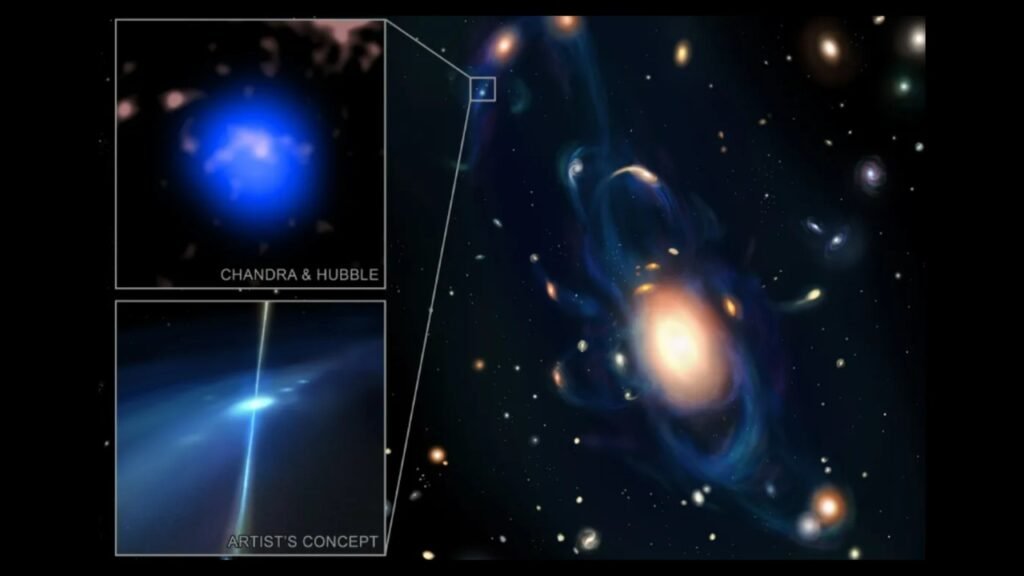
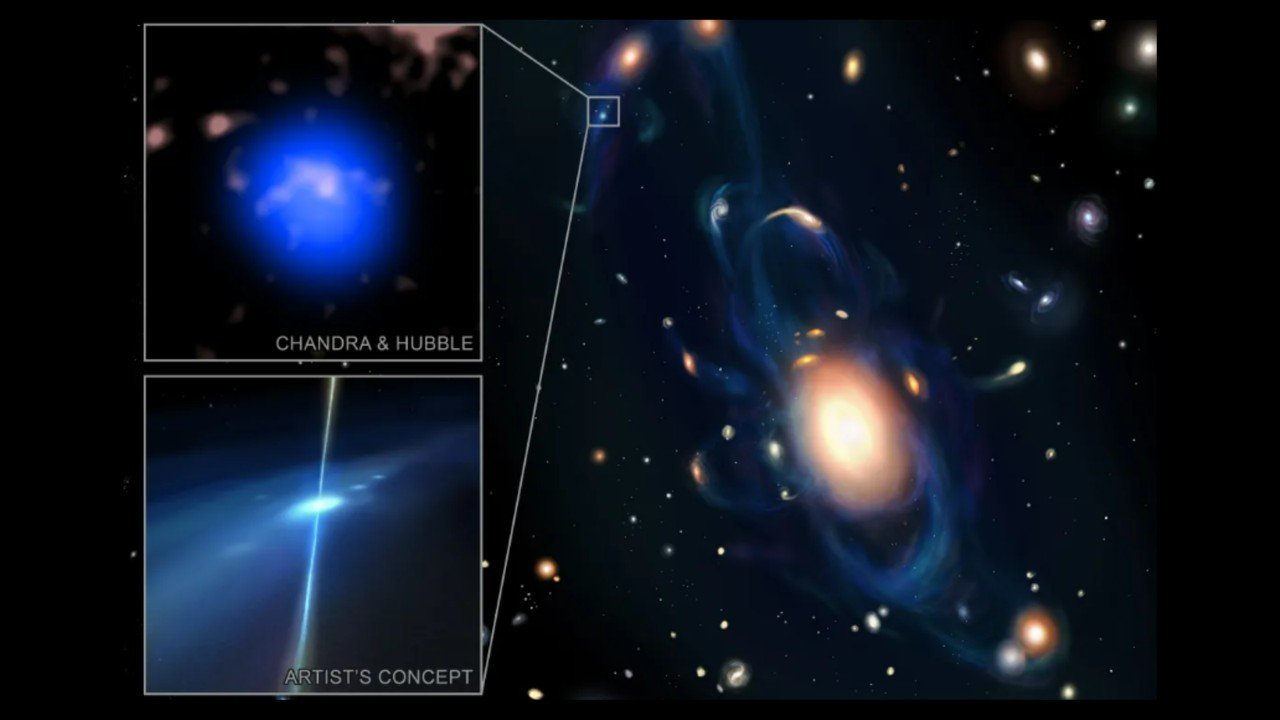
The merger occurred inside a faint, tiny dwarf galaxy nestled within a 600,000-light-year-long tidal stream of gas and stars. This stream formed from the collision of galaxy groups hundreds of millions of years earlier, which tore material into intergalactic space.[2][3]
Such small galaxies rarely host these violent events, which researchers previously linked to larger systems. The location challenged expectations, earning descriptions as a “forbidden” or unexpected zone. “We found a collision within a collision,” noted Eleonora Troja of the University of Rome. The ancient galactic smash likely sparked star formation, birthing the neutron stars that later merged.[2]
Hubble’s keen sensitivity revealed the dim host galaxy, invisible in standard ground-based images. This explained prior “hostless” gamma-ray bursts, where faint dwarfs escaped detection.
Forging the Universe’s Heavy Metals
Neutron star mergers serve as cosmic forges for elements heavier than iron, including gold and platinum. The smash triggers rapid neutron capture, producing these metals in a kilonova glow.[1]
Debris from GRB 230906A likely scattered such elements into the tidal stream, enriching distant stars. This process accounts for heavy metals in galactic outskirts, far from central supernovae. Lead researcher Simone Dichiara of Penn State called the find “game changing,” as it addresses two astrophysics puzzles: missing GRB hosts and peripheral element distribution.[2]
- Fermi: Initial gamma-ray detection.
- Chandra: X-ray pinpointing.
- Swift: Location refinement.
- Hubble: Faint galaxy imaging.
Coordinated Observations Unlock Secrets
The InterPlanetary Network refined Fermi’s initial position, paving the way for Chandra’s sharp X-ray view. “Chandra’s pinpoint X-ray localization made this study possible,” said Brendan O’Connor of Carnegie Mellon University. Swift and Hubble then confirmed the tiny galaxy at that spot.[2]
Distance estimates place the event 4.7 to 8.5 billion light-years away, marking one of the more remote short bursts observed.[1][2] Researchers published findings in The Astrophysical Journal Letters on March 10, 2026.
Key Takeaways
- First confirmed neutron star GRB in a dwarf galaxy tidal stream.
- Explains “hostless” bursts via faint hosts.
- Reveals heavy element spread from mergers to galaxy edges.
This discovery reshapes views on where cosmic cataclysms brew, showing even galactic debris fields can yield stellar remnants primed for merger. As telescopes advance, more such events may illuminate the universe’s elemental alchemy. What do you think about this cosmic collision? Tell us in the comments.