The Historical Record Behind the Legend (Image Credits: Getty Images)
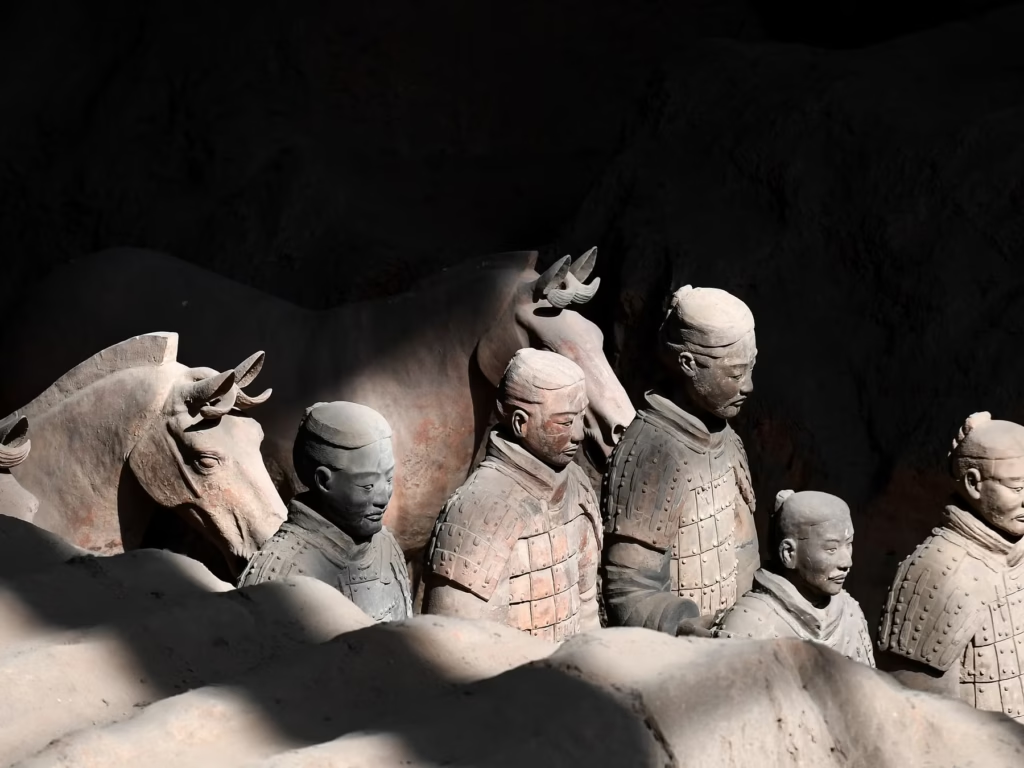
Few archaeological discoveries have captured the imagination of the world quite like the vast underground army guarding the tomb of China’s first emperor. Thousands of life-sized clay soldiers stand frozen in formation near the burial complex of Qin Shi Huang, the ruler who unified China more than two millennia ago. Since the site’s accidental discovery in 1974 near Xi’an, archaeologists have continued to uncover astonishing artifacts from this enormous funerary landscape.
Now, a remarkable discovery within the broader necropolis is renewing interest in one of ancient China’s most dramatic historical stories. Researchers have uncovered a massive treasure-filled tomb within the complex, raising the possibility that it may confirm a legend recorded more than 2,000 years ago in the ancient historical chronicle Shiji, also known as Records of the Grand Historian.
The Legendary Terracotta Army and Its Emperor
The Terracotta Army was built to protect the tomb of Qin Shi Huang, the first emperor who unified the Chinese states in 221 BCE. Historical records indicate that construction of his vast mausoleum began shortly after he took the throne as a teenager and eventually involved hundreds of thousands of laborers.
The necropolis surrounding the emperor’s tomb was designed as a symbolic replica of his empire. Archaeologists have uncovered pits containing soldiers, officials, entertainers, animals, and chariots—each representing aspects of imperial life meant to accompany the emperor into the afterlife.
Even today, large portions of the burial complex remain unexcavated, meaning the site continues to yield new discoveries decades after its initial excavation began.
A 16-Ton Treasure Casket Unearthed
During recent excavations within the larger mausoleum complex, archaeologists discovered an enormous casket weighing roughly 16 tons. Inside the tomb were remarkable burial goods including armor, weapons, thousands of bronze coins, jade artifacts, and decorative objects such as gold and silver camel figurines.
Perhaps even more extraordinary is the condition of the burial chamber. Unlike many ancient tombs that were looted over centuries, this chamber appears to have remained untouched by grave robbers for more than two millennia. The discovery has therefore preserved an unusually complete snapshot of Qin-era burial traditions.
Such intact tombs are extremely rare in Chinese archaeology, making this find particularly valuable for historians studying early imperial China.
A Tomb That May Belong to a Royal Prince
Archaeologists believe the lavish nature of the burial suggests the tomb belonged to a high-ranking individual, possibly a noble warrior connected to the imperial family.
One compelling possibility is that the burial belongs to Prince Gao, a son of the emperor whose tragic story appears in the ancient historical text Shiji. Written by the historian Sima Qian, the chronicle describes dramatic political turmoil following the death of Qin Shi Huang.
According to the text, Prince Gao confronted his brother—who had seized the throne during a succession crisis—and ultimately requested that he be buried beside their father after his death. If the newly discovered tomb indeed belongs to him, it would provide rare archaeological confirmation of events recorded in ancient historical literature.
The Historical Record Behind the Legend
The story of Prince Gao comes from the Shiji, one of the most influential works in Chinese historiography. Written during the Han dynasty, the text documents political events, biographies, and historical narratives stretching back centuries.
For generations, historians have debated how accurately these ancient accounts reflect real historical events. While many details have been confirmed through archaeology, other passages have remained uncertain.
This newly discovered tomb could therefore become a crucial piece of evidence. If researchers can identify the individual buried within—perhaps through inscriptions or artifacts—it may help confirm whether the ancient narrative about Prince Gao’s burial is historically accurate.
Why This Discovery Matters for Archaeology
Beyond confirming a single historical story, the discovery offers new insights into burial customs and power structures during the Qin dynasty.
Lavish burial goods such as weapons, armor, jade ornaments, and bronze currency indicate the immense wealth and status associated with elite Qin burials. These artifacts also help archaeologists better understand how the dynasty expressed political authority and loyalty through funerary rituals.
The find also demonstrates the incredible scale of the imperial necropolis surrounding the emperor’s tomb. Even after decades of excavation, the site continues to reveal previously unknown structures and burial chambers.
The Unexcavated Heart of the Mausoleum
Despite the discoveries surrounding it, the central tomb mound of Qin Shi Huang itself remains largely unopened. Archaeologists have been cautious about excavating it due to concerns about preserving fragile artifacts and the possibility of hazardous materials such as mercury described in ancient texts.
Historical accounts claim the tomb may contain elaborate chambers representing rivers and landscapes of China, possibly simulated with liquid mercury. Modern surveys have detected unusually high mercury levels in the soil near the mound, lending credibility to these ancient descriptions.
As technology advances, scientists hope to eventually explore the emperor’s tomb without damaging its contents.
Conclusion: When Archaeology Meets Ancient Legend
The discovery of a treasure-filled tomb within the Terracotta Army complex illustrates how archaeology can bring ancient history back to life. Stories recorded in dusty manuscripts centuries ago may suddenly become testable hypotheses once physical evidence emerges from the ground.
If the tomb truly belongs to Prince Gao, it would be a remarkable example of legend intersecting with reality. For historians, it would validate the meticulous work of early chroniclers like Sima Qian, whose writings preserved the dramatic human stories behind imperial power struggles.
More broadly, the discovery reminds us that even the most famous archaeological sites are far from exhausted. Beneath the soil of the Qin mausoleum still lies an enormous historical archive waiting to be revealed—one artifact, one tomb, and one legend at a time.