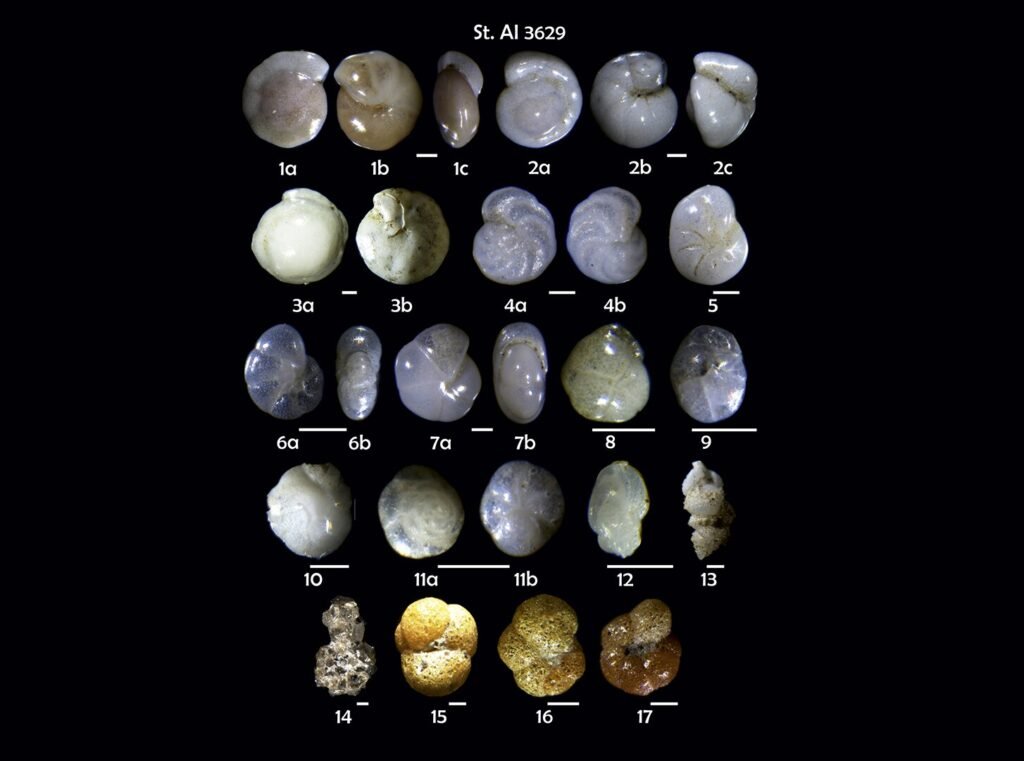
Scientists Used Benthic Foraminifera Fossils to Measure the Change in Spin (Image Credits: ETH Zurich)
Earth’s climate is changing in ways scientists are only beginning to fully understand. While rising temperatures, melting glaciers, and rising seas are well-known consequences of global warming, new research suggests the effects reach even deeper—literally altering how fast the planet rotates.
A new study led by researchers from the University of Vienna and ETH Zurich reveals that modern climate change is slowing Earth’s rotation at a rate unmatched for millions of years. By examining geological records stretching back over three million years, scientists found that the current change in the length of a day stands out dramatically in the planet’s long climate history.
Climate Change Is Literally Lengthening Earth’s Days
Earth does not rotate at a perfectly constant speed. Subtle variations in the distribution of mass across the planet—especially water and ice—can slightly speed up or slow down its spin.
The new research shows that melting ice sheets and rising sea levels are redistributing enormous amounts of water across the globe. This shift changes Earth’s balance in a way similar to a spinning figure skater extending their arms, causing the planet’s rotation to slow slightly and lengthening the duration of a day.
Evidence Hidden in Ancient Ocean Fossils
To investigate how Earth’s rotation has changed through time, scientists turned to microscopic fossils preserved in marine sediments. These fossils come from single-celled organisms known as benthic foraminifera, whose shells record past ocean conditions.
By analyzing the chemical signatures within these fossils, researchers reconstructed sea-level changes and linked them to variations in Earth’s rotation stretching back about 3.6 million years. This long record allowed them to compare modern changes with natural variations during earlier climate cycles.
A Rate of Change Never Seen in the Geological Record
The analysis revealed a striking result: today’s climate-driven change in Earth’s rotation is happening faster than at any time in the past several million years.
Currently, the length of a day is increasing by about 1.33 milliseconds per century. While this might seem insignificant, it represents a clear signal when viewed against the background of ancient climate fluctuations recorded in the geological record.
Ice Sheets and Sea Level Drive the Planet’s Spin
Throughout Earth’s history, the growth and melting of large ice sheets have repeatedly influenced the planet’s rotation. During glacial periods, massive ice sheets stored water on land, while warmer periods released it back into the oceans.
These shifts alter how mass is distributed across the planet, which directly affects rotational speed. However, the rapid melting occurring today—largely driven by human-caused climate change—is producing changes faster than those associated with past natural climate cycles.
Future Impacts Could Rival the Moon’s Influence
The Moon has long been the dominant force affecting Earth’s rotation through tidal interactions. But researchers say that by the end of the 21st century, climate change could become an equally powerful driver of changes in day length.
Although these changes occur on the scale of milliseconds, they matter for modern technology. Systems such as satellite navigation, spacecraft tracking, and precise astronomical measurements rely on extremely accurate knowledge of Earth’s rotation.
A New Perspective on the Reach of Climate Change
This research highlights a profound reality: climate change is not only altering ecosystems and weather patterns—it is affecting the fundamental physical behavior of the planet itself.
The findings underscore how interconnected Earth’s systems truly are. Changes in ice, oceans, and atmosphere ripple through the planet’s geophysical processes, linking climate science with fields such as geodesy, astronomy, and planetary physics.
When Climate Change Reaches the Planet’s Core Mechanics
The idea that human-driven climate change could alter the speed of Earth’s rotation may sound almost surreal, yet the evidence is increasingly clear. What once seemed like small environmental shifts—melting ice sheets, rising seas—are collectively powerful enough to influence the mechanics of an entire planet.
In my view, this discovery serves as a powerful reminder of how deeply humanity now shapes Earth’s systems. When climate change begins to alter something as fundamental as the length of a day, it becomes impossible to dismiss the scale of our influence. The real question is not whether the planet will continue changing—it will—but whether humanity will respond quickly enough to shape that future responsibly.