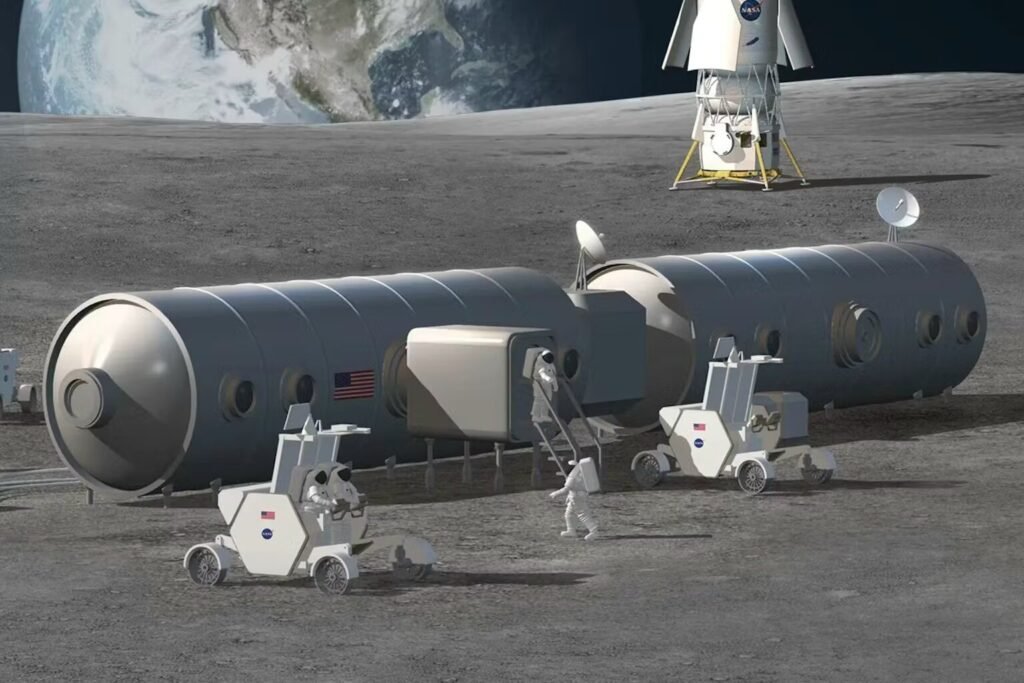
Lunar Base Concept Released by NASA in February 2026. Credit: NASA
For decades, the Moon has symbolized humanity’s boldest technological achievements, from the historic Apollo landings to modern robotic explorers mapping its surface. Now, a new push by the United States government and NASA aims to transform Earth’s nearest neighbor from a place of brief visits into a permanent outpost for scientific discovery and deep-space exploration.
Under a recent directive from the White House and legislation supported by U.S. lawmakers, NASA has been tasked with establishing the initial elements of a permanent lunar base by 2030. The outpost would function as a research laboratory and testing ground where astronauts learn how to live and work beyond Earth—an essential step toward future missions to Mars and beyond.
A New Era of Human Presence on the Moon
The plan for a lunar base reflects a dramatic shift in how space agencies view the Moon. Instead of short missions lasting a few days, NASA now envisions astronauts returning regularly and eventually staying for extended periods.
This strategy centers on creating a sustainable presence on the lunar surface where crews can conduct experiments, test technologies, and explore the Moon’s resources. By developing these capabilities on the Moon, scientists hope to prepare for longer missions deeper into the solar system.
The Artemis Program at the Heart of the Plan
NASA’s ambitious Artemis program forms the backbone of the lunar base initiative. Since its launch in 2017, Artemis has aimed to return astronauts to the Moon and establish a long-term human foothold there.
The program will soon send astronauts around the Moon again for the first time in more than half a century. Following recent changes to mission planning, NASA now intends to increase the frequency of Artemis missions and begin landing astronauts on the lunar surface again by 2028, laying the groundwork for future base construction.
Building the First Infrastructure on the Lunar Surface
Constructing a permanent base on the Moon will require a complex network of infrastructure. This includes landing systems, habitats for astronauts, reliable power supplies, and vehicles capable of traveling across the rugged lunar terrain.
Future missions may deliver modules that serve as living quarters, laboratories, and storage facilities. Engineers are also exploring ways to generate continuous power—potentially through solar installations or even small nuclear reactors—to support long-duration human operations.
The Moon as a Scientific Laboratory
A permanent base would transform the Moon into one of the most valuable scientific platforms in the solar system. Researchers could study the Moon’s geology, search for water ice, and investigate how humans can survive in harsh extraterrestrial environments.
Scientists also see the lunar surface as a gateway to broader discoveries about the early solar system. Rocks preserved on the Moon may contain records of ancient cosmic impacts that shaped Earth and other planets billions of years ago.
Competition and Cooperation in the New Space Race
The renewed focus on the Moon is unfolding amid growing global interest in lunar exploration. Other nations—including China and Russia—are planning their own lunar research stations, highlighting the Moon’s rising strategic importance.
For the United States, establishing a base is not only about science but also about maintaining leadership in space exploration. Policymakers increasingly view the Moon as a stepping-stone for future missions and as a region where technological and geopolitical competition will intensify.
A Launchpad for Missions to Mars
NASA’s long-term vision extends far beyond the Moon itself. By learning how to operate a sustained outpost in deep space, engineers and astronauts can develop technologies needed for even more ambitious journeys.
A lunar base could serve as a staging ground for missions to Mars and other distant destinations. The Moon’s lower gravity makes launching spacecraft easier, and its environment offers a realistic testing ground for life-support systems and advanced exploration technologies.
The Moon May Become Humanity’s First True Outpost in Space
The idea of a permanent base on the Moon once belonged firmly in the realm of science fiction. Today, it is rapidly becoming a tangible goal backed by political will, technological innovation, and international competition.
In my view, the push toward a lunar base represents more than just another milestone in space exploration—it signals a turning point in humanity’s relationship with space itself. If successful, the Moon could evolve from a distant symbol in the night sky into our first true off-world settlement, opening the door to a future where living and working beyond Earth becomes not an extraordinary achievement but an everyday reality.