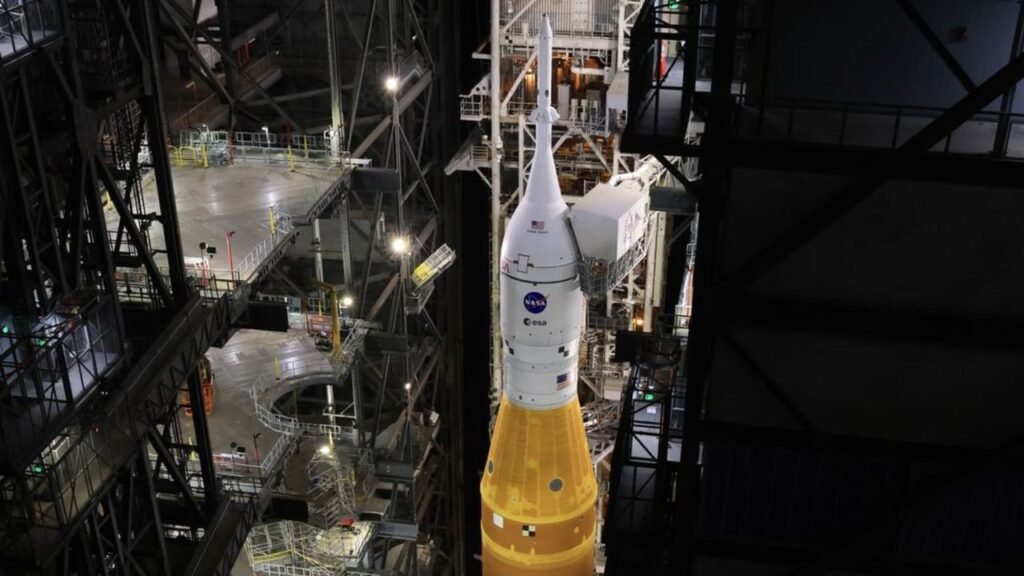
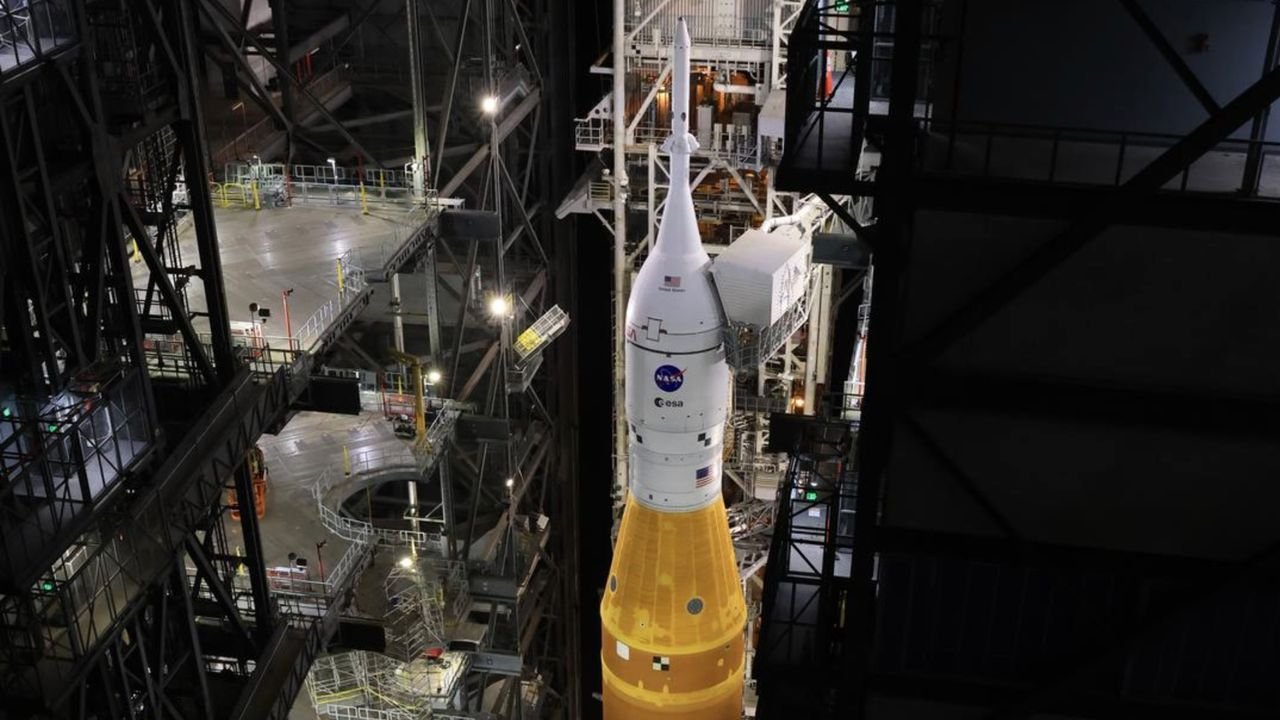
Engineers Conquer Helium Flow Setback (Image Credits: Cdn.mos.cms.futurecdn.net)
Kennedy Space Center, Florida – NASA wrapped up its Artemis II Flight Readiness Review on March 12, signaling the agency’s Space Launch System rocket and Orion spacecraft stand ready for a historic crewed trip around the Moon as early as April 1.[1]
Engineers Conquer Helium Flow Setback
Teams addressed a critical helium pressurization issue in the rocket’s upper stage that surfaced during preparations earlier this year. A dislodged seal had blocked proper flow to the Interim Cryogenic Propulsion Stage, prompting a rollback to the Vehicle Assembly Building on February 25.[2]
Engineers repaired the seal and completed additional checks, including battery swaps in the self-destruct system. This work returned the stack to prime condition inside the Vehicle Assembly Building. NASA now plans to roll the fully integrated rocket and spacecraft back to Launch Complex 39B on March 19, pending weather and final closeouts.[1]
The resolution keeps the mission on track after earlier delays from weather, leaks, and heat shield reviews following Artemis I. Officials expressed confidence in the fixes during a post-review news conference.[3]
Trailblazing Crew Prepares for Deep Space
Artemis II will carry four astronauts on NASA’s first crewed deep space voyage since Apollo 17 in 1972. Commander Reid Wiseman leads the team, with Pilot Victor Glover, Mission Specialist Christina Koch, and Canadian Space Agency astronaut Jeremy Hansen rounding out the crew.[4]
This lineup marks milestones: Koch becomes the first woman, Glover the first person of color, and Hansen the first non-American to venture to the Moon’s vicinity. The crew trained extensively for the 10-day free-return trajectory, which will take them farther from Earth than any humans before.[5]
Testing the Frontiers of Lunar Exploration
The mission validates the SLS Block 1 rocket and Orion spacecraft in human-rated operations. Astronauts will checkout life support systems, conduct proximity operations with the discarded upper stage, and test the Orion Artemis II Optical Communications system for high-speed data links.[4]
Payloads monitor crew health in deep space, including effects on tissues, sleep, and immunity. The flyby skims within 4,047 miles of the Moon’s far side before a high-speed reentry at 25,000 mph into the Pacific Ocean.[4]
- Validate SLS and Orion for crewed deep space.
- Demonstrate optical communications up to 260 Mbps.
- Gather data on space weather and human physiology.
- Pave way for Artemis III lunar landing.
Launch Windows and Final Preparations
Liftoff targets 6:24 p.m. EDT on April 1 from LC-39B, with backups on April 2, 3, 4, 5, 6, and 30. Success here positions Artemis III for 2027 lunar surface operations.[1]
Recovery awaits via U.S. Navy vessels. The wet dress rehearsal succeeded in February, confirming fueling and countdown procedures.[4]
Key Takeaways
- FRR complete with unanimous “go” on March 12.
- Helium fix enables March 19 rollout.
- April 1 NET launch revives Apollo-era ambitions.
Artemis II stands as a pivotal bridge to sustainable lunar presence and Mars ambitions, proving NASA’s hardware endures the void. As the countdown accelerates, the world watches these pioneers reclaim the lunar frontier – what role will this mission play in humanity’s cosmic future? Share your thoughts in the comments.