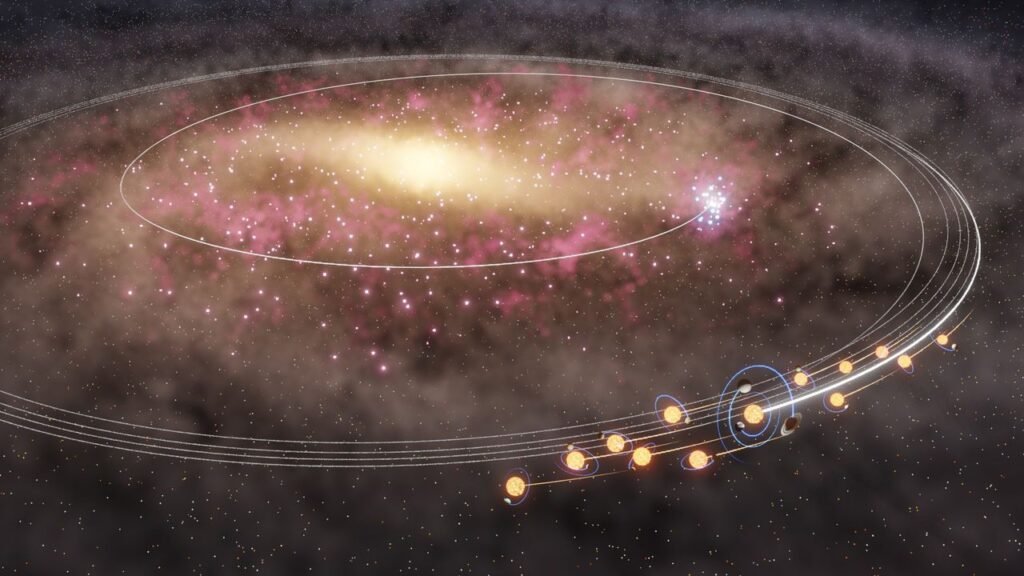
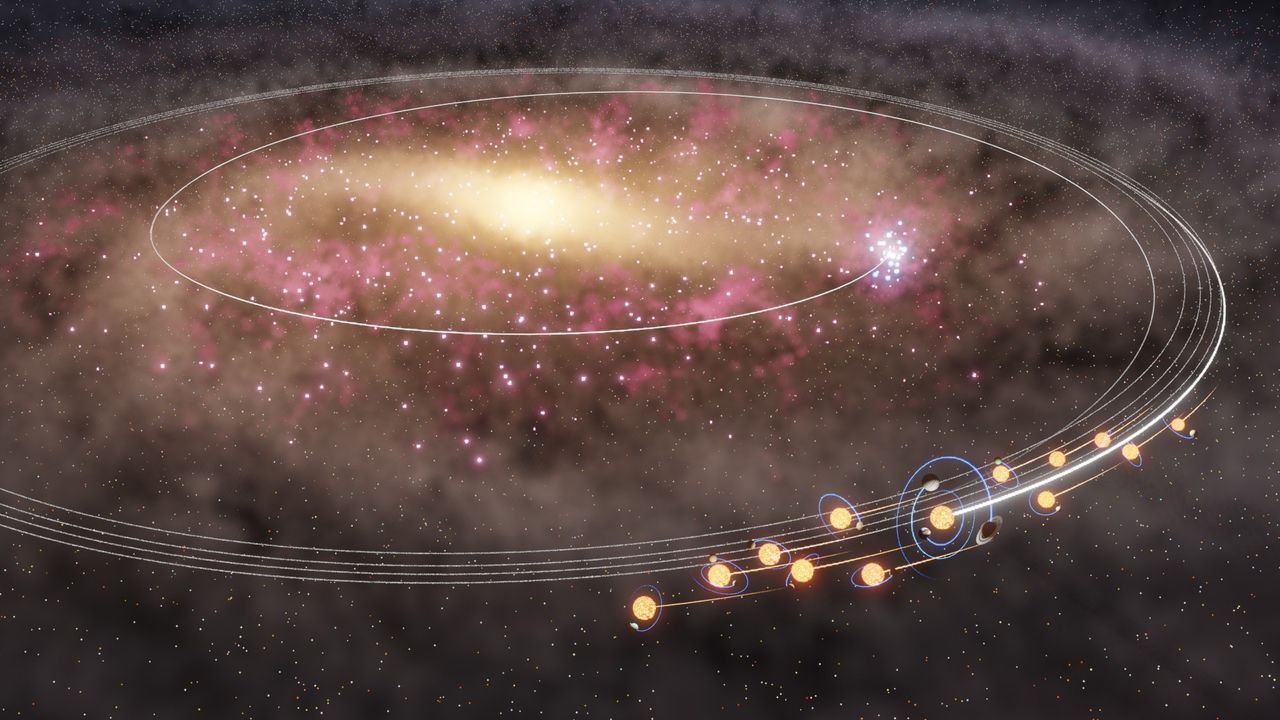
Solar Twins Unlock Galactic History (Image Credits: Cdn.mos.cms.futurecdn.net)
Astronomers uncovered compelling evidence that our Sun joined thousands of similar stars in a vast migration from the Milky Way’s dense core to quieter suburbs billions of years ago.[1][2]
Solar Twins Unlock Galactic History
Researchers analyzed data from the European Space Agency’s Gaia satellite, which observed more than two billion stars. They compiled a catalog of 6,594 solar twins – stars matching the Sun’s temperature, surface gravity, and chemical composition. This collection marked a significant advance, roughly 30 times larger than prior surveys.[1]
The team corrected for observational biases, such as brighter stars appearing more frequently. Age distributions revealed a striking pattern: a broad peak between four and six billion years old, encompassing the Sun’s age of 4.6 billion years. This clustering suggested these stars shared a common origin and journey.[3]
Assistant Professor Daisuke Taniguchi of Tokyo Metropolitan University led the effort, alongside Takuji Tsujimoto of the National Astronomical Observatory of Japan. Their findings appeared in two papers published in Astronomy & Astrophysics.[1]
Breaching the Galactic Barrier
The Sun formed more than 10,000 light-years closer to the Milky Way’s center than its current position. Yet a rotating bar of gas, dust, and stars at the core creates a corotation barrier, trapping inner stars from outward travel. Simulations indicated only about one percent of such stars could cross this hurdle within 4.6 billion years.[2]
However, the migration succeeded because the bar remained under construction during this period. Gravitational influences from the evolving bar, spiral arms, and passages of the Sagittarius dwarf galaxy propelled the group outward. “Stars similar to our Sun form a mass migration from the center of the Milky Way, occurring approximately 4 to 6 billion years ago,” the researchers stated.[1]
- Evolving galactic bar provided initial push.
- Spiral arms guided the trajectory.
- Sagittarius dwarf galaxy encounters accelerated movement.
- Timing aligned with incomplete corotation barrier.
Dangers of the Core Versus Suburban Stability
The galactic core teems with activity: rapid star formation, heavy metal buildup, frequent supernovae, and high stellar density raise risks of collisions and radiation exposure. Such chaos disrupts stable planetary orbits essential for life.[2]
Outer regions offer respite. Slower evolution allows balanced chemistry for rocky planet formation. The Sun’s relocation positioned our solar system in this habitable zone, where Earth could emerge and sustain complex organisms. “The center of the galaxy is a far less hospitable environment for the evolution of life than outer regions,” the team noted.[3]
Broader Implications for the Cosmos
This migration not only explains the Sun’s path but also timelines the Milky Way’s bar formation. The four-to-six billion-year window pinpoints when dynamical forces reshaped the galaxy’s heart.
Experts like Alice Quillen of the University of Rochester acknowledged potential sampling concerns but praised the bias corrections. Rosemary Wyse of Johns Hopkins called the argument persuasive, though timescales warrant further refinement.
The discovery reframes habitability discussions. It highlights how galactic dynamics influence where life might thrive, extending beyond planetary conditions to stellar neighborhoods.
Key Takeaways
- 6,594 solar twins confirm mass migration 4-6 billion years ago.
- Sun traveled over 10,000 light-years to safer suburbs.
- Galactic core’s hazards contrast with outer stability for life.
Our Sun’s journey underscores the delicate interplay of cosmic forces that enabled life on Earth. Future Gaia data releases promise deeper insights into these stellar wanderings. What role do you think galactic position plays in the search for extraterrestrial life? Share your thoughts in the comments.