A Blinding Blast Captured in Real Time (Image Credits: Cdn.mos.cms.futurecdn.net)
A team of astronomers monitored a distant stellar explosion for months and uncovered compelling evidence of a newborn magnetar powering its extraordinary brilliance.[1][2]
A Blinding Blast Captured in Real Time
On December 12, 2024, telescopes detected SN 2024afav, a superluminous supernova roughly a billion light-years away that outshone typical explosions by a factor of 30.[2] Researchers at the Las Cumbres Observatory tracked the event for nearly 200 days, snapping images every 12 hours to chart its fading light.[3]
The supernova’s luminosity rivaled the entire Milky Way galaxy at its peak, placing it among the rarest and most energetic cosmic events known.[3] Unlike ordinary supernovas, which mark the death of massive stars, this one lingered far longer and brighter, hinting at an unusual energy source.
Joseph Farah, a graduate student at the University of California, Santa Barbara, led the analysis. “Superluminous supernovae are 10 to 100 times brighter than regular supernovae,” he noted.[2]
Unveiling the Magnetar’s Extreme Power
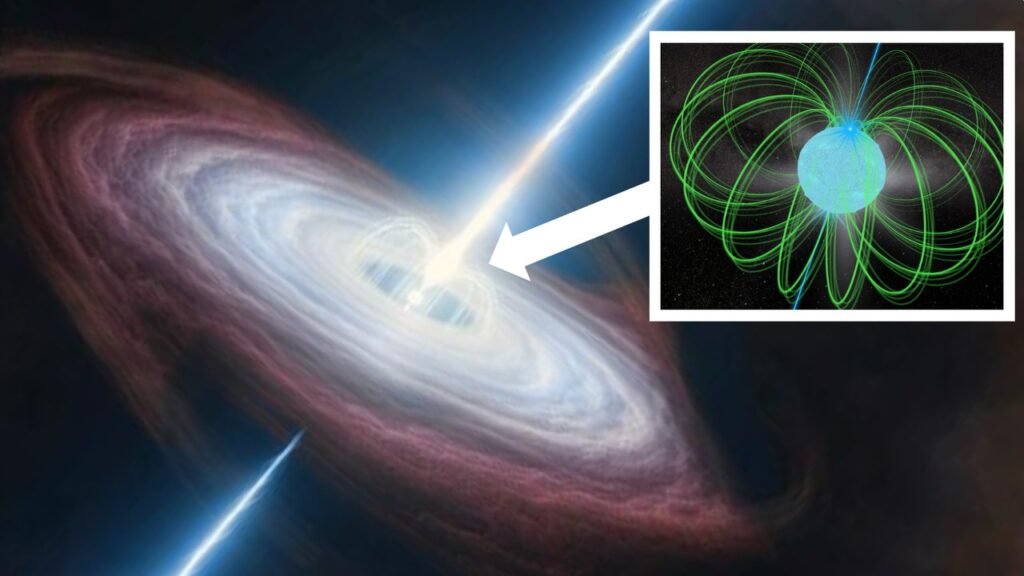
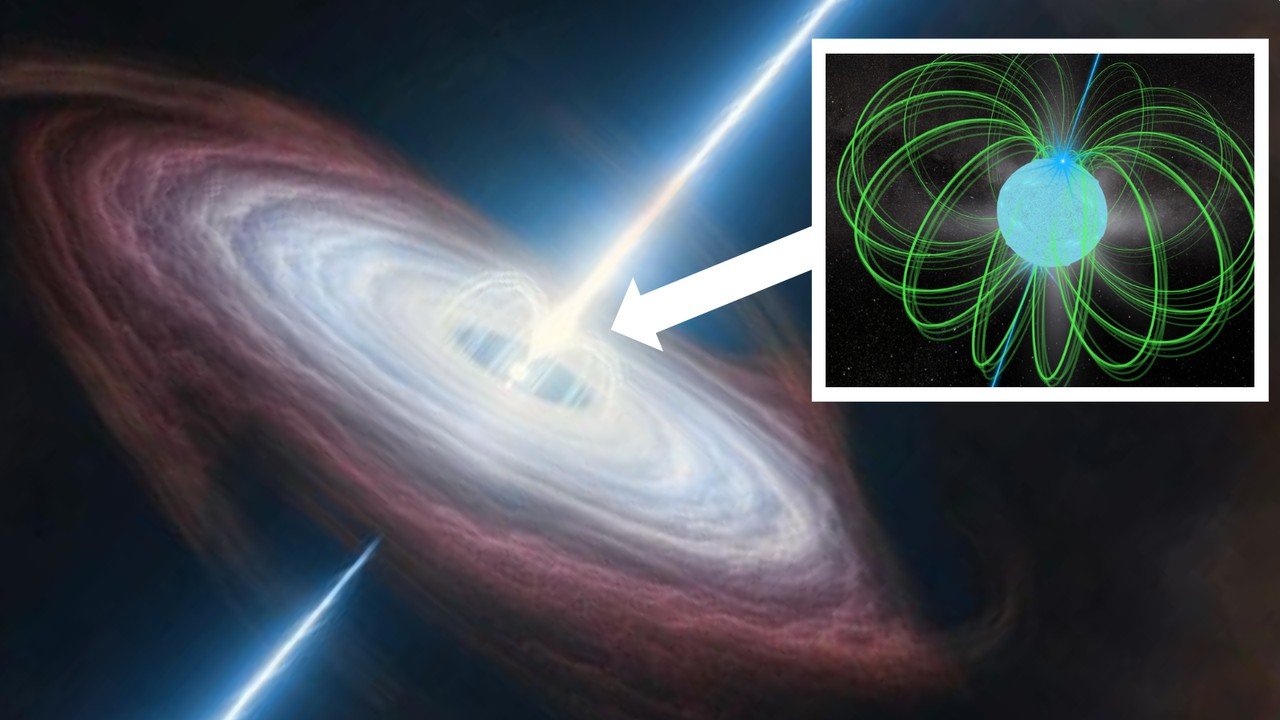
Magnetars represent the universe’s most magnetic objects: neutron stars with fields exceeding 10 trillion gauss, trillions of times stronger than Earth’s.[3] These city-sized remnants form when a massive star’s core collapses during a supernova, compressing immense mass into rapid rotation.
In SN 2024afav, the newborn magnetar spun every 4.2 milliseconds, its magnetic field channeling rotational energy into radiation that amplified the blast.[3] This mechanism had long been theorized but never directly observed until now.
- Magnetic fields: Up to 1,000 times stronger than typical neutron stars.
- Size: Roughly Manhattan’s width, with Mount Everest-scale density.
- Energy output: Fuels explosions 100 times brighter than standard supernovas.
- Rarity: Only about 300 superluminous supernovas identified to date.[2]
The Enigmatic ‘Chirp’ Cracks the Case
What set this event apart was a peculiar pattern in the light curve: periodic dips that accelerated like a chirping signal, unseen in prior supernovas.[1] Five such bumps appeared, each shorter than the last, as the supernova dimmed.
Computer models revealed the cause. Some explosion debris fell back, forming a tilted disk around the magnetar. As material spiraled inward, the disk shrank and its wobbles quickened, intermittently blocking light from Earth.[2]
“No supernova has had a chirp before, so there has to be something weird going on,” Farah observed.[2] The pattern matched predictions precisely, marking the first confirmed magnetar birth.
Einstein’s Relativity in Action
The disk’s behavior stemmed from general relativity’s Lense-Thirring precession, where the magnetar’s fierce spin dragged spacetime itself, forcing the disk to wobble.[1] Farah likened it to a spinning ball knotting a silk sheet, hauling nearby material along.
This extreme environment offered a rare test of Einstein’s theory under conditions unattainable in labs. “It means we can test one of our fundamental theories of reality in one of the most extreme environments in the universe,” Farah said.[1]
Though not all superluminous supernovas fit this model perfectly, the evidence strengthened the magnetar hypothesis across the class.[3]
Key Takeaways
- First direct observation links magnetar formation to superluminous supernovas.
- Accelerating ‘chirp’ traces a precessing accretion disk warped by spacetime drag.
- Opens doors to probing general relativity in cosmic extremes.
This breakthrough not only demystifies the universe’s brightest fireworks but also promises deeper insights as new telescopes come online. The Vera C. Rubin Observatory will soon spot thousands more such events, potentially confirming the pattern repeatedly.[2] What do you think this means for our understanding of stellar deaths? Tell us in the comments.