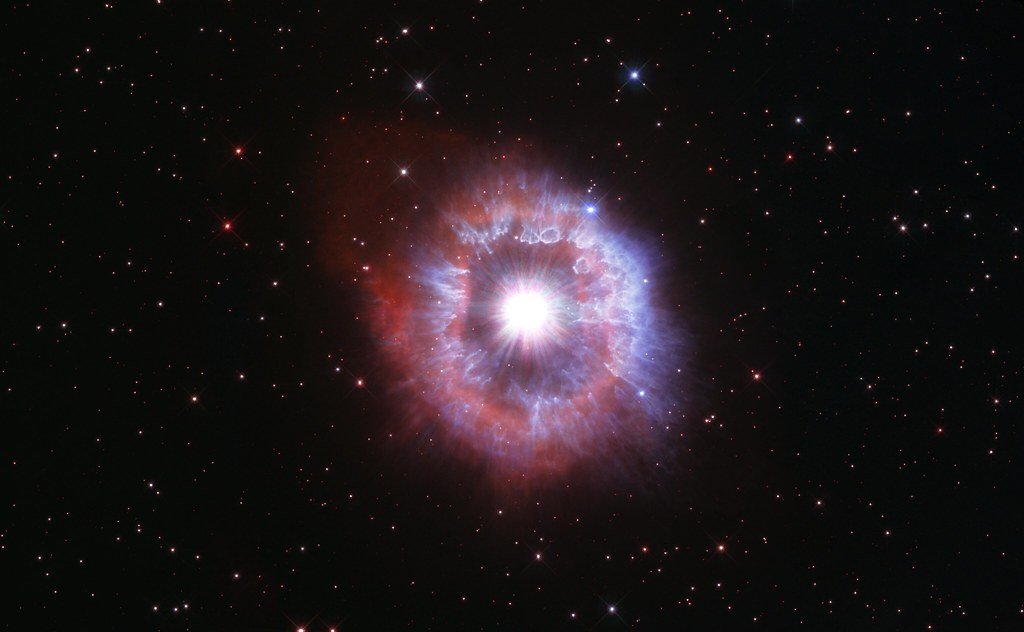
Rare Binary System Powers Unprecedented Dust Factory (Image Credits: Flickr)
Astronomers recently revealed that the universe’s largest stars generate some of its smallest solid particles, challenging long-held assumptions about cosmic dust formation.[1][2]
Rare Binary System Powers Unprecedented Dust Factory
Researchers turned their attention to WR 112, a binary star system featuring a massive Wolf-Rayet star in its final stages alongside a companion star. These stars eject powerful winds that collide, forming dense regions where carbon dust condenses before radiation scatters it into space. WR 112 stands out as one of the most prolific dust producers, generating material equivalent to three Earth moons annually.[1]
The Wolf-Rayet star, known for its intense heat and short lifespan, creates spiral arcs visible in infrared observations. This setup offered a unique laboratory to probe dust properties in extreme conditions. Lead author Donglin Wu, a Yale undergraduate, highlighted the scale: “It’s amazing to know that some of the most massive stars in the universe produce some of the tiniest dust particles before they die. The difference in size between the star and the dust it produces is about a quintillion to one.”[1]
Complementary Visions from JWST and ALMA
NASA’s James Webb Space Telescope captured mid-infrared images of WR 112’s bright spiral dust structures, revealing warm emissions from the particles. In contrast, the Atacama Large Millimeter/submillimeter Array detected no signal at millimeter wavelengths, a clue that only exceptionally small, warm grains could evade such sensitive scrutiny.[2]
By merging these datasets, the team analyzed the spectral energy distribution of the dust. This approach pinpointed grain sizes mostly below one micrometer, dominated by those just a few nanometers across – billionths of a meter. A secondary population hovered around 0.1 micrometers, forming a bimodal distribution.[3]
Bimodal Grains Explain Longstanding Conflicts
Past studies on similar systems yielded contradictory results: some detected only tiny grains, others larger ones. The new findings reconciled this by identifying two distinct populations and mechanisms that destroy intermediate sizes in the stars’ harsh radiation fields.[4]
Processes like fragmentation and evaporation preferentially eliminate mid-sized particles, leaving nanosized and slightly larger survivors. This bimodal profile best matched the observations among tested models. The study appeared in The Astrophysical Journal.[1]
- Primary grains: A few nanometers (dominant).
- Secondary grains: About 0.1 micrometers.
- Overall: Smaller than 1 micrometer.
- Composition: Carbon-rich.
- Annual output: Up to three lunar masses.
Implications for Galactic Dust Cycles
These nanoscale grains from massive binaries like WR 112 could significantly influence carbon distribution across galaxies. As they drift into interstellar space, they seed future stars and planets, altering models of dust evolution and accumulation. The discovery underscores how dying giants contribute to the building blocks of new worlds.
Future observations with JWST and ALMA on comparable systems will refine these insights, potentially reshaping our view of cosmic recycling.
Key Takeaways
- Massive Wolf-Rayet binaries produce carbon dust far smaller than expected, mostly nanometers in size.
- Combined JWST-ALMA data resolves grain size debates through a bimodal distribution.
- High dust output from WR 112 impacts galactic carbon budgets and planet formation.
This quintillion-fold contrast reminds us of the universe’s profound ironies, where behemoths craft the infinitesimal. What role do these tiny particles play in your vision of cosmic origins? Share your thoughts in the comments.