Astronomy has always been a game of patience and scale. The bigger the telescope, the sharper the view. Yet there’s a hard physical limit to how large a single telescope can be – and for decades, scientists have worked around it by connecting multiple telescopes together. Now, a genuinely wild new idea is threatening to upend everything we thought we knew about how far that concept can go.
Quantum entanglement, the strange phenomenon Einstein famously called “spooky action at a distance,” may be the key to linking telescopes separated by vast distances into a single, extraordinarily powerful observing system. The implications for astronomy are staggering. Let’s dive in.
The Core Problem: Why Bigger Isn’t Always Possible
Here’s the thing about telescopes – resolution, meaning how sharply you can see fine detail, doesn’t just depend on mirror size. It depends on something called the baseline, the physical distance between the points collecting light. A telescope the size of a football field is impressive, sure, but a network of telescopes spread across continents can, in theory, behave like a single instrument the size of a continent.
This technique already exists. It’s called Very Long Baseline Interferometry, or VLBI, and it’s the method that allowed the Event Horizon Telescope to capture that iconic image of a black hole in 2019. The problem is that VLBI has serious limitations. It requires physically transferring hard drives packed with recorded data, synchronizing atomic clocks, and works only with radio waves. Optical wavelengths, the kind that produce the sharpest, most detailed images, have remained stubbornly out of reach for this kind of long-baseline linking.
Enter Quantum Entanglement: A Genuinely Bizarre Solution
Quantum entanglement is one of those concepts that sounds like science fiction even when you understand it. When two particles are entangled, measuring one instantly affects the state of the other, regardless of the distance between them. It’s not a signal traveling through space. It’s more like two sides of the same coin, no matter how far apart you throw them.
Researchers are now proposing to use this phenomenon as a kind of quantum “bridge” between telescopes. Instead of recording light the traditional way and shipping drives across continents, entangled particles would be used to correlate the light signals received at distant observatories. The math is complex, but the fundamental idea is elegant: use quantum mechanics to do what classical physics simply cannot.
How the System Would Actually Work
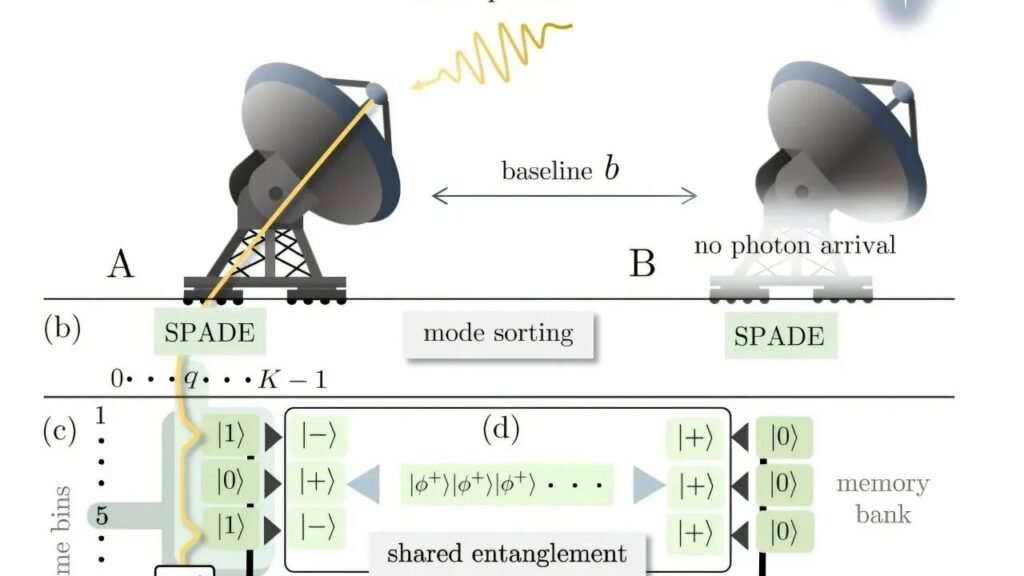
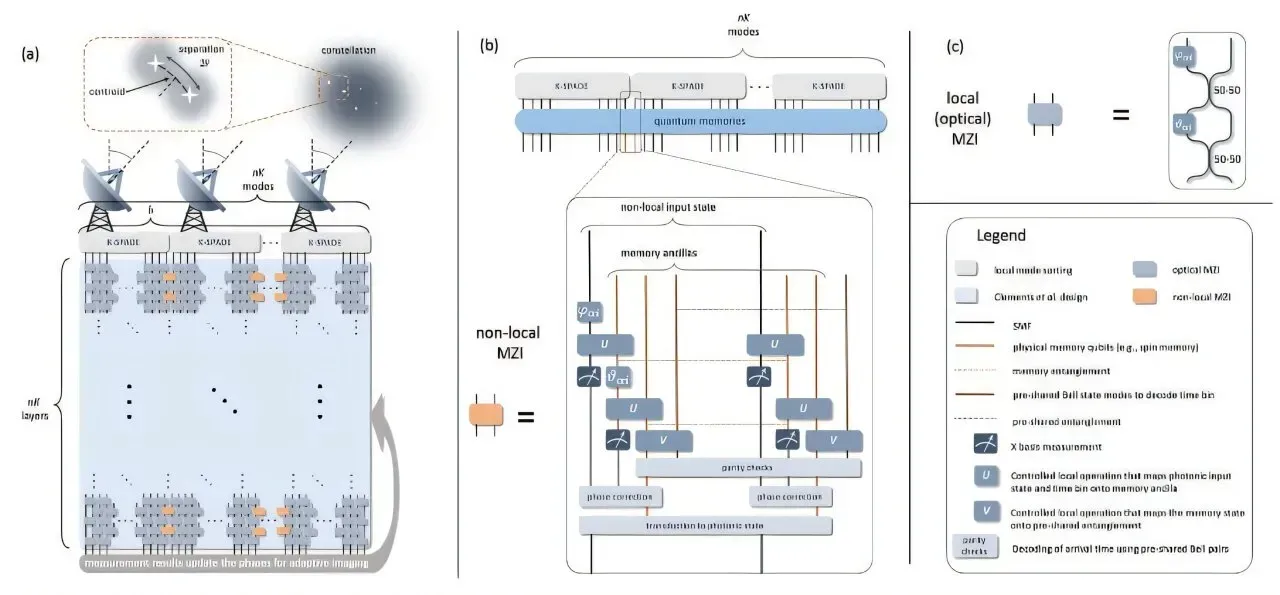
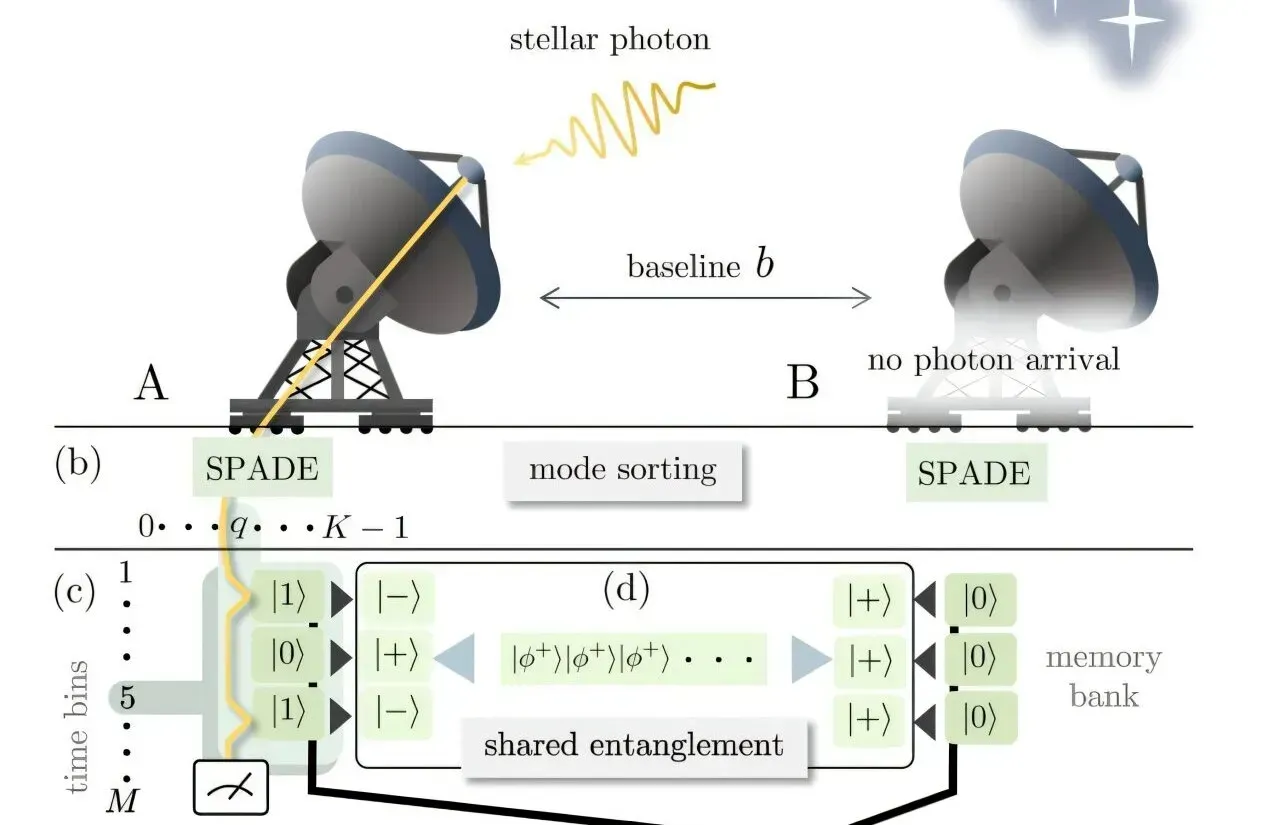
The proposed setup involves distributing entangled photons to telescope sites that could be separated by thousands of kilometers. When starlight arrives at each location, its interaction with the local entangled photons creates quantum correlations. These correlations can then be compared, effectively combining the telescopes’ observations in a way that mimics having a single mirror spanning the entire distance between them.
Honestly, wrapping your head around this is a bit like imagining that you could hear a symphony perfectly by standing in two cities simultaneously. The details involve quantum memories, which are essentially devices that can hold a quantum state long enough for the correlation process to work. This is one of the most challenging engineering hurdles the team acknowledges. Getting quantum memories to hold their coherence long enough, and at room temperature or near it, remains an active and deeply demanding area of research.
What This Could Mean for Observing the Universe
The resolution gains from this approach would be, to put it plainly, extraordinary. Optical interferometry over baselines of thousands of kilometers could allow astronomers to resolve features on the surfaces of distant stars, something currently impossible with any single telescope or even existing arrays. We’re talking about seeing individual surface features on stars light-years away.
Think about what that means for exoplanet science, for studying stellar physics, for probing the environments around black holes in far greater detail than even the Event Horizon Telescope managed. It could also fundamentally change how we search for biosignatures on exoplanets. Right now, detecting an atmosphere on a planet orbiting another star requires inferring it indirectly. Quantum-linked optical telescope arrays could potentially change the scale of what direct observation even means.
The Technical Challenges Are Enormous – But Not Impossible
Let’s be real: none of this is happening next year. The researchers behind this proposal are explicit about the fact that the technology needed to make it work is still in early stages. Quantum memories with sufficient coherence times, efficient entangled photon sources, and the infrastructure to distribute entanglement over long distances are all active research frontiers. Each one of those is a significant project on its own.
Still, the trajectory is encouraging. Quantum communication technology has advanced rapidly in recent years, with satellite-based quantum key distribution experiments already demonstrating entanglement over hundreds of kilometers. The pieces exist, scattered across labs and space agencies worldwide. What this proposal essentially does is imagine them assembled into something much larger and more ambitious. It’s hard to say for sure when, but the “if” is starting to look more and more like a “when.”
Why This Is Different From Existing Telescope Networks
Some readers might wonder: don’t we already have telescope arrays that work together? The answer is yes, but the distinction matters enormously. Existing optical interferometers, like the VLTI in Chile, work by physically combining light beams from telescopes that are at most a few hundred meters apart. This requires the telescopes to be at the same site, connected by precision optical pathways. The baselines are short by astronomical standards.
Quantum-linked telescopes would not need any physical light path connecting them. The entanglement does the correlation work instead. This is the breakthrough conceptually. Separating telescopes by a continent or even by the diameter of the Earth itself becomes theoretically possible. That kind of baseline at optical wavelengths would produce resolution so fine it is genuinely difficult to comprehend without resorting to superlatives.
A New Era in Astronomy Could Be Closer Than We Think
The proposal represents one of those rare moments where two cutting-edge fields, quantum physics and observational astronomy, collide in a way that produces something neither could achieve alone. Researchers from both communities are increasingly paying attention, which is itself a signal that this is being taken seriously rather than dismissed as a curiosity.
It’s worth remembering that VLBI itself once sounded borderline absurd to many physicists. The idea that you could link radio telescopes across continents and produce a coherent image seemed technically preposterous before it was demonstrated. Quantum-linked optical telescopes might be sitting at a similar inflection point right now. The universe has always rewarded our most audacious instruments with its deepest secrets.
The Spookiest Tool in Science Just Got a New Job
What strikes me most about this research is not just its ambition, but its elegance. Quantum entanglement, a phenomenon that still makes physicists uncomfortable with its implications, is being harnessed not to build a computer or crack a code, but to look deeper into the cosmos than we have ever managed before. There’s something poetic about using the universe’s strangest behavior to better understand the universe itself.
The road from proposal to working instrument is long, and full of obstacles that would make most engineers lose sleep. Yet the scientific community has proven time and again that “theoretically possible” has a stubborn way of becoming “experimentally demonstrated” faster than skeptics expect. If quantum entanglement really does become the link between Earth’s distant telescopes, we may one day look back on this moment as the quiet beginning of astronomy’s most radical transformation. What do you think – are we ready for what we might actually see?