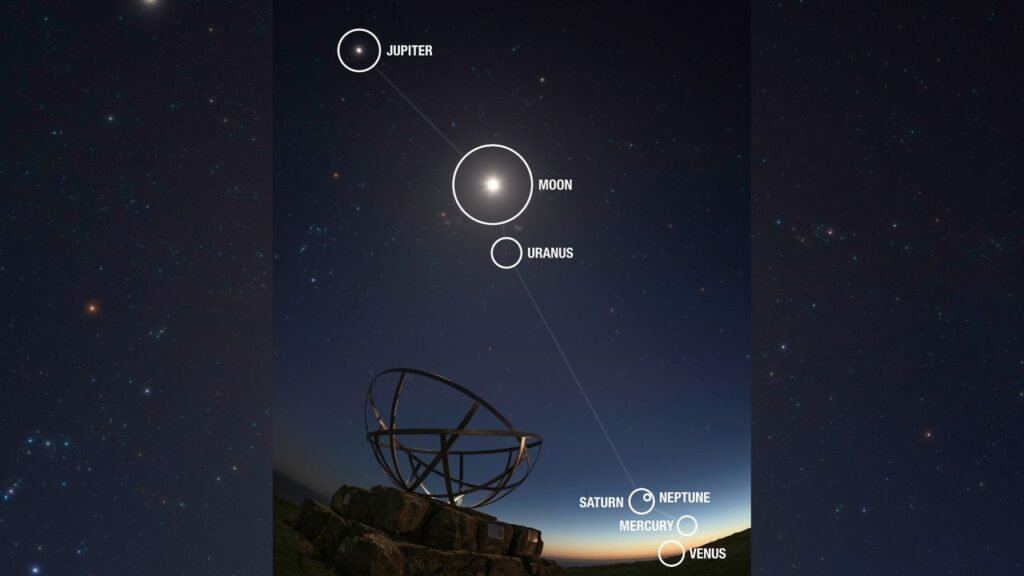
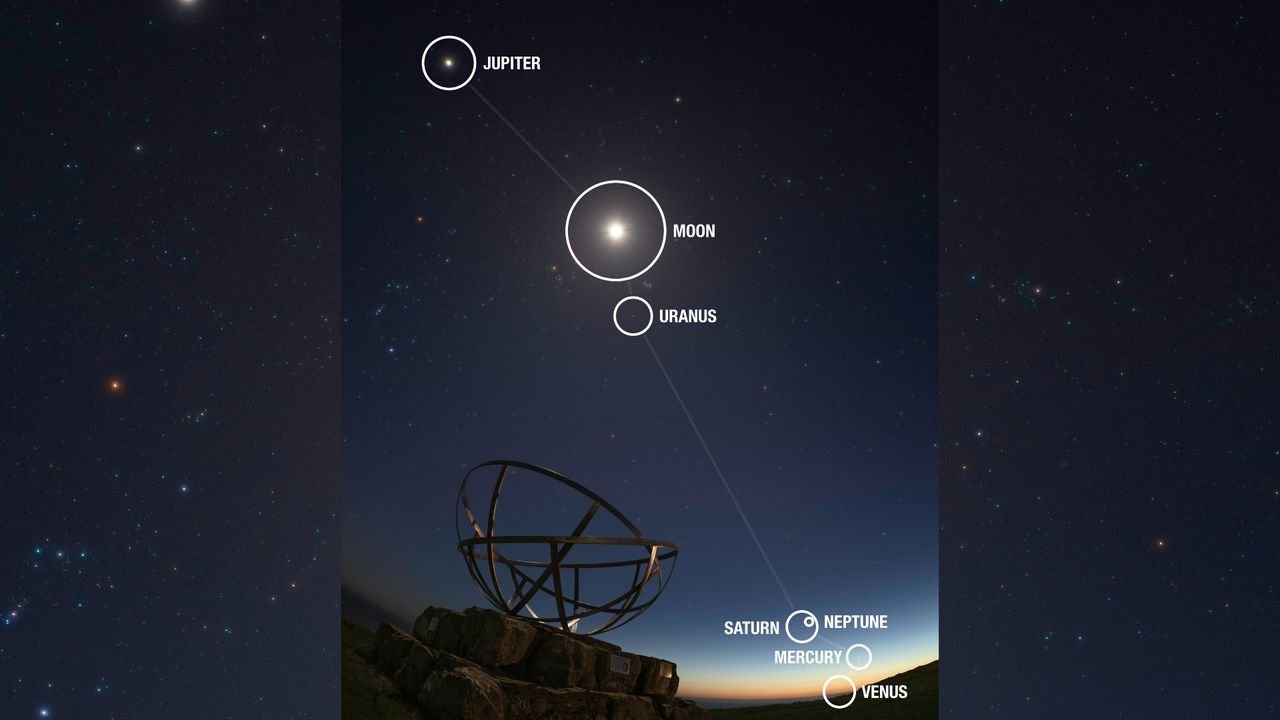
A Race Against the Fading Light (Image Credits: Cdn.mos.cms.futurecdn.net)
Dorset, England – An award-winning astrophotographer seized a fleeting twilight moment to document six planets aligned in a vast arc spanning nearly 180 degrees over the southern coast.[1][2]
A Race Against the Fading Light
Josh Dury, based in Bristol, traveled four hours to reach a telecommunications memorial in Worth Matravers on February 24, 2026. Road closures extended what should have been a two-hour drive, turning the outing into a test of determination.[2][3] He arrived just as the sun dipped below the horizon, positioning himself around 6:35 p.m. local time. Clear skies offered a rare break from typical British weather, allowing the parade to unfold.[1]
Dury described the scene as he waited for darkness. “As the light faded and with clear skies overhead, it was a veritable joy to witness the planetary parade of 2026,” he told Space.com.[1] Venus appeared first after sunset, followed by Mercury and Saturn. The first-quarter moon and Jupiter stood prominent, while Uranus hovered near the Pleiades star cluster and Neptune lingered close to Saturn.
Clever Gear Overcomes Vast Scale
The alignment demanded specialized equipment to fit the immense span. Dury employed a Sigma 15mm diagonal fisheye lens, capturing a near-180-degree field of view in a single frame.[1][3] This ultra-wide setup framed Jupiter in the southeast and Venus low on the western horizon, stringing the planets like pearls across the sky.
A NiSi Starsoft diffuse filter proved essential. It spread light from faint objects over a larger area, boosting visibility of Uranus and Neptune amid twilight glow and moonlight.[1] Dury waited patiently for optimal darkness, battling time constraints. The foreground memorial added a poignant touch, symbolizing humanity’s quest for extraterrestrial signals during the celestial display.
The Planets on Display
This parade featured six of the seven planets visible to the naked eye from Earth. Observers could spot brighter ones without aid, though binoculars or telescopes helped for the dimmer pair.
- Venus: Low on the western horizon shortly after sunset.
- Mercury: Nearby, emerging in twilight.
- Saturn: Positioned near Neptune.
- Neptune: Faint, requiring enhancement.
- Uranus: Close to the Pleiades (M45).
- Jupiter: Prominent with the moon.
Mars remained absent, positioned on the sun’s far side at dawn.[1] Dury called the lineup rare due to their precise evening-sky arrangement. “It just really puts into perspective our place among the solar system,” he noted.[2]
Why This Alignment Captivates Astronomers
Planetary parades occur when worlds gather on one side of the sun from Earth’s view, but spanning such a wide arc proved unusual. The event peaked visibility through February 28, demanding a clear western horizon in a brief half-hour window after sunset.[1]
Last year brought all seven planets into view, but 2026 skipped Mars. Dury reflected on the difference: “Unlike the great planetary parade in 2025, Mars is now visible on the opposite side of the Sun at dawn.”[1] His image, shared widely, highlighted the parade’s developmental stages and inspired stargazers worldwide.
- The capture spanned nearly 180 degrees using a fisheye lens and diffuse filter.
- Planets included Mercury, Venus, Saturn, Neptune, Uranus, and Jupiter, plus the moon.
- Visible until February 28 with clear skies and optical aid for faint ones.
This Dorset snapshot reminds us of the solar system’s dynamic beauty, blending ancient skies with modern pursuits. Skywatchers still have time to seek their own views before the alignment fades. What celestial sight have you chased lately? Share in the comments.