

If you think you know what the human body is capable of, get ready to have that belief smashed to pieces. Hidden in ordinary people are some truly bizarre abilities that seem to stretch – or completely ignore – everything we’re told about biology, pain, and physical limits. Some of them have been studied in labs, others just show up on grainy videos and in quiet medical reports that leave scientists scratching their heads.
What makes this so wild is that many of these feats aren’t reserved for elite athletes or comic-book mutants. They come from regular people: an office worker who can hold their breath for minutes, a grandmother who lifts a car in a crisis, a neighbor who barely feels pain. As you read through these, you might even catch yourself thinking: “Wait… could I do something like that too?”
The Mind-Blowing Limits of Breath-Holding

Imagine calmly sitting underwater while everyone around you is convinced you’ve passed out or worse – and you’re just fine. Elite freedivers can hold their breath for well over five minutes, with a few highly trained individuals passing the ten-minute mark under carefully controlled conditions using strategies like pre-breathing pure oxygen. What’s so strange is not only that this is possible, but that the usual feeling of “I’m going to die if I don’t breathe” can be trained to quiet down dramatically.
Researchers know about something called the mammalian dive reflex, where your heart rate slows, blood flow shifts toward vital organs, and the body becomes more efficient when submerged in water. But there’s still a sense of mystery around just how far some people can push it without blacking out or causing permanent damage. I remember trying breath-holding as a kid, turning red at barely thirty seconds, and feeling like my chest would explode; finding out later that someone can stay still and peaceful for over eight minutes feels almost like discovering a glitch in the human operating system.
The “Superhuman” Strength of Hysterical Episodes

Stories of people lifting cars or bending metal to save someone sound like urban legends, yet emergency responders and doctors keep reporting similar cases. In moments of extreme fear or desperation, some individuals have managed to move objects that, on paper, should be way beyond their physical capacity. The usual explanation points to adrenaline flooding the body, boosting muscle output while temporarily bypassing pain signals and self-preservation limits.
But here’s the weird part: even when you account for adrenaline, the math often doesn’t quite add up to what actually happens. Muscles normally have built-in “governors” to stop you from tearing yourself apart, and during these hysterical strength moments, those safety systems seem to be overridden. Afterward, people frequently collapse or suffer serious strains, as if their bodies are paying the bill for a few seconds of borrowed power. It raises an unsettling question: how much strength is quietly sitting inside all of us, locked behind psychological brakes we barely understand?
People Who Barely Feel Pain

Most of us stub a toe and instantly discover an entire new vocabulary of swear words. Yet there are rare individuals with conditions like congenital insensitivity to pain who feel little to no pain at all, even with broken bones or serious injuries. They can place a hand on a hot surface, crush a finger in a door, or undergo procedures that should be excruciating, and report barely a twinge or nothing at all.
Scientists have identified some genetic mutations that interfere with the way pain signals travel along nerves, especially involving certain sodium channels in the nervous system. Still, the full picture of how they move through life without the usual alarm system is not fully clear. Ironically, this “superpower” is incredibly dangerous: many of these people end up with injuries that go unnoticed and untreated, leading to infections, joint damage, or worse. It’s a disturbing reminder that pain, as awful as it feels, is one of the most important survival tools we have.
Freakish Flexibility and Human “Contortionists”

Watching a skilled contortionist twist themselves so their feet rest beside their head or their spine folds almost in half can be genuinely unsettling. Much of this comes from hypermobility, where joints move beyond the normal range, sometimes due to differences in connective tissues like collagen. Some people are born with conditions that make their ligaments looser and their joints more mobile, giving them what looks like impossible flexibility.
Training definitely plays a big role; years of stretching and strength work allow these performers to move deeper into ranges that would injure most of us. Yet even with training, not everyone can reach that level of bendiness, which makes it hard to separate innate biology from sheer dedication. There’s also a darker side: some hypermobile individuals are prone to joint dislocations, chronic pain, and fatigue, showing that a body built for circus-level bending can be as much a curse as a gift. The line between “wow, that’s incredible” and “that looks dangerous” can be disturbingly thin.
Ice Men and Women Who Laugh at the Cold

There are people who can sit in ice baths, wander barefoot through snow, or climb freezing mountains with minimal clothing while their body temperature barely budges. Certain cold-resistance practitioners have shown they can keep their core temperature stable for surprising lengths of time using a mix of breathing, focus, and gradual exposure. For most of us, that same environment would trigger shivering, numb fingers, and a desperate search for a blanket in minutes.
Studies on a few of these individuals have suggested that they may be capable of voluntarily influencing parts of their autonomic nervous system that are usually considered automatic. Brain scans and lab tests hint at changes in stress hormones, blood flow, and brown fat activation, but not everyone can replicate these feats, even with training. I tried cold showers after reading about this and lasted about twenty seconds before I started bargaining with myself like I was stuck in a horror movie. Somehow, a small number of people treat the same icy shock as a mild inconvenience, almost like their body has quietly rewritten the user manual.
Ultra-Endurance: Running for Days Without Stopping

Most people feel proud completing a 5K or a marathon, and they should be. Then there are ultra-endurance athletes who run distances that sound almost made up: hundreds of kilometers over rough terrain, for twenty or more hours at a stretch, sometimes with barely any sleep. Their hearts keep pumping, their legs keep turning over, and their minds stay focused when an ordinary person would have quit long ago from sheer exhaustion.
Some of this can be traced to years of training, efficient running form, and carefully tuned nutrition. There is also evidence suggesting that a small subset of people may have genetic or metabolic advantages, like better use of fat for fuel and more fatigue-resistant muscles. But even then, sitting at a desk thinking about someone still moving after an entire night of running feels unreal, as if they operate on a different kind of battery. The real mystery sits not only in the body but in the mind: how do you keep going when every signal tells you to stop, and why can a handful of humans ignore that voice so completely?
Memory Masters with Near-Perfect Recall

At first glance, remembering long strings of numbers or entire decks of cards sounds like a brain trick, not a physical feat. Yet memory athletes train in ways that lean heavily on physical processes: heart rate control, breathing patterns, posture, and the raw stamina it takes to keep laser focus for hours. Some people with extremely rare forms of autobiographical memory can recall, with vivid detail, what they did on almost any given calendar date years ago, down to what they were wearing or eating.
Brain imaging shows differences in how various regions activate during these feats, but it’s still unclear why a few brains excel so wildly beyond the norm. Many top performers actually use mental “palaces” and structured techniques rather than some mystical built-in gift, which makes it even stranger that most of us struggle to remember what we had for lunch yesterday. I once tried one of those memory techniques to learn a list of groceries and still forgot the milk. Meanwhile, someone else is calmly reciting thousands of digits of pi as if they’re reading it off a screen.
The Bone-Bending Power of Static Holds
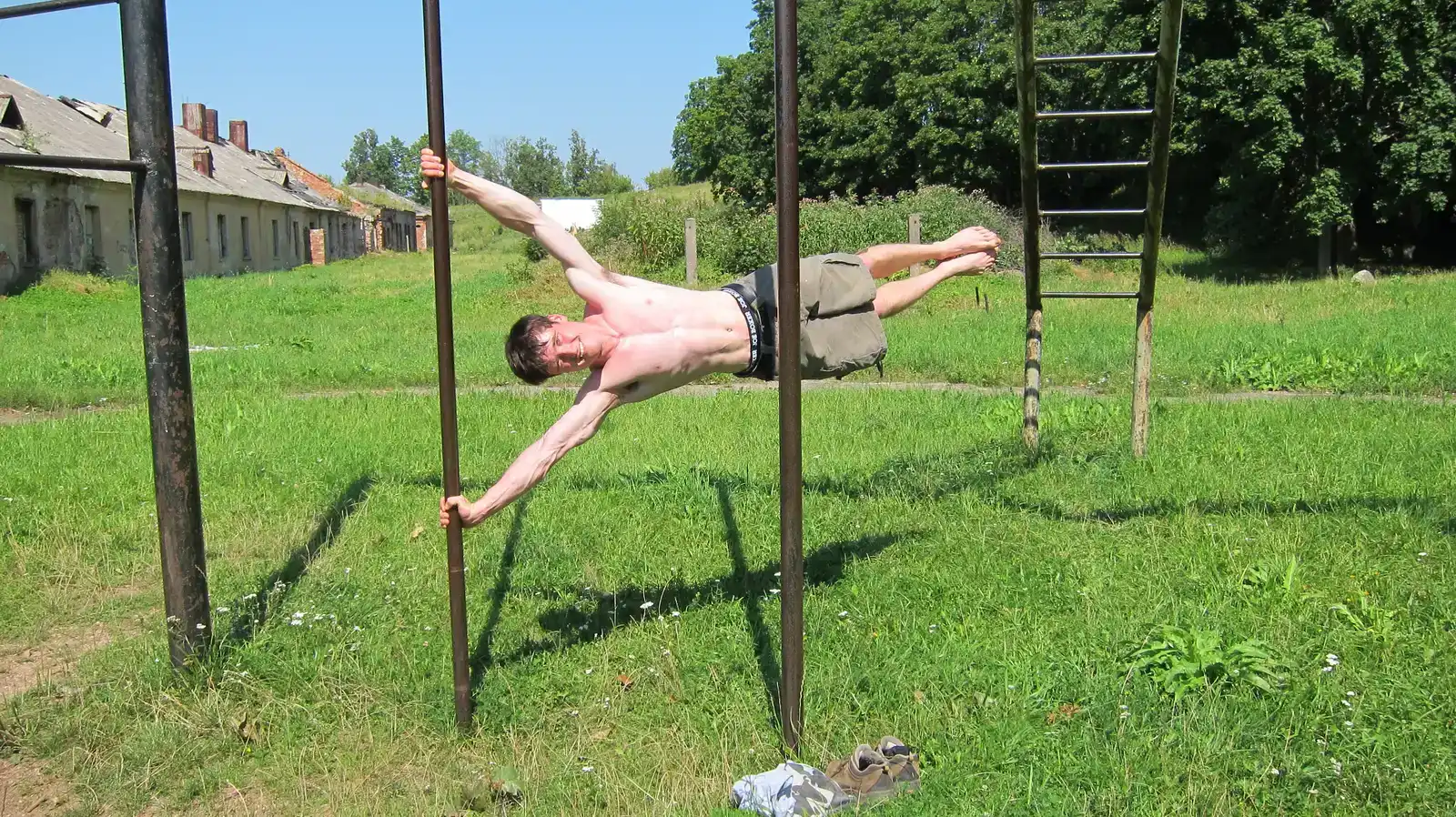
There are strength athletes and calisthenics enthusiasts who can hold their body in positions that seem to defy gravity itself. Think of a human flag, where someone grips a pole and holds their body straight out horizontally, or a planche, where a person supports their entire body on just their hands, parallel to the ground. These poses demand not just strong muscles, but an almost supernaturally stable core and shoulder structure that look impossible when you see them in real life.
What’s especially bizarre is how static holds can feel like a different universe compared with regular lifting. A person who can bench-press heavy weights might tremble trying to hold a perfectly straight plank for extended periods. Advanced practitioners show tendon and connective tissue adaptations that researchers are still working to fully understand. Watching someone hover above the ground, perfectly still, makes it feel as if they’ve hacked into the code of leverage and found a cheat that the rest of us missed.
Extreme Heat Tolerance and Fire Performers
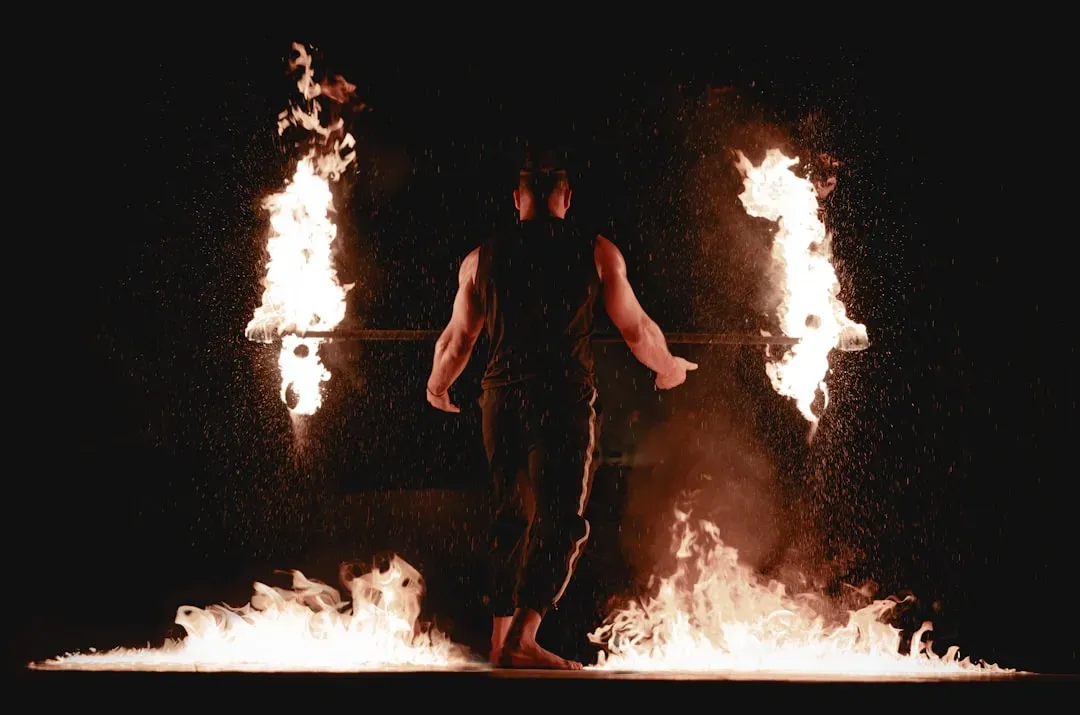
Fire breathers, fire walkers, and performers who handle burning objects seem to brush right up against the edge of what skin should be able to tolerate. Yes, there are tricks involved: understanding how quickly heat transfers, using brief contact times, and preparing the skin. Even with that knowledge, many of these stunts still rely on pushing human tissue very close to damage thresholds without quite crossing the line.
Some individuals appear to be naturally more tolerant of heat, reporting less discomfort and recovering faster from exposure that would leave others blistered. Pain perception, sweat rate, and skin thickness all play a role, but there’s still no simple formula that predicts who will thrive and who will burn. I’ve touched a hot pan for a second and spent the rest of the day annoyed at a tiny red mark, so watching someone calmly stroll across glowing coals feels almost like watching a magic trick. Except in this case, the “magic” is raw biology, timing, and nerves of steel.
Magnetic-Like Skin and Object-Sticking Oddities

Every so often, you’ll see videos of people sticking spoons, coins, or even heavier objects to their skin and claiming to be “magnetic.” Tests usually show there’s no real magnetism involved, yet the objects do cling in a way that looks hard to explain at first glance. Factors like slightly sticky or oily skin, flat object surfaces, and careful body positioning can create enough friction to keep items in place longer than you’d expect.
Still, a few cases have puzzled observers because the amount of weight or the angle of the objects seems difficult to achieve with simple stickiness alone. Some researchers suspect a mix of unusually smooth skin, a specific posture that maximizes contact, and perhaps subtle body hair differences. Most demonstrations fall apart when the skin is cleaned and talc is applied, which suggests there’s less mystery than initial appearances suggest. Yet the idea that someone can walk around with cutlery plastered to their chest without them falling off still feels oddly uncanny, like gravity is running at a slightly different setting in their personal space.
Human Calculators and Lightning-Fast Mental Math

There are people who can multiply huge numbers, extract roots, or tell you the day of the week for distant dates almost instantly, without a calculator. While this sounds purely mental, the speed and consistency of these performances hint at deep physical adaptation in the brain’s networks, kind of like muscle memory but for numbers. Many of these “human calculators” describe seeing patterns, shapes, or colors instead of raw digits, suggesting their brains are processing information in ways that feel alien to the rest of us.
Brain scans have found unusual activation patterns in regions responsible for numerical processing and working memory, but there is still no complete explanation for why a tiny minority can reach such extraordinary speed. Practice and training absolutely matter, yet even among people who train hard, only a few achieve truly breathtaking performance. Personally, I sometimes have to double-check a tip calculation on my phone, so hearing someone rattle off the answer to a complex problem in seconds is genuinely humbling. It blurs the line between a clever trick and a complete rewiring of how information flows through a human brain.
Insane Balance: Slackliners and Highline Walkers

Watching someone walk across a thin line stretched high above a canyon or between buildings can make your palms sweat even from the safety of your couch. These slackliners and highline walkers maintain stability on a moving, flexible line that reacts to every tiny shift in their weight. Their bodies make constant micro-adjustments through the ankles, hips, and core, guided by an exquisitely tuned sense of balance and spatial awareness.
Researchers studying balance and motor control have found that practice reshapes how the brain and muscles communicate, increasing efficiency and reaction speed. But the sheer level of control some of these athletes display, especially when they start adding tricks or sitting down and standing up mid-line, still feels unreal. Fear management is a massive part of it, too: staying calm while staring down a massive drop is its own kind of physical feat. It’s one thing to balance on a curb outside your house; it’s another to do the same thing when the ground below looks like a painting you might never reach if you slip.
When you line up these feats side by side, a strange picture emerges: we do not fully understand our own bodies. The same basic human design can produce ice bath fanatics, pain-free outliers, ultra-runners, and people who twist themselves into knots or walk calmly above endless drops. Sometimes there are genetic clues, sometimes careful training, and sometimes a chaotic blend of both that adds up to something that still feels slightly impossible.
The most unsettling and exciting part is the idea that these aren’t alien abilities, but extreme versions of capacities we might all share in softer, quieter forms. Maybe we’re all walking around with far more strength, endurance, and adaptability than we ever tap into in everyday life. Next time you feel certain you’ve hit your limit, it might be worth remembering these edge cases and wondering if that “limit” is more flexible than it seems. Which of these bizarre feats would you have believed in if you hadn’t just read about it?