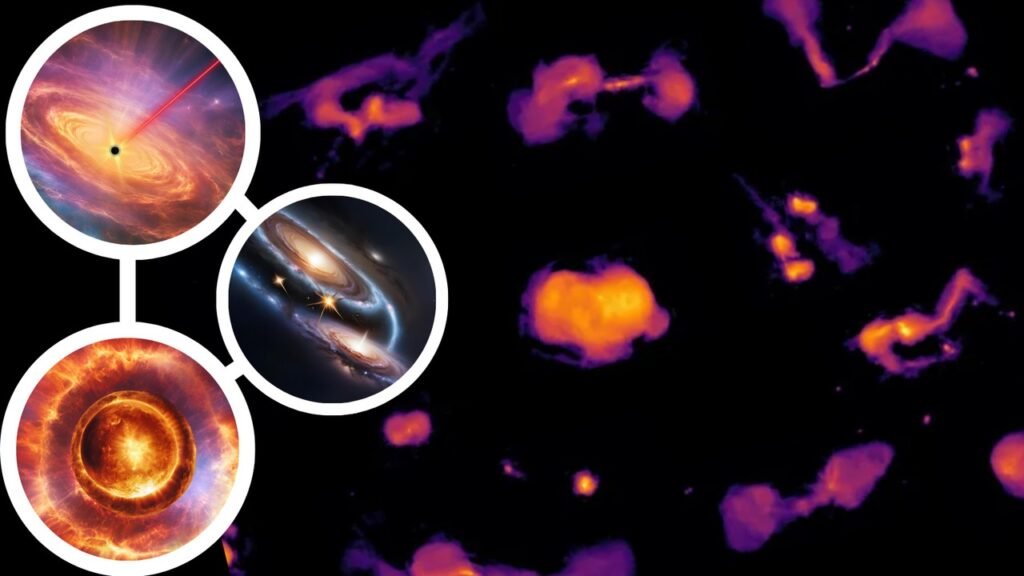
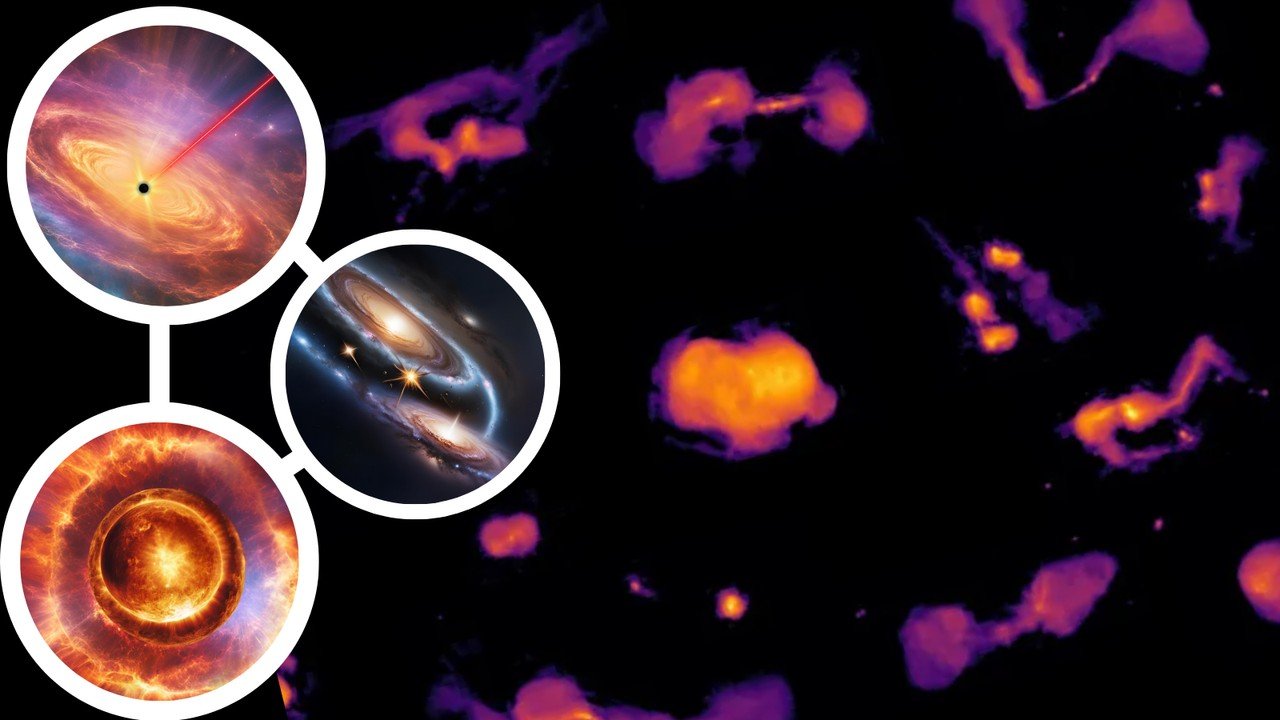
A New Era of Cosmic Exploration (Image Credits: Cdn.mos.cms.futurecdn.net)
An international team of astronomers released the most detailed radio map of the northern sky, capturing energetic phenomena from supermassive black holes to exploding stars across vast cosmic distances.
A New Era of Cosmic Exploration
Astronomers achieved a breakthrough with the LOFAR Two-metre Sky Survey’s third data release, known as LoTSS-DR3.[1][2] This effort cataloged 13,667,877 radio sources over 19,035 square degrees, covering 88 percent of the northern sky.[3]
The survey delivered the most comprehensive census to date of actively growing supermassive black holes, revealing their influence on galaxies and environments.[1] Lead author Timothy Shimwell of ASTRON and Leiden University noted, “This data release brings together more than a decade of observations, large-scale data processing and scientific analysis by an international research team.”[2]
The Power Behind LOFAR
LOFAR, or the Low Frequency Array, spans Europe with 38 stations in the Netherlands and 14 more across the continent, stretching nearly 2,000 kilometers between the farthest points.[1] This setup formed one of the world’s largest and most sensitive radio telescopes, operating at low frequencies between 120 and 168 MHz.
Researchers processed 18.6 petabytes of data from over 13,000 hours of observations, consuming more than 20 million core hours of computing power.[1] Advanced algorithms corrected for ionospheric distortions, yielding images with a median sensitivity of 92 microJansky per beam and resolutions around 6 arcseconds.[3]
Revealing the Universe’s Hidden Giants
The map exposed diverse systems powered by supermassive black holes, including radio jets and lobes extending millions of light-years.[1] It also uncovered rare features such as merging galaxy clusters, faint supernova remnants, and some of the largest known radio galaxies.
Other highlights included variable radio sources from flaring stars, previously unknown supernova remnants, and potential signals from exoplanet-host star interactions.[2] Prof. Martin Hardcastle of the University of Hertfordshire explained, “We can study a diverse population of supermassive black holes and their radio jets at different stages of their evolution.”[1]
- Actively growing supermassive black holes in millions of galaxies
- Merging clusters generating shocks and turbulence over vast scales
- Faint remnants of supernova explosions
- Twisted jets from black holes in galaxies like NGC 315 and NGC 383
- Diffuse radio rings tracing star formation in the Andromeda Galaxy
Overcoming Challenges for Scientific Gold
The project demanded innovative solutions to handle immense data volumes and atmospheric interference.[2] Teams from the Netherlands, Germany, France, the United Kingdom, Poland, Italy, Sweden, Ireland, Latvia, and Bulgaria collaborated under LOFAR-ERIC.
Results appeared in Astronomy & Astrophysics on February 19, 2026, with all data now publicly available for further research.[1]
| Survey Specs | Details |
|---|---|
| Sources Cataloged | 13.7 million |
| Sky Coverage | 88% northern sky |
| Resolution | ~6 arcseconds |
| Data Volume | 18.6 petabytes |
Key Takeaways:
- Most complete view of growing black holes ever assembled.
- Exposes rare transients and extended radio structures.
- Paves way for LOFAR2.0 upgrades and deeper cosmic insights.
This survey not only transforms our understanding of cosmic engines but also equips scientists for the next wave of discoveries with enhanced telescopes. What do you think about these revelations from the radio sky? Tell us in the comments.