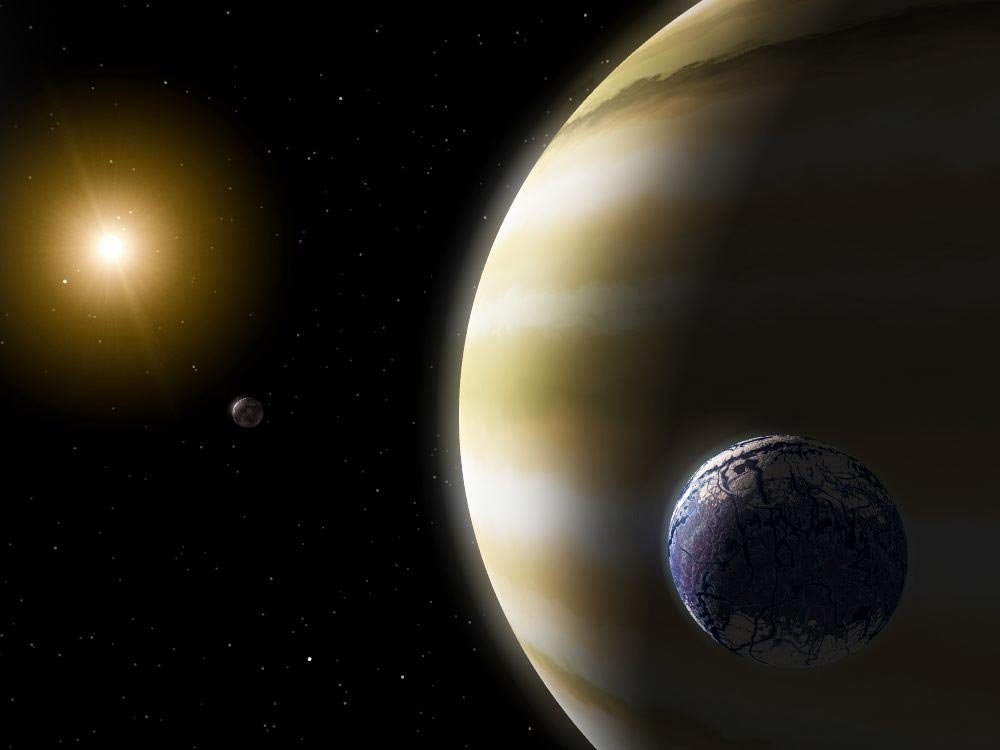
Moons Abound in Our Cosmic Backyard (Image Credits: Upload.wikimedia.org)
A new study outlines how reflections during lunar eclipses could enable telescopes to spot Earth-sized moons orbiting giant exoplanets light-years away.[1]
Moons Abound in Our Cosmic Backyard
Researchers have long marveled at the abundance of moons in our solar system. Nearly 900 such satellites circle various bodies, with more than 400 orbiting the eight planets and others accompanying dwarf planets, asteroids, and distant Trans-Neptunian Objects.[1]
Among these, a select few stand out for their potential to harbor life. Jupiter’s Europa and Ganymede, along with Saturn’s Titan and Enceladus, draw intense scrutiny from astrobiologists. These icy worlds, locked in orbit around gas giants, hint at subsurface oceans that might sustain microbial life. Such discoveries fuel speculation about similar setups beyond our system.
Exomoons: The Next Frontier
Astronomers have confirmed over 6,000 exoplanets, yet no exomoons have been verified. These elusive companions could orbit massive gas giants in habitable zones, potentially offering stable environments for life. Finding them would expand our understanding of planetary system diversity and open doors to new habitability prospects.
The challenge lies in detection. Traditional transit methods struggle with the faint signals from moons amid brighter planets. Direct imaging promises better odds, especially with upcoming observatories designed for reflected light observations.
Eclipse Reflections: A Breakthrough Technique
A team of U.S. and U.K. researchers, led by Mary Anne Limbach, devised a strategy centered on “lunar eclipses” in exosystems. When an Earth-like exomoon passes behind its host planet from our viewpoint, it can reflect starlight filtered through the planet’s reflected glow and its own atmosphere. This subtle flash becomes detectable during targeted observations.[1]
NASA’s Habitable Worlds Observatory (HWO), slated for launch around 2041, emerges as the ideal instrument. Computer simulations demonstrated that HWO could identify moons as small as 0.5 Earth radii around Jupiter-sized planets at 1 AU, even at distances up to 12 parsecs – or about 39 light-years.[1] The approach prioritizes systems with known habitable-zone giants, maximizing efficiency.
Testing the Limits Through Simulations
The study employed detailed models to mimic these events. Results showed high sensitivity for eclipse monitoring, though blind searches prove time-intensive. Dedicated campaigns on promising targets yield the best returns, particularly for smaller moons.
“Exomoons are a place where we should think ‘outside the box’ about what HWO can find,” the researchers emphasized. They recommended keeping habitable-zone giant planet hosts on observation lists and developing protocols for exomoon characterization.[1]
Promising Candidates Await Scrutiny
Several exomoon hopefuls already linger in data archives. The study revisited contenders like Kepler-1625b-i, Kepler-1708b-i, Kepler-90g, Kepler-80g, and WASP-49b. While 2023 analyses questioned some, a 2025 review left their existence plausible.[1]
- Kepler-1625b-i: Orbits a gas giant; debated but open case.
- Kepler-1708b-i: Similar profile; requires confirmation.
- Kepler-90g and Kepler-80g: Potential around smaller worlds.
- WASP-49b: Another gas giant satellite candidate.
These systems offer test beds for eclipse techniques as telescope capabilities advance.
Key Takeaways
- HWO could detect Earth-sized exomoons up to 12 parsecs away via eclipse reflections.
- Focus on habitable-zone giants boosts success rates.
- Simulations support moons down to 0.5 Earth radii.
Exomoons hold untapped potential to reshape our view of life-bearing worlds. As HWO prepares to scan the stars, eclipse observations could finally illuminate these shadowed realms. What role might alien moons play in the search for extraterrestrial life? Share your thoughts in the comments.