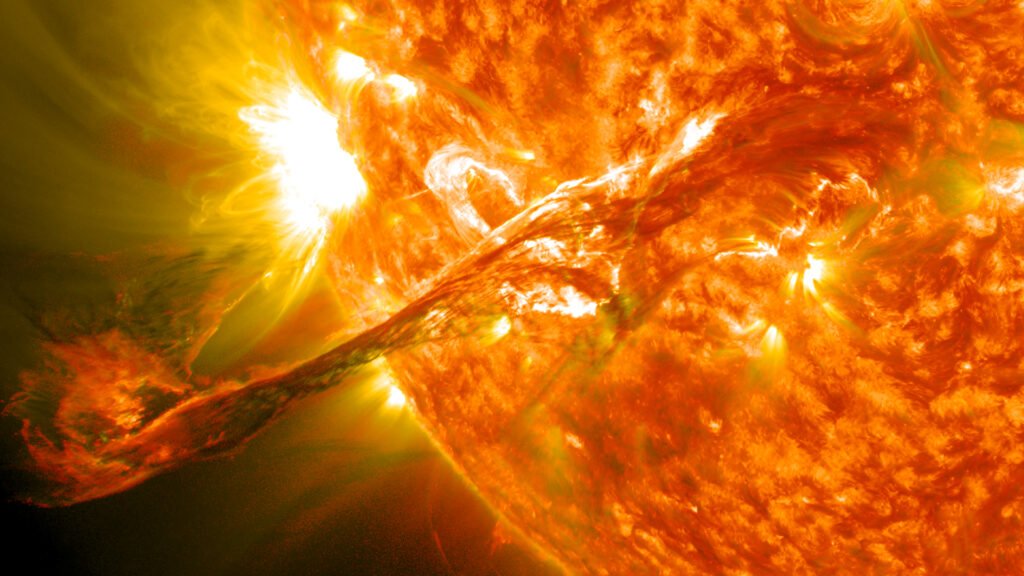
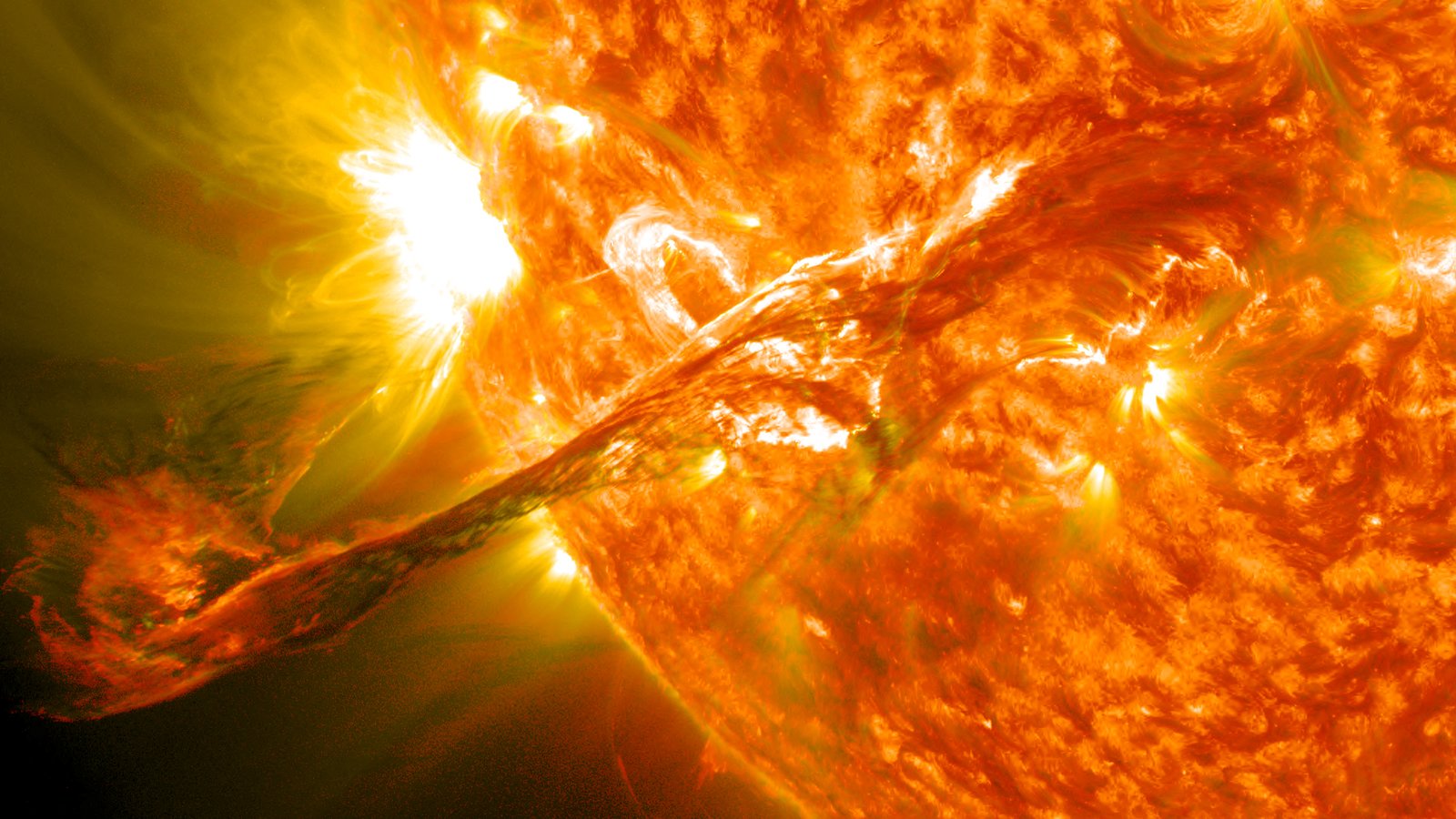
Electrostatic Forces Bridge Sky and Crust (Image Credits: Upload.wikimedia.org)
Researchers at Kyoto University introduced a theoretical framework suggesting solar activity could influence earthquake timing through ionospheric disturbances.
Electrostatic Forces Bridge Sky and Crust
A fractured zone in Earth’s crust acts like a capacitor in the new model, charged by high-temperature, high-pressure water laced with ions.[1][2] This setup couples capacitively with the ionosphere, forming a vast electrostatic system spanning atmosphere and lithosphere.
Solar flares boost electron density in the ionosphere, creating a negatively charged layer at lower altitudes. These charges induce powerful electric fields inside tiny voids within crustal fractures, generating pressures up to several megapascals – levels comparable to tidal stresses.[3] When a fault nears critical stress, this added electrostatic nudge could collapse voids and spark rupture.
Solar Disruptions Alter Atmospheric Charge
Intense solar events like flares send charged particles toward Earth, reshaping the ionosphere’s electron distribution. Total electron content can surge by 10 to 90 units, shifting negative space charges downward.[1]
The model describes a feedback loop: pre-quake crustal changes also produce ionospheric anomalies, such as elevated electron density or slowed traveling disturbances. Solar activity amplifies this interaction, potentially hastening failure in primed fault zones.[4]
Key elements of the capacitive coupling include:
- Crustal fractures trapping supercritical fluids as charge storage.
- Ionospheric electron shifts from solar particles.
- Induced fields penetrating nanometer-scale voids.
- Electrostatic pressures rivaling gravitational or tidal forces.
- Bidirectional signals between lithosphere and atmosphere.
Timing Matches Major Quakes
The 2024 Noto Peninsula earthquake in Japan followed closely after the year’s strongest solar flare on December 31, 2023. Another event in December 2025 came after an X-class flare, aligning with the model’s predictions.[5][2]
Authors Akira Mizuno, Minghui Kao, and Ken Umeno emphasized timing over energy. “We are not claiming that solar flares generate tectonic stress,” Umeno stated. “Our argument is about timing, not energy. When a fault is already close to failure, even a small perturbation may shift when rupture occurs.”[5]
Skeptics Highlight Model’s Limits
Critics noted the proposal’s speculative nature. Geophysicist Victor Novikov called the model greatly simplified, pointing to rock layers’ electrical resistance that might block fields from reaching faults.[2] The U.S. Geological Survey observed no matching 11-year cycle between solar activity and quakes.
Overlaps between common flares and tremors could stem from chance, experts argued. Observational data has not yet confirmed the mechanism, though the study calls for integrated monitoring of ionosphere and subsurface signals.[3]
Key Takeaways
- Solar flares enhance ionospheric negativity, inducing crustal pressures via capacitive coupling.
- Several MPa forces may tip critically stressed faults, as seen in 2024 and 2025 Japanese quakes.
- The bidirectional model suggests ionospheric monitoring could aid seismic preparedness.
This framework challenges traditional views of earthquakes as purely internal processes, urging interdisciplinary tests to probe sun-Earth-seismic ties. As solar maximum approaches, will space weather data refine hazard models? Share your thoughts in the comments.