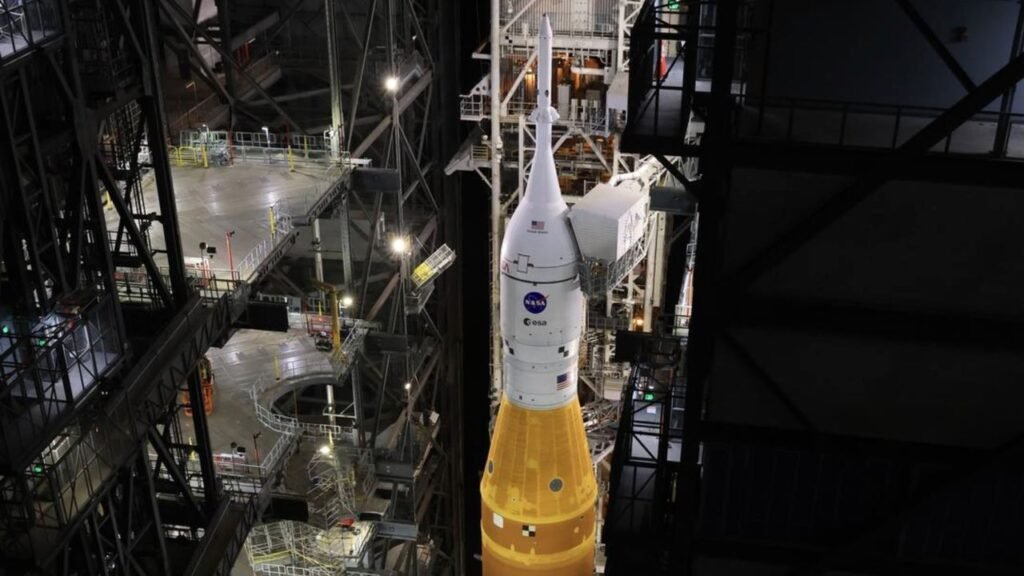

The Dramatic 10-Hour Journey Home (Image Credits: Cdn.mos.cms.futurecdn.net)
Kennedy Space Center, Florida – NASA engineers guided the towering Artemis II rocket stack back to the Vehicle Assembly Building on Tuesday after a helium flow interruption surfaced in its upper stage.[1][2]
The Dramatic 10-Hour Journey Home
A 322-foot-tall giant, weighing millions of pounds, does not move quickly. The Space Launch System rocket, topped with the Orion spacecraft and perched on its mobile launcher, inched along at about 1 mph aboard Crawler-Transporter 2. First motion came at 9:38 a.m. EST on February 25, following a “go” from the launch director just minutes earlier. The four-mile trek from Launch Pad 39B to the VAB’s High Bay 3 consumed 10.5 hours, culminating in arrival around 8 p.m. EST.[1][3]
This rollback marked a precautionary step to shield the hardware from coastal weather while enabling deeper diagnostics. Teams had already removed pad access platforms amid forecasts of high winds. Once secured inside the massive hangar, technicians erected service platforms for unfettered access to hard-to-reach components.[4]
Root of the Problem: Helium Glitch in the Upper Stage
The culprit emerged during routine post-test procedures. After a successful second wet dress rehearsal ended on February 19, operators detected no helium flow to the Interim Cryogenic Propulsion Stage during a purge and repressurization. Helium maintains engine environments and pressurizes liquid hydrogen and oxygen tanks in this critical upper stage.[5][3]
Engineers pinpointed potential sources: a ground-to-rocket line interface, an upper stage valve, or a filter in the umbilical. Backup methods kept the stage stable in the interim. NASA reviewed Artemis I data, where similar helium pressurization woes arose before the 2022 uncrewed launch but resolved without rollback. Corrective measures from that mission aimed to prevent repeats, though vigilance persists.[4]
- Helium’s roles: Propellant pressurization, tank purging, fire risk reduction.
- Pad limitation: No access to ICPS tanks or connections.
- VAB advantage: Full scaffolding for comprehensive checks.
Repair Roadmap and Path to Launch
Work inside the VAB focuses on swift resolution. Technicians will probe the helium system, swap limited-life batteries across the upper stage, core stage, solid rocket boosters, and flight termination system. These updates coincide with the anomaly fix to streamline preparations.[2][4]
The rollback eliminated any March liftoff possibility. NASA now eyes an early April window, opening April 1 with daily slots through April 6. A third wet dress rehearsal could follow repairs and a return to the pad. Program managers expressed confidence in preserving this timeline pending repair outcomes.[5][3]
High Stakes for Artemis II Crew
Four astronauts await this pivotal flight, the first crewed Artemis mission. Commander Reid Wiseman, Pilot Victor Glover, and Mission Specialists Christina Koch of NASA join Canadian Space Agency’s Jeremy Hansen. Their 10-day journey will loop around the Moon, testing Orion in deep space before splashdown.[5]
Such technical hurdles underscore the complexity of human spaceflight return. Yet NASA’s methodical approach prioritizes safety and reliability. The stack’s safe return positions teams for a methodical comeback.[1]
Key Takeaways
- Helium flow halt traced to ICPS; repairs only feasible in VAB.
- Rollback protects hardware, enables battery swaps.
- NET launch: April 1, 2026; March window closed.
Artemis II stands as a cornerstone for lunar exploration revival, proving Orion and SLS with humans aboard. As repairs progress, the focus sharpens on that April dawn launch. What impact will this delay have on the broader Artemis timeline? Share your thoughts in the comments.