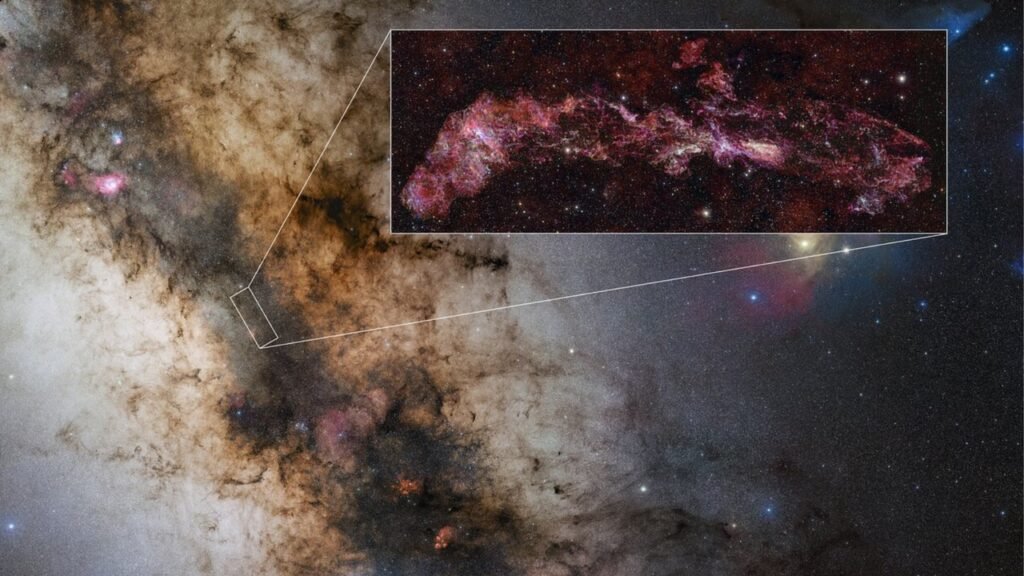
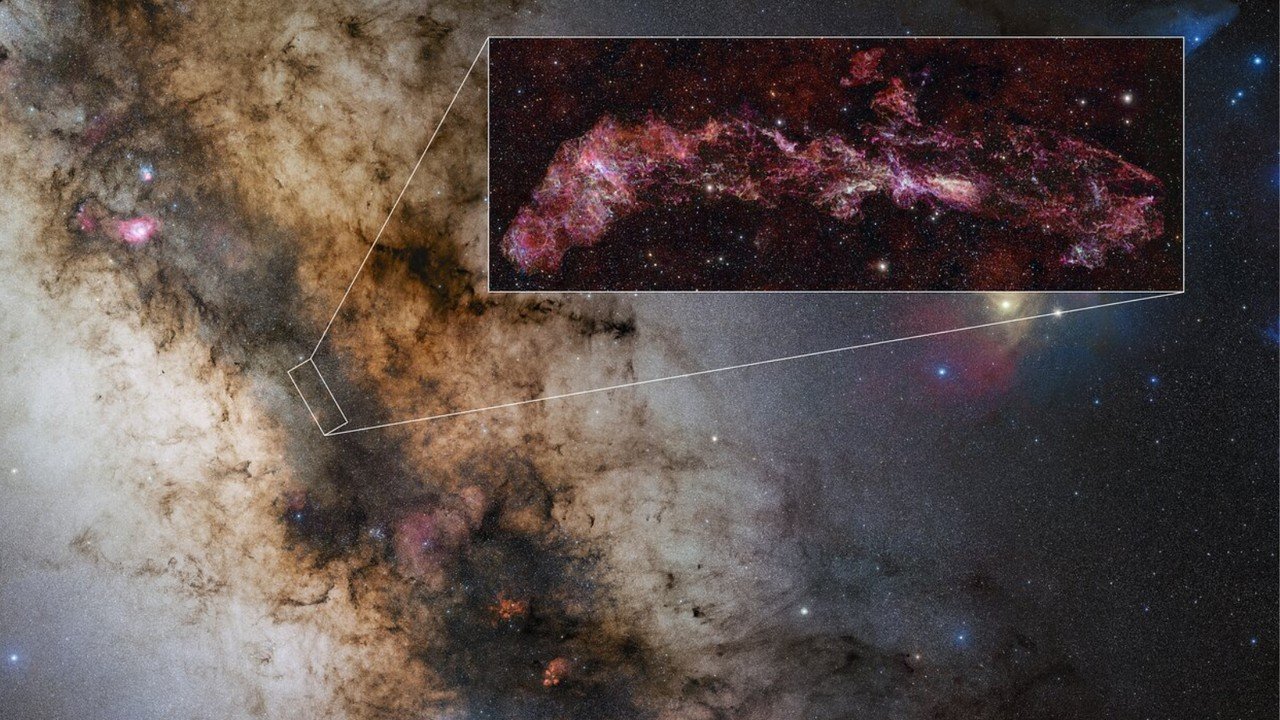
Unmatched Clarity in Galactic Chaos (Image Credits: Cdn.mos.cms.futurecdn.net)
Astronomers utilized the Atacama Large Millimeter/submillimeter Array to create the largest image ever of the Milky Way’s Central Molecular Zone, exposing a web of gas filaments and complex chemistry near the supermassive black hole Sagittarius A*.[1][2]
Unmatched Clarity in Galactic Chaos
The mosaic stunned researchers with its scope, covering over 650 light-years across the sky – roughly the width of three full moons placed side by side. This achievement came from the ALMA CMZ Exploration Survey, or ACES, which stitched together numerous individual observations into one vast dataset.[1]
Located in Chile’s Atacama Desert, ALMA’s 66 antennas peered into millimeter and submillimeter wavelengths to map cold molecular gas, the building blocks of stars. For the first time, scientists examined this entire region in such fine detail, from massive structures dozens of light-years wide down to tiny clouds encircling individual stars. The result revealed a far more intricate environment than anticipated.[3]
Katharina Immer, an ALMA astronomer, noted the surprise at the data’s richness. The survey’s findings appeared in five papers published in Monthly Notices of the Royal Astronomical Society, with a sixth forthcoming.[2]
Filaments Fueling Stellar Births
Cold gas streams along elaborate filaments in the CMZ, channeling material into dense clumps where new stars ignite. These flows differ sharply from calmer processes in the galaxy’s outer arms, amplified by the region’s intense gravity and radiation.[1]
The black hole’s influence creates supersonic gas rivers and colliding clouds, fostering a hotbed of activity. Massive stars dominate here, burning brightly before exploding as supernovae or even hypernovae. Such blasts reshape the gas, testing theories of star formation under duress.[3]
Steve Longmore, ACES leader and astrophysics professor at Liverpool John Moores University, highlighted the zone’s extreme stars: “The CMZ hosts some of the most massive stars known in our galaxy, many of which live fast and die young, ending their lives in powerful supernova explosions, and even hypernovae.”[1]
Unveiling a Molecular Menagerie
The observations detected dozens of molecules thriving amid the turmoil, painting a picture of vibrant chemistry invisible at other wavelengths. Simple compounds like silicon monoxide mingled with organics such as methanol, acetone, and ethanol.[2]
Other tracers included HNCO, HCO+, CS, SO, CH3CHO, and HC3N, each signaling distinct physical conditions like shocks from cloud collisions. This diversity underscores the CMZ’s role as a cosmic laboratory for extreme processes.
- Silicon monoxide: Indicates high-temperature shocks.
- Methanol: Precursor to more complex organics.
- Acetone and ethanol: Rare organics hinting at rich chemistry.
- HNCO and HCO+: Markers of dense, irradiated gas.
- CS and SO: Trace sulfur-bearing molecules in filaments.
Windows to Cosmic History
By decoding star birth in the CMZ, researchers gain clues to galactic evolution. Longmore explained that the zone mirrors early universe galaxies, where rapid star formation fueled chaotic growth: “By studying how stars are born in the CMZ, we can also gain a clearer picture of how galaxies grew and evolved.”[1]
Ashley Barnes of ESO described the site’s uniqueness: “It is the only galactic nucleus close enough to Earth for us to study in such fine detail.” Future upgrades to ALMA and the Extremely Large Telescope promise even sharper views of gas, stars, and black hole interactions.
Key Takeaways
- The ACES survey delivered ALMA’s largest mosaic, spanning 650 light-years of the CMZ.
- Filaments channel cold gas to star-forming sites amid supernova chaos.
- Dozens of molecules, from simple to organic, reveal hidden chemical processes.
This landmark dataset marks a pivotal step in unraveling our galaxy’s core mysteries, reminding us how nearby extremes echo the universe’s wild youth. What insights might future observations unlock next? Share your thoughts in the comments.