

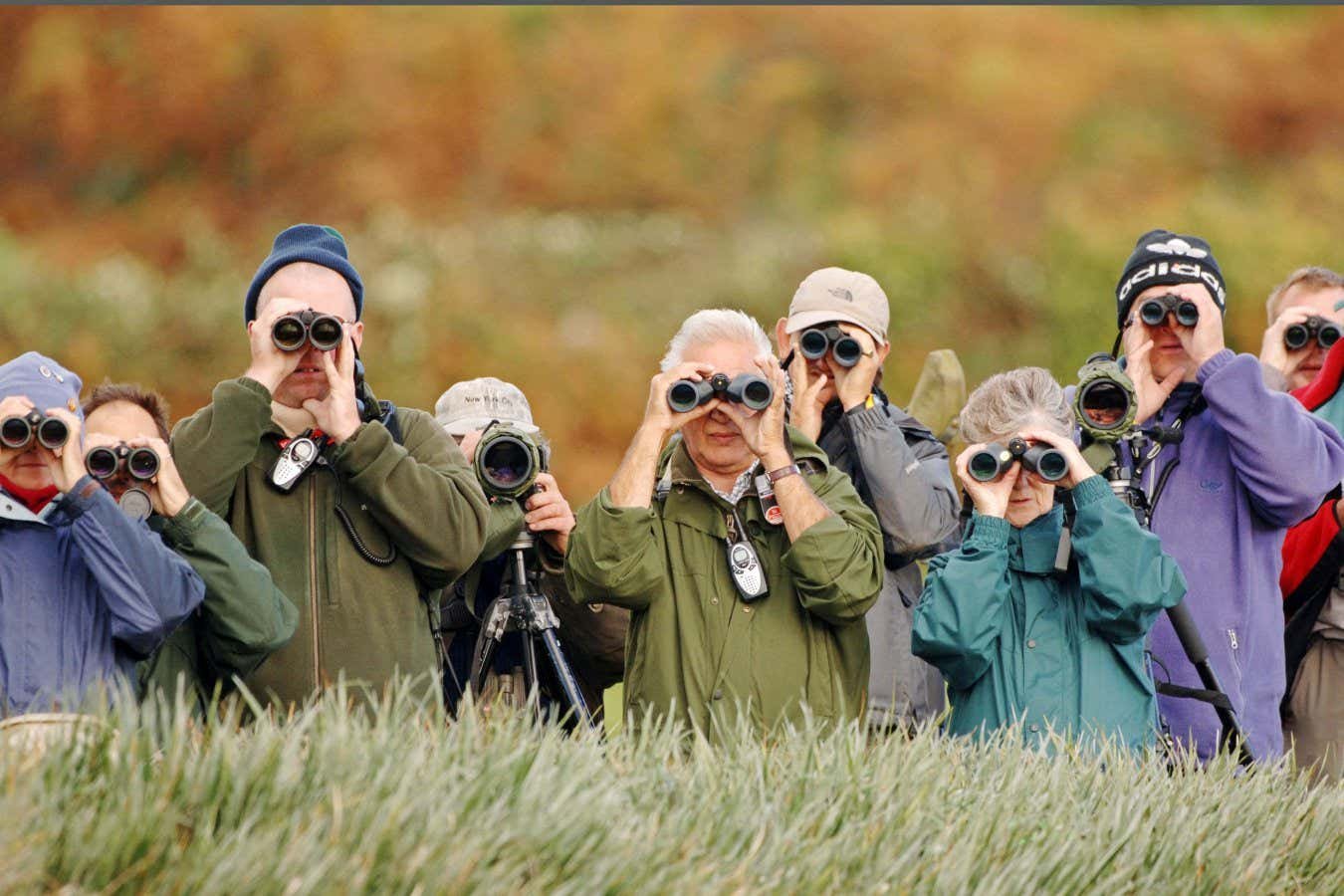
Compact Brain Tissue Fuels Expert Perception (Image Credits: Images.newscientist.com)
Researchers uncovered structural brain differences in seasoned birdwatchers that enhance their identification abilities and hint at safeguards against cognitive decline.[1][2]
Compact Brain Tissue Fuels Expert Perception
Expert birdwatchers demonstrated notably denser brain regions tied to attention and perception compared to novices. Scientists measured this through diffusion MRI, which revealed lower mean diffusivity in these areas – a sign of more organized and efficient neural tissue.[1] These changes correlated directly with superior performance in bird identification tasks.
The study involved 29 experts, aged 24 to 75, matched by age and sex with 29 beginners. Participants viewed images of local and unfamiliar bird species, then matched them from options. Experts achieved 83 percent accuracy on familiar birds and 61 percent on unfamiliar ones, far surpassing novices at around 44 percent for both.[3] Lead researcher Erik Wing explained, “The measure we used is the diffusion of water molecules in the brain. One way of putting it is that there’s more constraint on where water goes in the brains of experts.”[4]
Specific Regions Show Expertise-Driven Changes
Functional MRI scans highlighted heightened activity in experts during challenging identifications of non-local birds. Regions like the superior frontal gyrus and intraparietal sulcus lit up more prominently, supporting visual processing, attention, and working memory.[1]
Structural scans pinpointed several key areas with increased density:
- Frontoparietal network: Superior frontal gyrus (SFG), intraparietal sulcus (IPS).
- Posterior cortical zones: Angular gyrus (AG), precuneus, lateral occipital complex (LOC), fusiform gyrus.
These adaptations likely stem from years of honing skills in visual search, pattern detection, and species categorization. Wing noted that birding “combines fine-grain identification, visual search and attention to the immediate environment.”[2]
Enduring Benefits Into Older Age
Older experts maintained these neural advantages over age-matched novices, with less pronounced declines in tissue density. This persistence suggests birdwatching fosters cognitive reserve – the brain’s resilience to aging and damage.[1]
Behavioral tests further supported this: Older birders recalled arbitrary faces better when paired with birds, leveraging their domain knowledge. Such findings align with neuroplasticity seen in musicians or linguists, where sustained practice remodels the brain.[4] Wing added, “Acquiring skills from birding could be beneficial for cognition as people age.”[4]
Broader Lessons for Brain Health
The research, published in the Journal of Neuroscience, underscores how complex hobbies drive lasting neural changes. While causation requires longitudinal studies, the snapshot evidence points to protective effects against typical age-related thinning in key areas.[3]
| Group | Local Birds Accuracy | Non-Local Birds Accuracy |
|---|---|---|
| Experts | 83% | 61% |
| Novices | 44% | 44% |
Experts and novices shared similar education and lifestyles, isolating birding as the key factor.
Key Takeaways
- Expert birding compacts brain tissue for efficiency in perception and memory.
- These changes endure across the lifespan, buffering age-related decline.
- Complex perceptual hobbies may enhance overall cognitive reserve.
Birdwatching offers a compelling model for nurturing brain health through engaging, skill-building pursuits. Simple yet profound, it demonstrates the power of dedication to reshape neural architecture for long-term gains. What hobby might transform your brain? Share your thoughts in the comments.