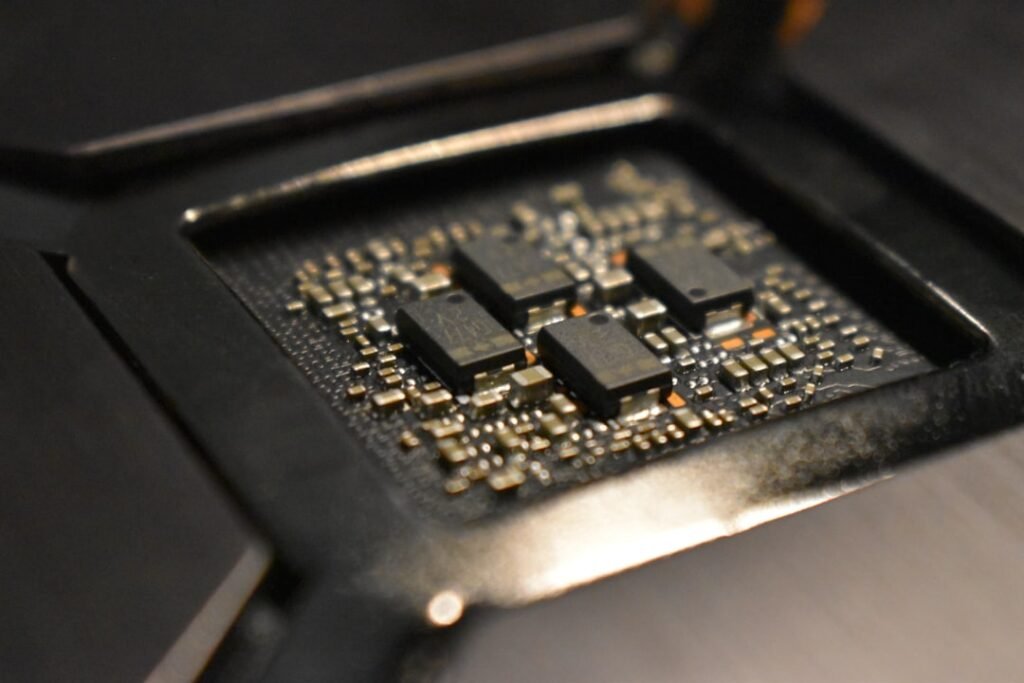
Superconducting Qubits Power Rapid Advances (Image Credits: Unsplash)
Quantum computing edges closer to transformative applications as competing hardware platforms demonstrate incremental progress toward error-corrected systems.
Superconducting Qubits Power Rapid Advances
Google’s 2019 demonstration of quantum supremacy highlighted superconducting circuits, which remain a frontrunner in the field.[1]
These systems employ tiny loops of superconducting material chilled to near absolute zero, where microwave pulses manipulate qubit states. Engineers draw on familiar semiconductor fabrication methods to integrate thousands of qubits on chips. Companies like IBM, Google, Rigetti Computing, IQM, and Oxford Quantum Circuits drive this approach forward.
Strengths include lightning-fast gate operations and potential for massive scaling through chip manufacturing. However, the need for dilution refrigerators poses logistical challenges, and coherence times suffer from environmental noise as qubit numbers grow. Processors now exceed 1,000 physical qubits, yet error rates keep most devices in the noisy intermediate-scale quantum, or NISQ, regime.[1]
Trapped Ions Offer Unmatched Stability
Charged atoms suspended in electromagnetic traps form the basis of ion-based quantum computers, prized for their longevity. Laser beams precisely control these qubits inside vacuum chambers.
IonQ, Quantinuum, and Alpine Quantum Technologies lead development here. The platform boasts long coherence times and inherent qubit uniformity, easing calibration efforts. No cryogenic cooling proves necessary, unlike superconducting rivals.
Gate speeds lag behind, and scaling ion chains introduces control complexities. Quantinuum recently showcased early fault-tolerant operations, such as logical qubit teleportation, signaling promise for complex algorithms.[1]
Photonics and Neutral Atoms Challenge the Status Quo
Photonic systems harness photons as qubits, routing them through beam splitters and phase shifters for computations at room temperature in some designs. PsiQuantum, Xanadu, Quandela, Orca Computing, and Quix Quantum advance this optical paradigm.
Ideal for quantum networks due to low-loss fiber transmission, photonics struggles with lossy detection and probabilistic gates that demand heavy error correction. Meanwhile, neutral atom arrays – trapped by laser tweezers – enable flexible qubit rearrangements without extreme cooling.
Atom Computing, Pasqal, Infleqtion, and QuEra Computing pioneer this method. Weak inter-atom interactions aid scaling, though gate operations remain deliberate. Both approaches sidestep some cryogenic demands but face hurdles in speed and fidelity.[1]
| Platform | Key Strength | Main Challenge |
|---|---|---|
| Superconducting | Fast gates | Cryogenic requirements |
| Trapped Ions | High fidelity | Slow scaling |
| Photonics | Network compatibility | Photon loss |
| Neutral Atoms | Array flexibility | Control precision |
Toward Fault Tolerance: Shared Hurdles and Horizons
Emerging modalities like quantum dots and topological qubits trail these leaders, while quantum annealers pursue optimization tasks outside universal gate models. QuantWare’s late-2025 10,000-qubit superconducting processor marked a scaling milestone.[1]
Industry voices underscore the field’s dynamism. “Each modality has its own strengths and weaknesses… We don’t have a favorite,” noted Michael Biercuk. Carl Dukatz added, “If we look at history, it tells us that there will generally be one that’s selected as the way, the preferred device, simply for the economies of scale.”[1]
Roadmaps from IBM, Google, and Quantinuum project accelerating timelines, though full fault tolerance eludes all platforms amid persistent error rates and overheads.
- Superconducting and ion systems dominate current deployments, with photonics and neutral atoms gaining traction for networking and scalability.
- NISQ limitations persist, but fault-tolerant demos hint at breakthroughs.
- Economies of scale may crown a single winner amid today’s diversity.
The quantum hardware race blends fierce competition with collaborative error-correction advances, poised to unlock unprecedented computational capabilities. Which platform holds the edge? Share your views in the comments.