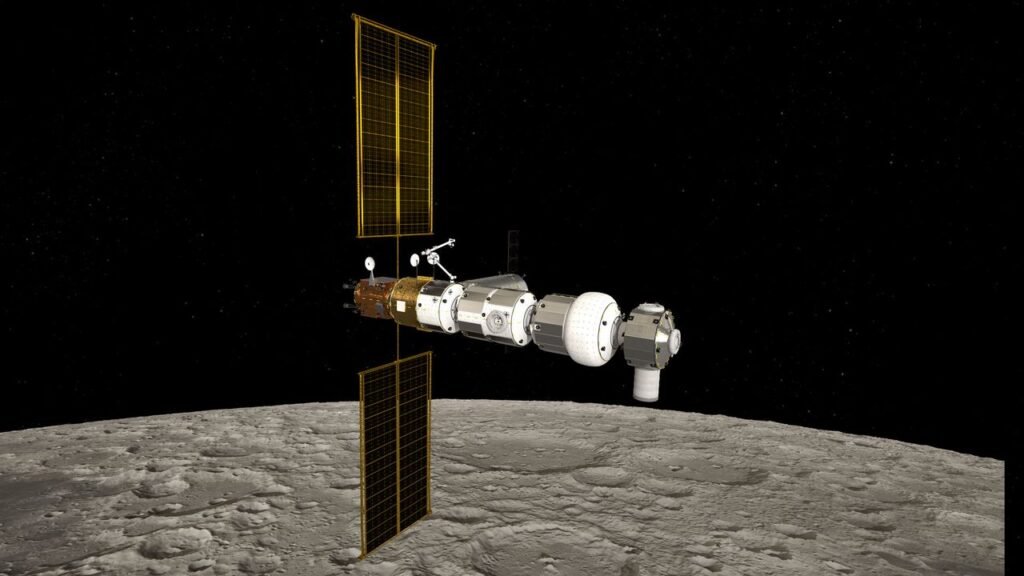
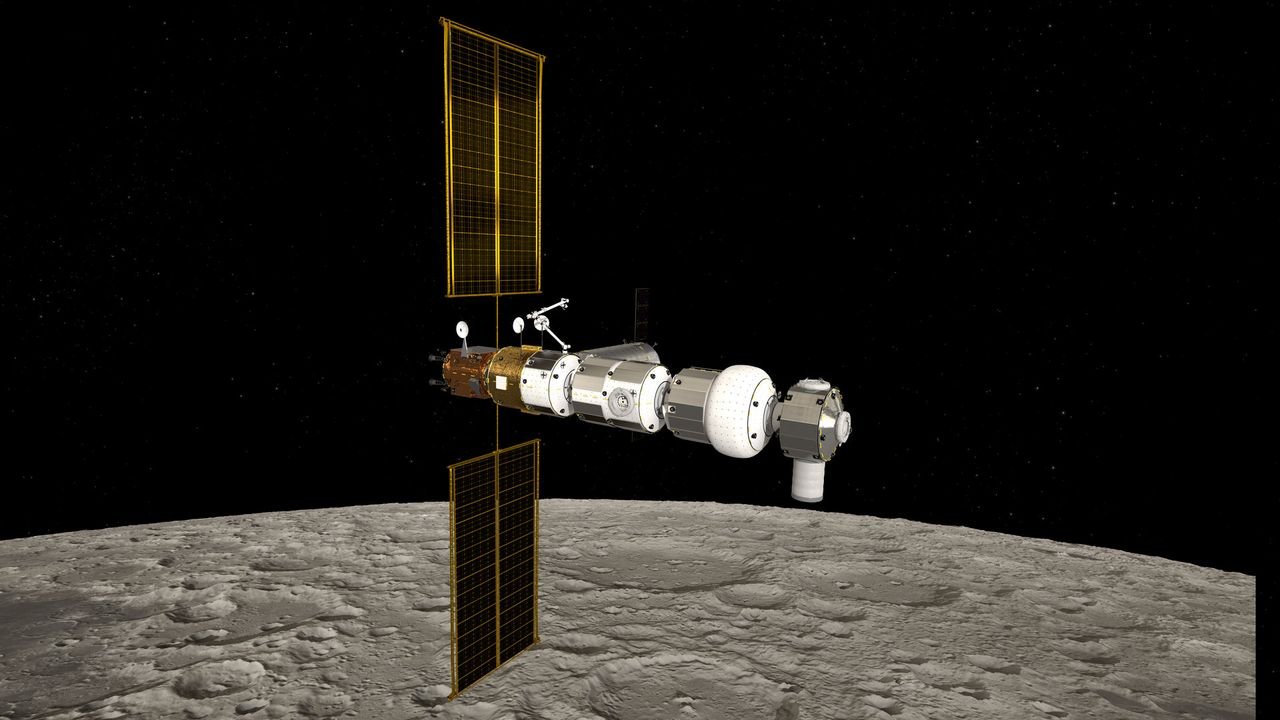
Serving as a Strategic Launchpad for Surface Operations (Image Credits: Cdn.mos.cms.futurecdn.net)
NASA’s ambitious Lunar Gateway project positions a compact space station in lunar orbit as a cornerstone of the Artemis program, fueling discussions on its role in future exploration.
Serving as a Strategic Launchpad for Surface Operations
The Gateway emerged as a key enabler for repeated lunar landings. Engineers designed it to dock with spacecraft like Orion and Starship Human Landing Systems, allowing crews to stage extended missions to the Moon’s south pole.[1][2]
Positioned in a near-rectilinear halo orbit, the station offers stable access to polar regions with minimal communication blackouts and low fuel needs for maintenance. Robotic arms like Canadarm3 will facilitate assembly, repairs, and rover teleoperation from orbit. This setup reduces risks associated with direct Earth-to-surface flights and supports logistics resupply via commercial carriers.
Unlocking New Frontiers in Deep-Space Science
Gateway transforms lunar orbit into a laboratory for experiments impossible on Earth. Instruments will monitor solar radiation, cosmic rays, and heliospheric phenomena, providing data on space weather impacts.[3]
Astronauts will conduct biology studies, test life support systems, and analyze lunar samples in real-time without immediate return to Earth. The station’s external ports host payloads for astrophysics and planetary science, advancing knowledge of deep-space environments.
- Radiation shielding trials for long-duration missions.
- Earth observation from cislunar space.
- Human health research in microgravity beyond low Earth orbit.
- ISRU technology demos using lunar resources.
Building Bridges Through International Collaboration
Partners from Canada, Europe, Japan, and the United Arab Emirates contribute critical modules, spreading costs and expertise. The European Space Agency supplies habitation and refueling elements, while Canada provides advanced robotics.[4]
Japan delivers life support systems, and the UAE builds the crew airlock. This coalition mirrors the International Space Station model, ensuring diverse input for sustainable operations over at least 15 years.
Navigating Costs, Delays, and Skeptical Voices
Critics question the station’s necessity amid ballooning expenses and technical setbacks. Reports highlighted mass overruns and integration challenges, prompting budget cut proposals in 2026 that Congress ultimately rejected.[2]
Some experts argued direct landers suffice for initial returns, viewing Gateway as added complexity without Apollo-era precedents. However, proponents countered that it enables reusable infrastructure and counters rivals like China’s lunar efforts.
| Pros | Cons |
|---|---|
| Enables sustained presence and science | High development costs |
| Reduces mission risks via staging | Launch delays to 2027+ |
| Fosters global partnerships | Debate on orbital vs. surface bases |
Paving the Path to Mars Exploration
Beyond the Moon, Gateway tests technologies for Mars transit, including propulsion and habitation in deep space. Crews will validate systems during 30-to-60-day stays, informing future deep-space vehicles.
Recent milestones included the Habitation and Logistics Outpost’s arrival in the U.S. in early 2026 and power system activations, signaling progress toward a 2027 launch.[1]
Key Takeaways
- Gateway supports Artemis landings and deep-space science through its unique orbit and modules.
- International modules enhance capabilities while sharing burdens.
- Despite criticisms, it positions humanity for Mars by proving long-term orbital living.
The Lunar Gateway represents a bold investment in humanity’s cosmic future, balancing innovation against fiscal realities. As assembly ramps up, its success could redefine lunar strategy. What do you think about investing in a moon-orbiting station? Tell us in the comments.