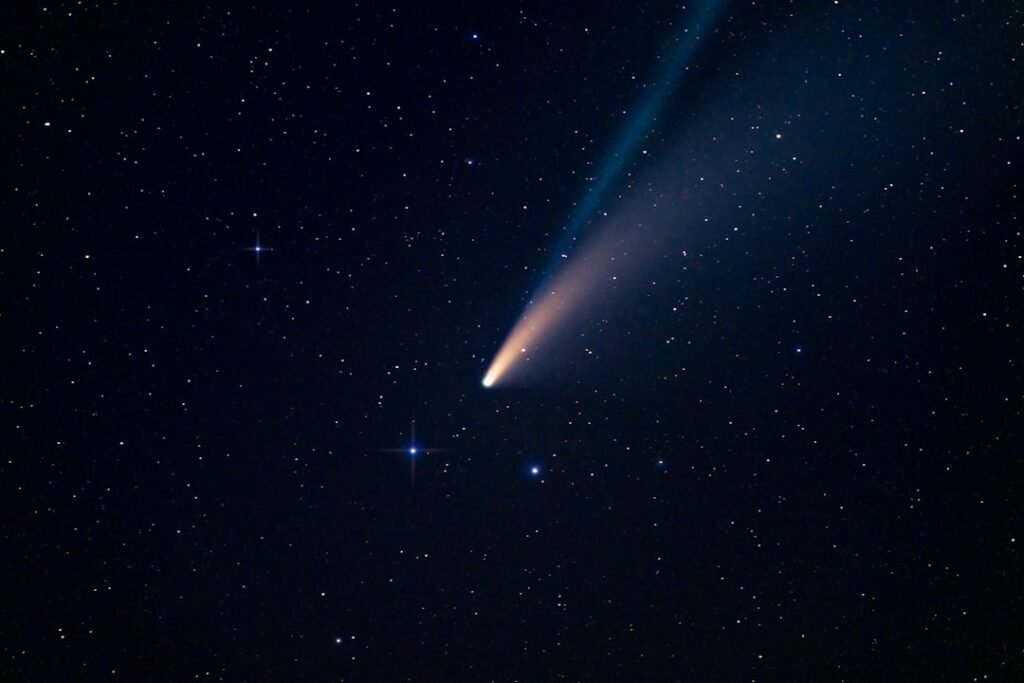
The Fury of the Fastest Comet (Image Credits: Unsplash)
Interstellar comet 3I/ATLAS races outbound through the solar system after its perihelion passage late last year, prompting scientists to devise innovative strategies for a future chase.[1][2]
The Fury of the Fastest Comet
Discovered on July 1, 2025, by the ATLAS survey in Chile, 3I/ATLAS stands as the third confirmed interstellar object to visit our solar system.[1] This comet hurtled inbound at speeds exceeding 60 kilometers per second, marking it as the quickest ever observed.[1]
Its hyperbolic orbit, with an eccentricity of about 6.14, confirmed origins beyond our stellar neighborhood. The nucleus measures less than 1 kilometer across, shrouded in a CO₂-dominated coma rich in water ice, carbon monoxide, and trace elements like nickel.[1] Perihelion occurred on October 29, 2025, at 1.36 AU from the Sun – farther out than Earth’s orbit. As of February 2026, it fades to magnitude 16 while approaching Jupiter on March 16 at roughly 0.36 AU.[1]
Catching a Cosmic Fugitive
3I/ATLAS’s blistering exit velocity – 58 km/s hyperbolic excess – poses a formidable barrier to interception. Direct missions from Earth demand over 24 km/s delta-V, beyond current capabilities for timely launches.[2] Earlier proposals targeted flybys with assets like Mars orbiters or Juno near Jupiter, requiring modest propellant but limited by fuel constraints.[3]
Researchers from the Initiative for Interstellar Studies now propose a dedicated probe launched in 2035. This timeline leverages optimal planetary alignments for efficiency. The 50-year journey would culminate in a flyby, yielding pristine data on extrasolar materials.[2]
- High outbound speed rules out propulsion matching post-discovery.
- Past windows for loitering interceptors like ESA’s Comet Interceptor closed too soon.
- Juno could divert with 3 km/s delta-V for a distant Jupiter rendezvous, but fuel scarcity hampers execution.[3]
- Solar Oberth offers the delta-V edge without exotic tech.
Mastering the Solar Oberth Effect
The core innovation draws on the Oberth effect: thrusting deepest in a gravity well extracts maximum kinetic energy. Here, a spacecraft dives toward solar perihelion, firing engines amid the corona’s intense plasma.[2]
Optimum Interplanetary Trajectory Software simulations chart the path, incorporating gravitational assists from Earth and Jupiter. Lead designer noted the 2035 window minimizes launch demands and flight time. “Alignments of the celestial bodies… are the most propitious,” one expert explained.[2]
This indirect routing contrasts quicker but unfeasible direct transfers. Proven in concepts like Project Lyra for ‘Oumuamua, it promises feasible pursuit with off-the-shelf propulsion.[2]
Navigating Extreme Perils
Plunging into the solar corona exacts steep tolls. Temperatures soar beyond 1 million degrees Kelvin, radiation fries electronics, and solar wind buffets structures. No probe has ignited engines so perilously close before.
Yet precedents like Parker Solar Probe’s sun-skimming orbits inform shielding strategies. The payoff? Unmatched velocity to overhaul 3I/ATLAS, probing its composition for clues to alien world-building.[1]
| Close Approaches | Date | Distance (AU) |
|---|---|---|
| Mars | Oct 3, 2025 | 0.194 |
| Venus | Nov 3, 2025 | 0.649 |
| Earth | Dec 19, 2025 | 1.80 |
| Jupiter | Mar 16, 2026 | 0.358 |
Unlocking Interstellar Secrets
This gambit underscores humanity’s drive to grasp fleeting cosmic messengers. Success could reveal formation processes in distant systems, sans millennia-long treks to exoplanets.
Pursuing 3I/ATLAS tests engineering limits and expands our cosmic purview. What do you think about this daring solar dive? Tell us in the comments.