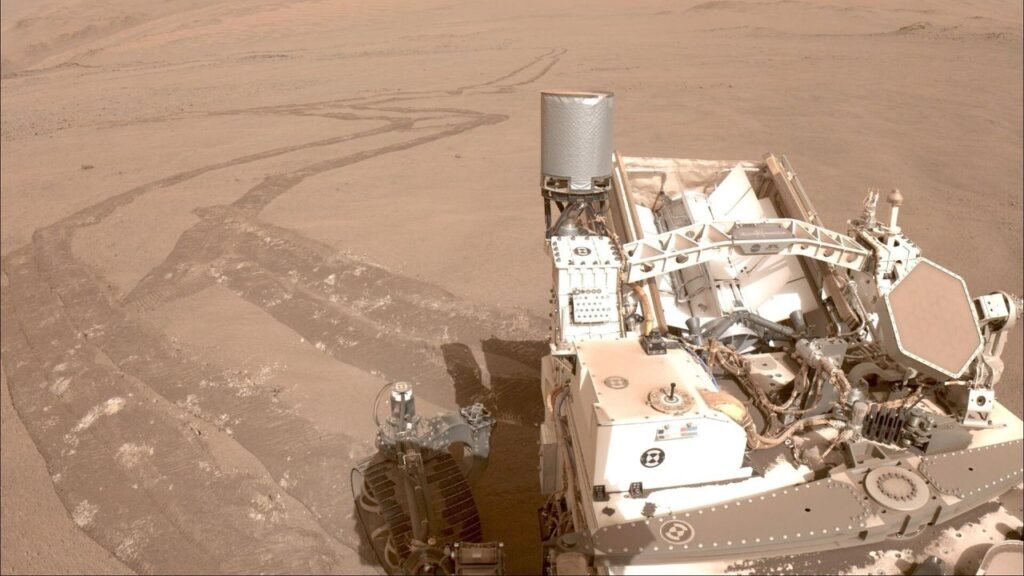
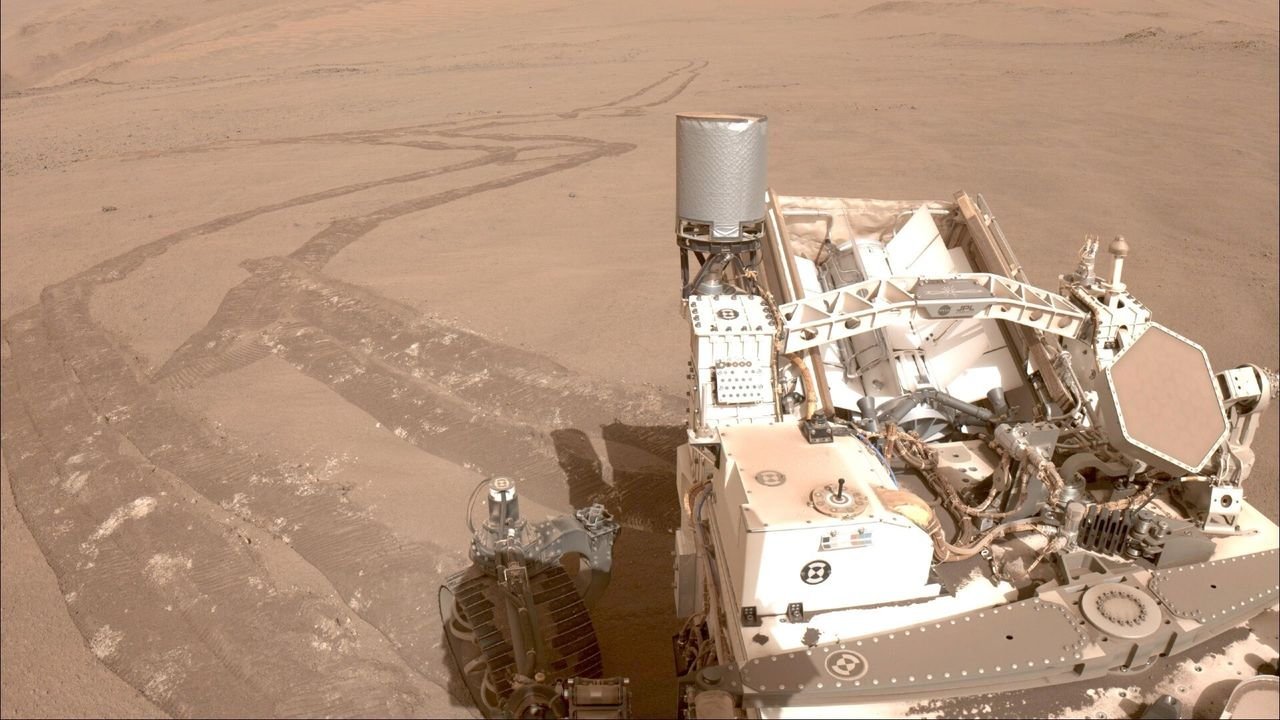
A Leap Forward in Rover Independence (Image Credits: Cdn.mos.cms.futurecdn.net)
Mars – NASA’s Perseverance rover has gained the power to locate itself accurately without signals from Earth, marking a significant advance in planetary robotics.[1][2]
A Leap Forward in Rover Independence
Engineers at NASA’s Jet Propulsion Laboratory introduced Mars Global Localization, a system that lets the rover match its own images against orbital maps stored onboard. This capability debuted in routine operations on February 2 and 16, 2026, after rigorous testing.[1]
Previously confined by growing position errors, Perseverance now resolves uncertainties in minutes. The upgrade repurposed a high-speed processor from the former Ingenuity helicopter base station, accelerating computations over 100 times faster than the rover’s primary systems.[3]
“We’ve given the rover a new ability,” said Jeremy Nash, the JPL robotics engineer who led the algorithm development. “This has been an open problem in robotics research for decades, and it’s been super exciting to deploy this solution in space for the first time.”[1]
Decoding the Technology’s Core Mechanics
The system captures 360-degree panoramic images from the rover’s navigation cameras and converts them into orthomosaics. An algorithm then compares these to high-resolution maps from the Mars Reconnaissance Orbiter’s HiRISE instrument.[2]
Processing takes about two minutes and delivers pinpoint accuracy within 10 inches, or 25 centimeters. A built-in verification runs the match multiple times and cross-checks with onboard computers for reliability.[1]
Tests across 264 prior rover stops yielded perfect results, confirming the method’s robustness across diverse terrains.[3]
Surpassing Traditional Navigation Hurdles
Earlier methods relied on visual odometry, which tracked wheel movements and features but accumulated errors up to 100 feet over long drives. Mission teams manually aligned rover panoramas with orbital images, often waiting a full Martian day for communication round-trips.[2]
Perseverance frequently paused near hazards, awaiting Earth confirmation to proceed safely. The new localization eliminates these bottlenecks, enabling seamless continuation.[1]
| Aspect | Previous Approach | Mars Global Localization |
|---|---|---|
| Accuracy | Up to 100 feet uncertainty | 10 inches precision |
| Processing | Earth-dependent, 1+ day delay | Onboard, 2 minutes |
| Drive Limits | Capped by error buildup | Potentially unlimited autonomy |
Amplifying Scientific Returns
Vandi Verma, JPL’s chief engineer for robotics operations, highlighted the impact: “This is kind of like giving the rover GPS. Now it can determine its own location on Mars. It means the rover will be able to drive for much longer distances autonomously, so we’ll explore more of the planet and get more science.”[3]
The tool complements recent AI-driven route planning, demonstrated in Jezero Crater last December. Together, they promise extended treks and richer data collection.[2]
- Reduces daily human oversight, freeing teams for analysis.
- Supports faster traversal of rugged landscapes.
- Adaptable for future lunar or distant-world rovers.
- Enhances hazard avoidance with reliable positioning.
- Maximizes battery use for science over navigation waits.
Key Takeaways:
- Mars Global Localization achieves 25 cm accuracy in two minutes.[1]
- Deploys Ingenuity’s spare processor for speed.
- Paves way for boundless autonomous Mars drives.
This innovation transforms Perseverance from a cautious traveler into a bold explorer, potentially redefining how robots chart alien worlds. As the rover presses deeper into Jezero Crater, its self-assured navigation heralds efficient, expansive discovery. What do you think this means for future Mars missions? Tell us in the comments.