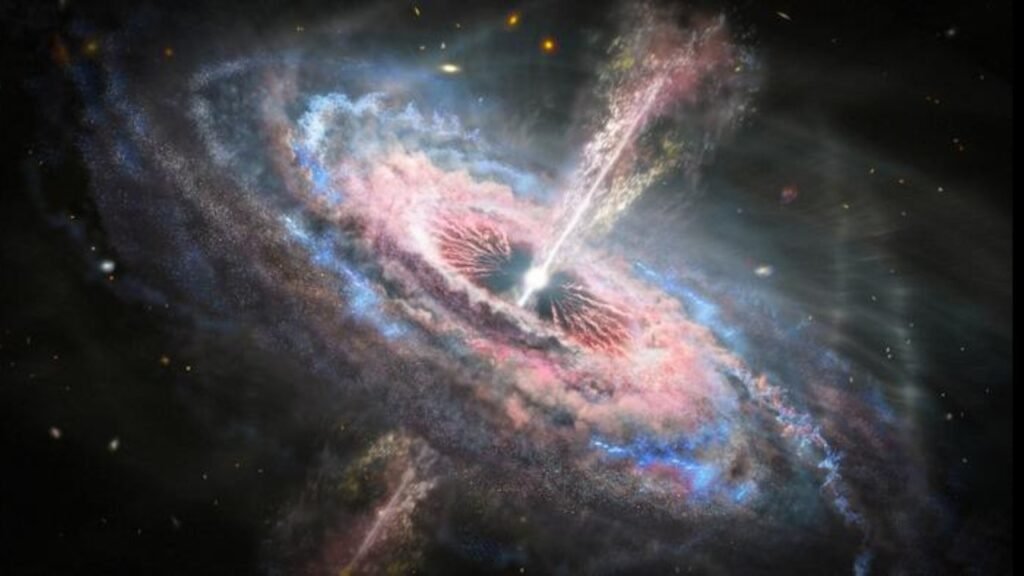
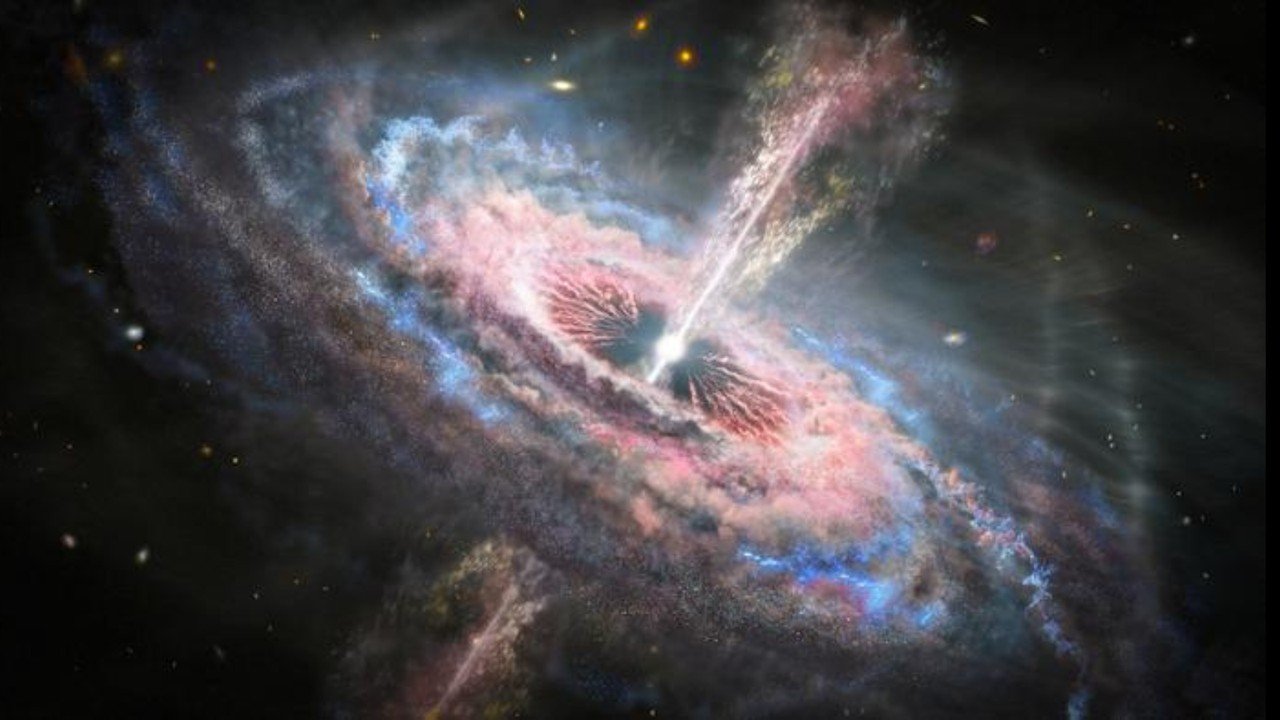
Early Universe Mystery Unraveled by JWST (Image Credits: Cdn.mos.cms.futurecdn.net)
Powerful radiation from active supermassive black holes reaches far beyond their host galaxies, quenching the birth of new stars in neighboring systems during the universe’s infancy.
Early Universe Mystery Unraveled by JWST
Initial James Webb Space Telescope observations puzzled astronomers. Brilliant quasars in the young universe appeared isolated, surrounded by fewer galaxies than models predicted.[1][2] Researchers initially wondered if the telescope had malfunctioned. Instead, they realized nearby galaxies existed but showed signs of suppressed recent star formation.
The team focused on quasar J0100+2802, observed at redshift z=6.3, roughly 900 million years after the Big Bang. This hyperluminous object, powered by a black hole 12 billion times the sun’s mass, outshone the Milky Way’s stars by 40,000 times.[3] Lead author Yongda Zhu, a postdoctoral researcher at the University of Arizona, described the finding as evidence of intergalactic influence.
Radiative Feedback: The Mechanism at Work
Active supermassive black holes enter a quasar phase when feeding on gas and dust. Swirling accretion disks superheat material, unleashing intense ultraviolet radiation.[1] This energy floods surrounding space, ionizing hydrogen and photodissociating molecular hydrogen in distant gas clouds.
Stars form when cold molecular hydrogen collapses under gravity. Quasar radiation disrupts this process by heating gas and preventing cloud accumulation. The effect extends at least one million light-years, turning potential stellar nurseries barren.[2]
- Ionization of intergalactic hydrogen alters gas conditions.
- Photodissociation of H2 halts cloud collapse.
- Suppressed nebular emissions signal reduced young star activity.
- UV continuum from older stars remains detectable.
- No reliance on jets; radiation alone suffices.
Key Evidence from JWST Spectra
NIRCam imaging and NIRSpec spectroscopy targeted J0100+2802 and its environs. Galaxies within one million light-years showed weaker [O III] λ5008 emission relative to ultraviolet continuum light.[1] This line traces ionization by hot, young stars in active regions.
Distant galaxies displayed normal ratios, confirming proximity to the quasar as the factor. The study, published in The Astrophysical Journal Letters, provides the first observational proof of quasar feedback on intergalactic scales.[3]
“An active supermassive black hole is like a hungry predator dominating the ecosystem,” Zhu stated. “It swallows up matter and influences how stars in nearby galaxies grow.”[2]
Implications for Galaxy Evolution
Galaxies evolve less independently than once believed. Quasars reshape entire neighborhoods, explaining the scarcity of companions around early-universe beacons.
This “galaxy ecosystem” suggests supermassive black holes played outsized roles in cosmic structure formation. Our Milky Way’s dormant Sagittarius A* may have once wielded similar power locally.[3] Future JWST surveys of other quasars will test the phenomenon’s prevalence.
Key Takeaways
- Quasar radiation suppresses star formation up to one million light-years away.
- [O III] emission drops near active black holes, signaling quenched youth.
- Early galaxies formed in interconnected groups influenced by cosmic predators.
Supermassive black holes emerge not just as galactic anchors but as far-reaching regulators of stellar birth. This discovery reframes the early universe as a dynamic web of interactions. What role might such predators play in our cosmic neighborhood today? Share your thoughts in the comments.