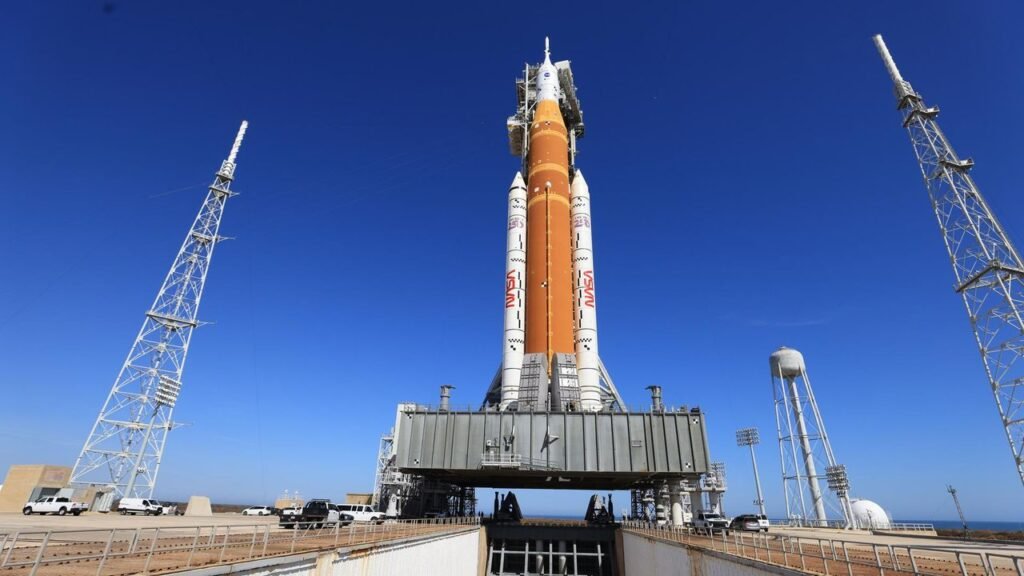
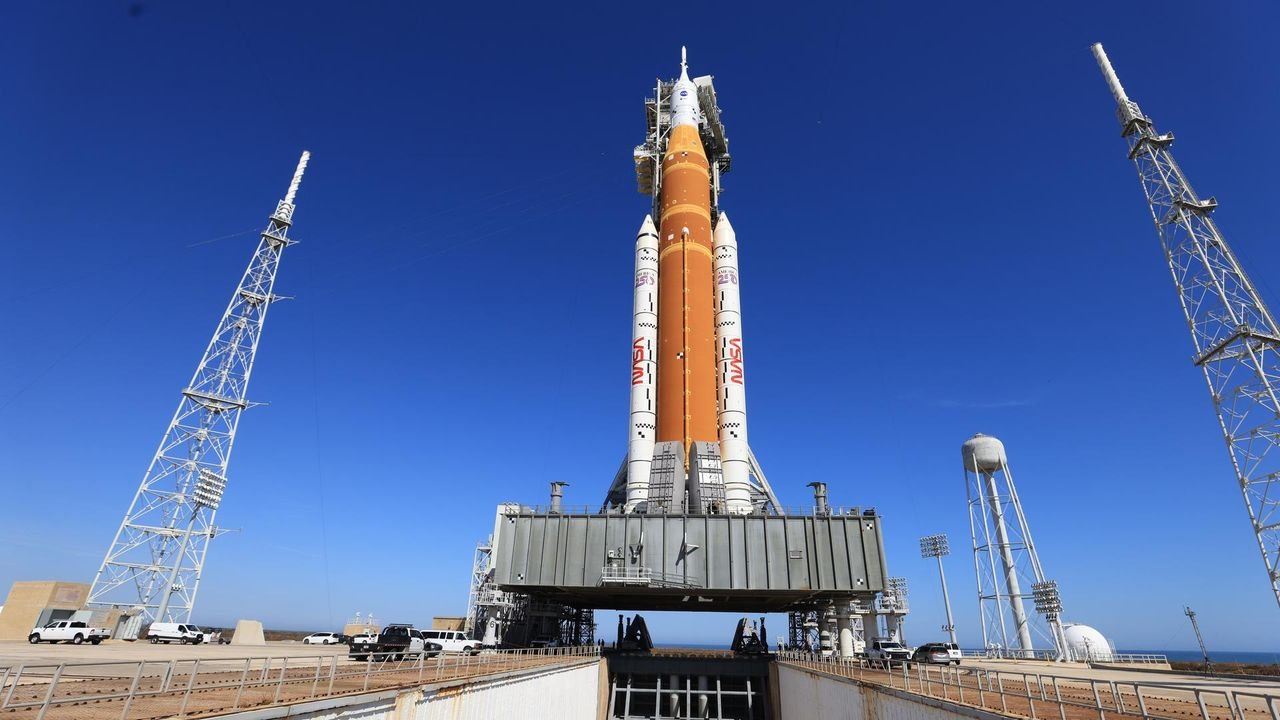
Second Wet Dress Rehearsal Delivers Results (Image Credits: Cdn.mos.cms.futurecdn.net)
Kennedy Space Center, Florida — NASA officials outlined a potential March 6 launch date for the Artemis 2 mission following a successful fueling test of the Space Launch System rocket.[1]
Second Wet Dress Rehearsal Delivers Results
Engineers completed the second wet dress rehearsal over two days ending February 19. The test involved loading more than 730,000 gallons of cryogenic liquid hydrogen and liquid oxygen into the rocket’s core stage and upper stage tanks. Leak rates remained minimal, peaking at 1.6 percent and dropping to 0.4 percent during fast-fill operations for liquid hydrogen.[2]
Teams also demonstrated closing the Orion spacecraft hatches and ran two terminal countdown sequences to within 29 seconds of liftoff. Artemis 2 Launch Director Charlie Blackwell-Thompson noted the performance stood out. “It really performed well,” he said. The exercise checked major prelaunch operations and built confidence in the hardware.[1]
Lessons from the First Test Overcome
The initial wet dress rehearsal on February 2 ended early due to a liquid hydrogen leak at the tail service mast umbilical interface. Engineers identified the issue stemmed from seals and replaced two of them at the pad. A confidence test on February 12 confirmed the fix before proceeding to the full rehearsal.[1]
Similar leaks delayed Artemis 1 in 2022, but seal changes there resolved the problem without rollback. This time, concentrations stayed well below limits. Blackwell-Thompson called the low 0.4 percent leak rate during fast fill “almost unheard of.” The improvements highlighted refinements in procedures and equipment handling.[2]
Artemis 2: Returning Humans to Deep Space
The mission marks the first crewed flight beyond low Earth orbit since Apollo 17 in 1972. Four astronauts will undertake a 10-day journey around the moon, covering about 600,000 miles without landing. NASA astronauts Reid Wiseman, Victor Glover, and Christina Koch join Canadian Space Agency astronaut Jeremy Hansen.[3]
Three crew members observed the test firsthand. The flight tests Orion’s systems in space ahead of future lunar landings. Launch Complex 39B serves as the pad for this SLS-Orion stack, standing over 320 feet tall.
- Loaded 730,000 gallons of propellants without major issues.
- Achieved low hydrogen leak rates under 1.6 percent.
- Completed hatch closeouts and dual countdown runs.
- Validated seal replacements from prior test.
- Positioned rocket for post-test pad operations.
Steps Remaining Before Liftoff
Officials emphasized work ahead despite the positive outcome. Teams must analyze data, install contingency access trusses on the mobile launch tower, and test the flight termination system. A flight readiness review follows late next week.[4]
The crew entered quarantine at Johnson Space Center on February 20, preparing for the March window spanning March 6 through 10. Backup dates include early April. Lori Glaze, acting associate administrator for exploration systems, captured the momentum. “This is really getting real, and it’s time to get serious and start getting excited,” she said.[1]
John Honeycutt, chair of the Artemis 2 Mission Management Team, described the test as an outstanding day that earned the team’s right to proceed.
Key Takeaways
- Second fueling test succeeded where the first faltered, minimizing leaks.
- March 6 emerges as earliest opportunity pending reviews.
- Crew quarantine signals commitment to the timeline.
Success in this rehearsal revives hopes for a steady Artemis cadence. The mission stands as a crucial step toward sustained lunar presence. What are your thoughts on the Artemis 2 timeline? Share in the comments.