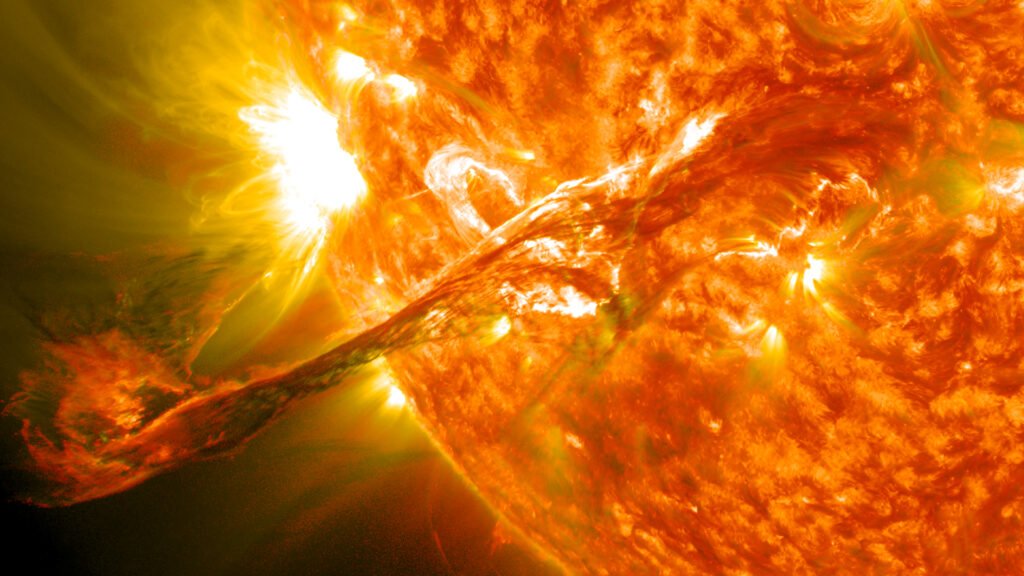
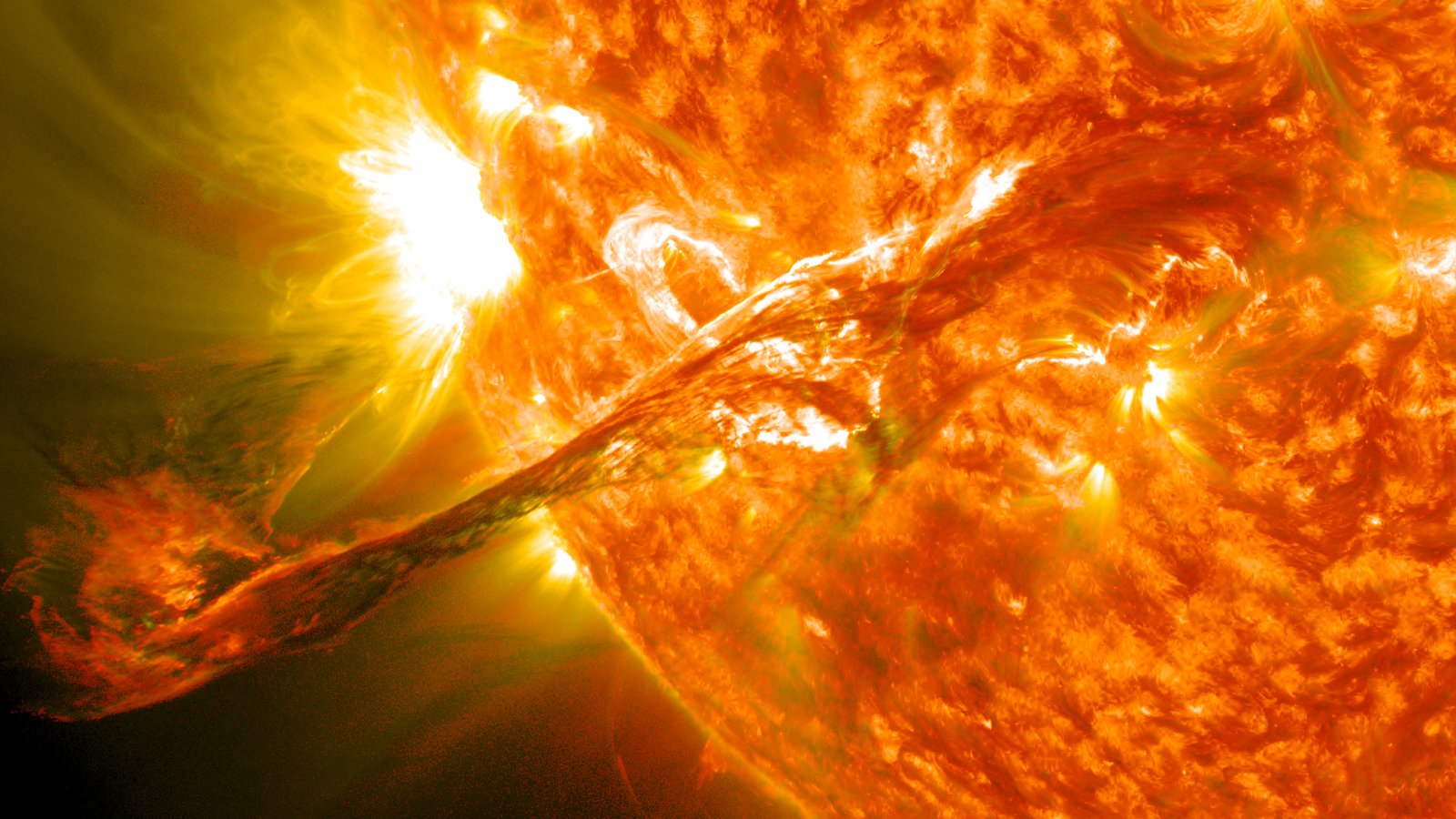
A Hidden Solar Spectacle Unfolds (Image Credits: Upload.wikimedia.org)
A powerful solar prominence surged from the Sun’s southwest limb on February 19, 2026, ejecting material into space while low-level activity hinted at possible northern lights displays.[1]
A Hidden Solar Spectacle Unfolds
Solar telescopes captured a massive blast originating on the Sun’s far side. The event featured a prominent eruption that rose above the southwest horizon, flinging ejecta outward. No corresponding flare appeared on the Earth-facing disk, confirming the activity’s remote location.[1]
Specialists pinpointed the blast near the former active region AR4371. Observations from NOAA’s GOES-19 SUVI instrument in the 304 angstrom channel highlighted the chromosphere and cool plasma in the rising structure. This far-side position meant minimal direct threat to Earth, yet the scale impressed researchers.
Tracking the Resulting CME
The eruption generated a coronal mass ejection first visible in the LASCO C2 coronagraph at 4:36 UTC on February 18. Imagery showed the CME expanding from the southwest, billowing into the outer corona. Analysts determined its trajectory avoided a direct hit on our planet.[1]
Separately, a filament eruption from February 16 produced a CME expected for a glancing blow around February 19. Experts continued assessing a northeast limb event from 18:30 UTC on February 18 to check for any Earth-bound components. Such dynamics underscored the Sun’s complex behavior during this period.
Recent Solar Activity Overview
Solar conditions stayed low over the past 24 hours through February 19. Four minor flares occurred: two C-class and two B-class events. The strongest reached C2.2 intensity from an incoming active region in the southeast at 20:42 UTC on February 18.[1]
Three numbered sunspot regions appeared on the visible side. Solar wind speeds ranged low to moderate, with the interplanetary magnetic field showing mostly southward Bz orientation. Earth’s magnetic field remained quiet to unsettled, registering Kp indices of 2 to 3.
- C2.2 flare: Southeast region, 20:42 UTC February 18
- Two additional C-class flares
- Two B-class flares
- Three Earth-facing active regions
Outlook for Auroras and Space Weather
A large coronal hole aligned toward Earth by February 20, set to stream fast solar wind that could rattle our magnetosphere. This development, combined with occasional southward Bz turns, raised prospects for auroral activity in coming days. Forecasts predicted quiet-to-active geomagnetic conditions on February 19, with isolated G1 storms possible from prior CMEs.[1]
Flare risks stayed low through February 20, at 10% for M-class and 1% for X-class. Conditions improved to mostly quiet by February 21. Recent precedents, like G2 storming on February 17, had already sparked auroras as far south as New York and Wisconsin.
Key Takeaways
- A far-side prominence eruption hurled ejecta but posed no Earth threat.
- Glancing CME effects and coronal hole winds boost aurora potential.
- Solar activity remains low, with monitored minor flares and regions.
Solar monitoring reveals the Sun’s far-side power even when hidden from direct view, reminding us of its influence on Earth. As fast winds approach, skywatchers should prepare for possible lights – what do you think about these solar surprises? Tell us in the comments.