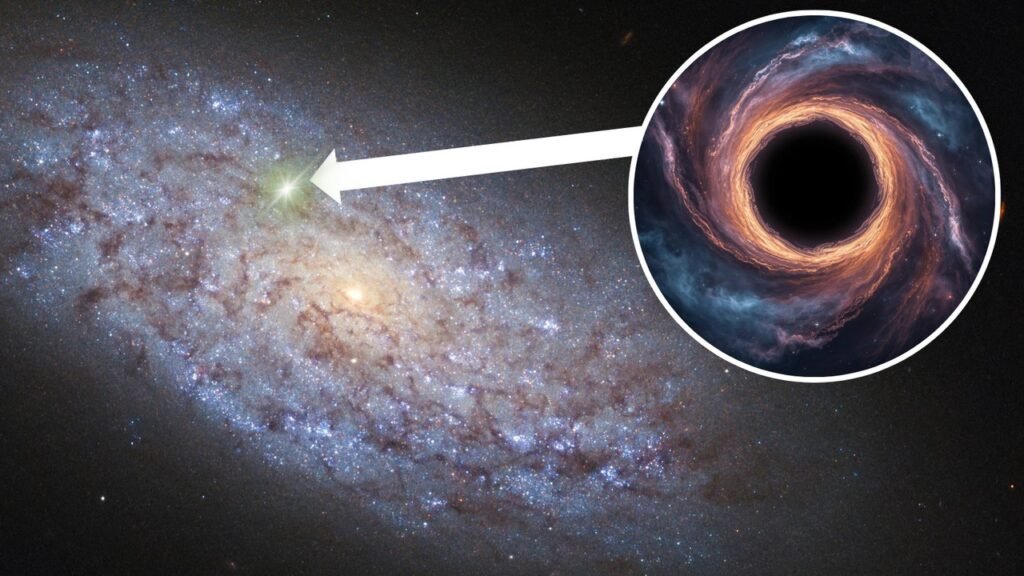
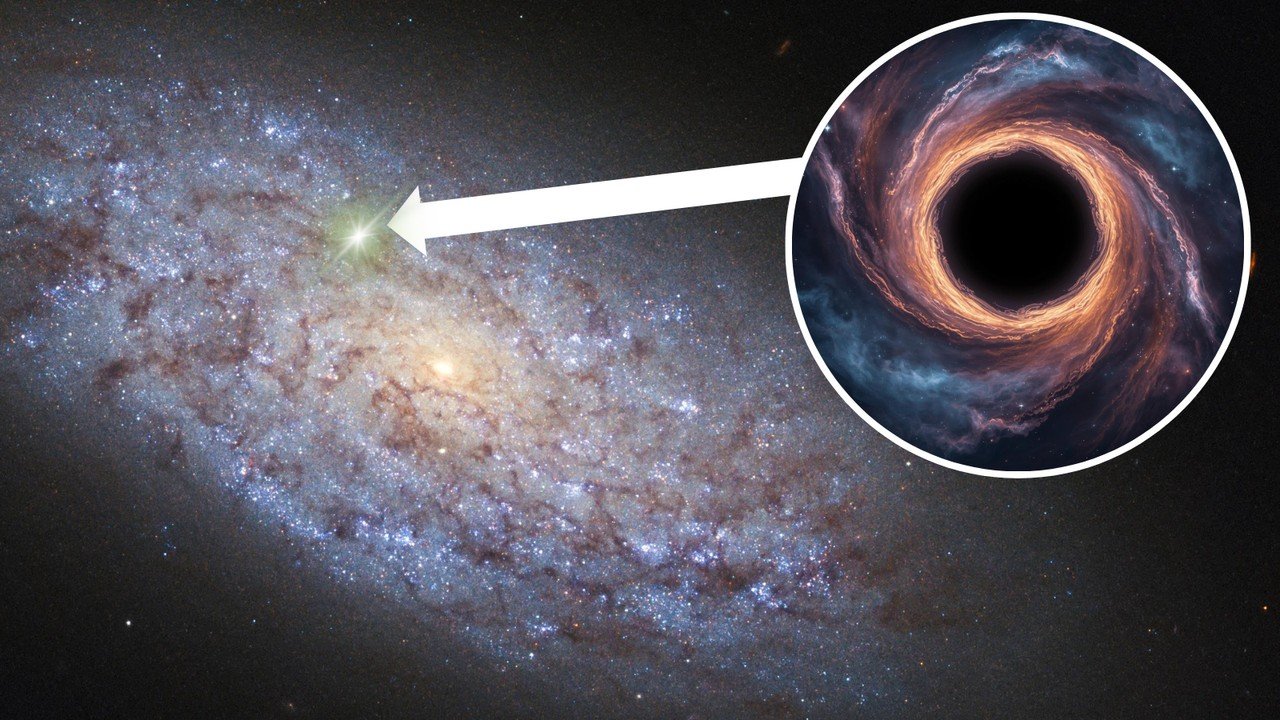
Dwarf Galaxies as Windows to the Past (Image Credits: Cdn.mos.cms.futurecdn.net)
Astronomers utilized NASA’s Hubble Space Telescope and Chandra X-ray Observatory to investigate rogue black holes drifting through dwarf galaxies, seeking insights into supermassive black hole evolution from the universe’s early days.[1][2]
Dwarf Galaxies as Windows to the Past
Dwarf galaxies offer a pristine view of black hole development because they experienced fewer mergers than larger galaxies like the Milky Way. These smaller systems preserve traces of early supermassive black holes, which may have served as seeds for galactic formation.[1]
Simulations indicated that up to half of central black holes in dwarf galaxies could be offset from the core, either due to mergers that displace them or formation processes that place them off-center from the start. Researchers targeted such wandering black holes to test these models and refine theories on black hole growth.[1]
The relative stability of dwarf galaxies makes them ideal laboratories. Unlike massive galaxies, which obscure their histories through repeated collisions, dwarfs retain a clearer record of primordial conditions.[3]
Multi-Wavelength Search Strategy
A team led by Megan R. Sturm from Montana State University examined 12 dwarf galaxies selected from a prior study by Reines et al. in 2020. These candidates featured radio emissions detected by the Very Large Array, suggestive of accreting black holes, though some signals mimicked star formation.[2][1]
Chandra provided X-ray data with exposures ranging from 3.8 to 20.8 kiloseconds, while Hubble captured optical images using the Wide Field Camera 3 in filters like F475W and H-alpha. The approach combined radio, X-ray, and optical observations to distinguish true active galactic nuclei from imposters.[3]
Eight of the 12 radio sources were non-nuclear, positioning them as prime wandering black hole suspects. Additional Palomar spectroscopy helped verify redshifts for potential contaminants.[2]
Confirmed Finds and Notable Imposters
Five radio sources showed detections in both X-ray and optical wavelengths within positional limits. Among these, three displayed multi-wavelength signatures of nuclear massive black holes: ID 26 shone brightly across radio, X-ray, and optical; ID 82 appeared prominent in X-rays despite obscuration, supported by coronal lines; and ID 83 excelled in X-rays with compatible optical traits.[3][1]
- ID 26: Bright in all three wavelengths, strong AGN evidence.
- ID 82: X-ray dominant, obscured accretion confirmed.
- ID 83: High X-ray luminosity, optical consistent with black hole.
- ID 92: Matched an extreme compact starburst, not AGN.
- ID 64: Off-nuclear optical source revealed as background galaxy at higher redshift.
The remaining seven off-nuclear sources lacked X-ray or optical counterparts. Three with extreme offsets featured compact radio cores from Very Long Baseline Array data, aligning with background active galactic nuclei rather than dwarfs.[2]
Unresolved Mysteries and Next Steps
Hubble’s sensitivity ruled out large host clusters for undetected wanderers, limiting any stellar clusters to masses under 10^6 solar masses. X-ray upper limits suggested possible heavy obscuration or faint intrinsic emission in these candidates.[3] One ghost source, ID 65, emerged as a potential fast radio burst origin. The heterogeneous sample underscored confirmation challenges, with radio luminosities exceeding star formation norms yet multi-wavelength gaps persisting.[1]
Future observations with the James Webb Space Telescope could resolve these ambiguities. The study, detailed in an arXiv preprint, advances understanding of black hole seeding and wandering dynamics.[2]
Key Takeaways
- Three dwarf galaxies confirmed with nuclear massive black holes via Chandra, Hubble, and VLA data.
- Imposters included background galaxies and starbursts, complicating the hunt.
- Seven candidates remain elusive, possibly faint wanderers or distant interlopers.
These efforts highlight dwarf galaxies’ role in decoding supermassive black hole origins, potentially reshaping models of early universe growth. What insights might deeper probes reveal next? Share your thoughts in the comments.