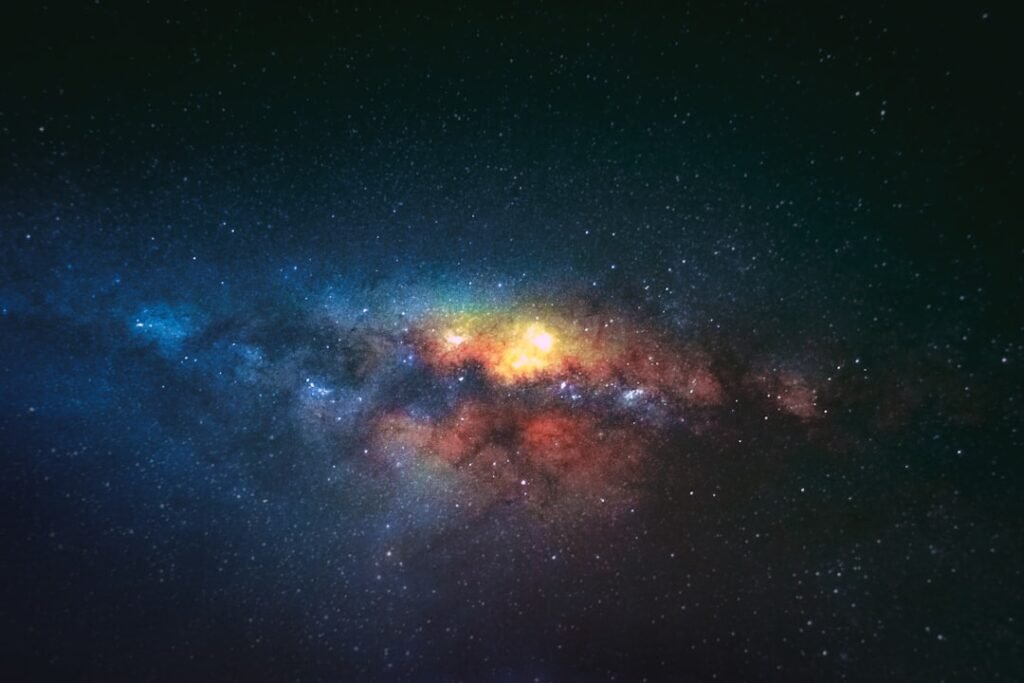
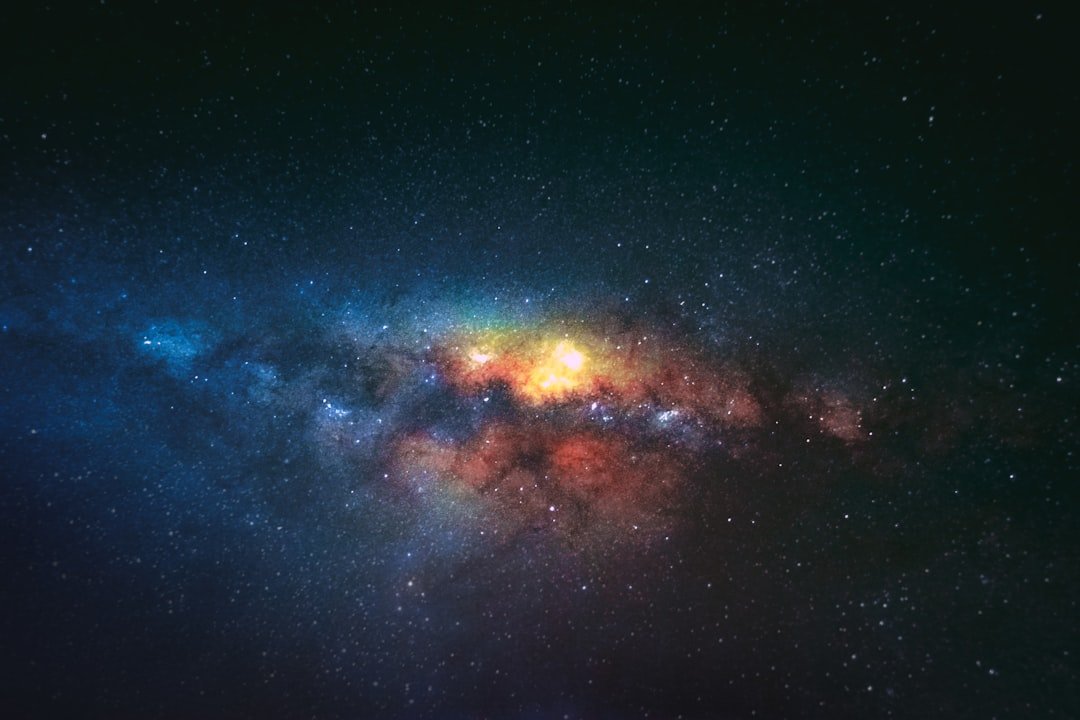
The Elusive 21cm Glow Amid Cosmic Noise (Image Credits: Unsplash)
Researchers have introduced a statistical technique that analyzes early galaxy clustering to sharpen the detection of elusive 21cm signals from the Epoch of Reionization, a pivotal phase when the first stars ionized the cosmos.[1][2]
The Elusive 21cm Glow Amid Cosmic Noise
The Epoch of Reionization marked the universe’s transition from darkness to light roughly a billion years after the Big Bang. Neutral hydrogen emitted faint 21cm radio waves as ultraviolet radiation from emerging stars stripped away electrons. These signals hold clues to the first galaxies’ properties, yet foreground contamination and instrumental noise have long obscured them.
Traditional approaches relied on two-point correlation functions, which averaged pairwise separations but overlooked complex, non-Gaussian patterns in the data. Cross-correlating 21cm maps with high-redshift galaxy positions offered a path forward, as galaxies traced ionized regions. Still, detection remained challenging, especially after foreground removal suppressed key large-scale modes.[1]
A Smarter Statistical Lens: kNN CDF Explained
Anirban Chakraborty and colleagues from the National Centre for Radio Astrophysics (NCRA-TIFR) and the Indian Institute of Science Education and Research (IISER) proposed k-nearest-neighbour cumulative distribution functions (kNN CDF). This method computes the cumulative probability distribution of distances from each point to its k nearest neighbors, capturing clustering information across all orders.
Applied to cross-correlations between 21cm brightness temperature and galaxy overdensities, kNN CDF provided a fuller picture than two-point statistics. It encoded joint distributions without assuming Gaussianity, proving ideal for the patchy ionization during reionization. The team focused on the first-neighbor statistic (k=1) for initial tests, highlighting its sensitivity to local environments.[2]
Simulations formed the backbone of validation. N-body codes modeled dark matter and gas evolution, while radiative transfer incorporated ionizing radiation effects. Galaxy catalogs simulated [O III] 5008Å line-emitting sources at redshift z=7, aligning with upcoming surveys.
Simulations Prove kNN CDF’s Edge
Tests on mock data revealed stark advantages. In scenarios with instrumental noise alone, the kNN CDF cross-correlation achieved a detection significance of χ² ≈ 280,000, dwarfing the two-point statistic’s χ² = 721. Even after aggressive foreground filtering, kNN CDF registered χ² ≈ 3,500, while two-point dropped to χ² = 27.
These metrics stemmed from comparisons against 1,000 null realizations, underscoring robust signal extraction. kNN CDF preserved anti-correlations across scales, where filtering flattened two-point functions to noise levels.[2]
Discerning Reionization’s Hidden Patterns
Beyond detection, kNN CDF differentiated reionization models at a fixed global ionized fraction of Q_HI ≈ 0.385. Models varied in escape fraction prescriptions: steeper (α_esc = -0.45), fiducial (-0.3), and shallower (-0.15). Two-point statistics yielded negligible χ² values (around 3-4 in noise, near zero post-filtering), rendering models indistinguishable.
kNN CDF, however, produced χ² ≈ 1,313 for steep versus fiducial and 1,193 for shallow versus fiducial in noise. Post-filtering, values held at 494 and 804, respectively. Fragmented ionization in steeper models contrasted with larger bubbles in shallower ones, patterns kNN CDF uniquely resolved at intermediate scales.
- Higher sensitivity to non-Gaussian features
- Resilience to foreground wedge removal
- Model discrimination at matched ionization levels
- Scalable computation for large datasets
- Versatility for multi-tracer synergies
Toward a Clearer Cosmic Dawn
This innovation promises to maximize data from upcoming 21cm telescopes like the Square Kilometre Array and galaxy surveys such as those from the Roman Space Telescope. By revealing reionization’s sources, timing, and topology, it edges astronomers closer to the universe’s formative moments. Researchers outlined their approach in a recent paper on arXiv.[3]
Key Takeaways
- kNN CDF vastly outperforms two-point statistics in noisy, filtered 21cm-galaxy data.
- It distinguishes reionization models invisible to standard methods.
- Simulations at z=7 pave the way for real observations.
As these tools mature, they could rewrite our understanding of cosmic reionization. What insights do you expect from future 21cm detections? Tell us in the comments.