A Flare Too Quick for Supermassive Suspects (Image Credits: Pixabay)
Astronomers detected a strikingly brief optical flare in a distant elliptical galaxy that challenges conventional understanding of cosmic cataclysms.[1][2]
A Flare Too Quick for Supermassive Suspects
The event, known as AT2022zod, ignited in October 2022 and burned for just over a month, from October 13 to November 18.[1] This brevity set it apart from typical stellar disruptions, which often linger for hundreds of days or even years.
Team leader Kristen Dage of Curtin University in Australia noted the anomaly: “AT2022zod is slightly off-nuclear, and very short in comparison with previously observed TDEs, while still highly energetic.”[1] Observations pinpointed the flare roughly 10,000 light-years from the galaxy’s core, far from the usual domain of supermassive black holes.[1]
Hosted in the elliptical galaxy SDSS J105602.80+561214.7, about 1.5 billion light-years from Earth, the outburst suggested a different culprit entirely.[1]
Unpacking Tidal Disruption Events
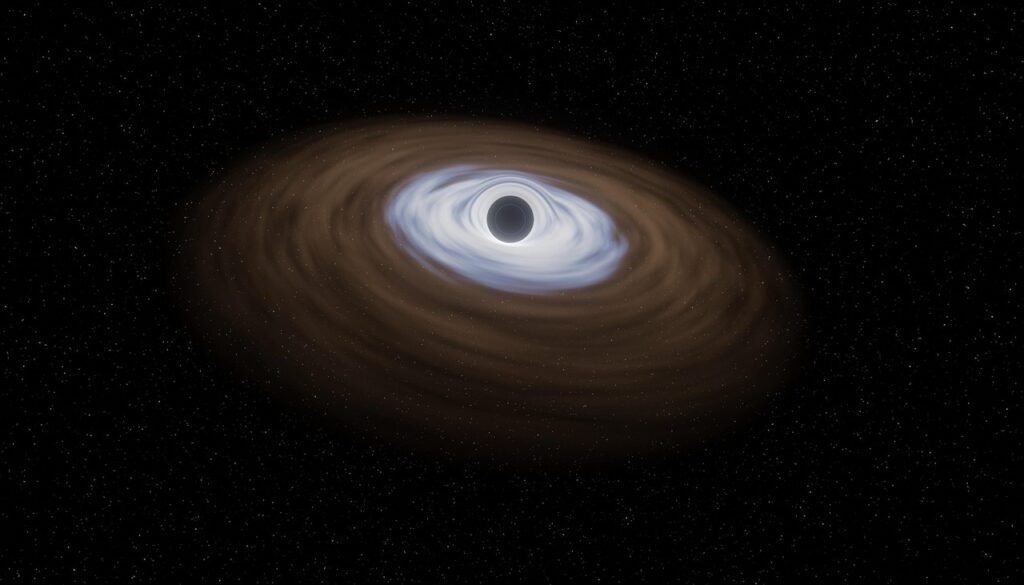
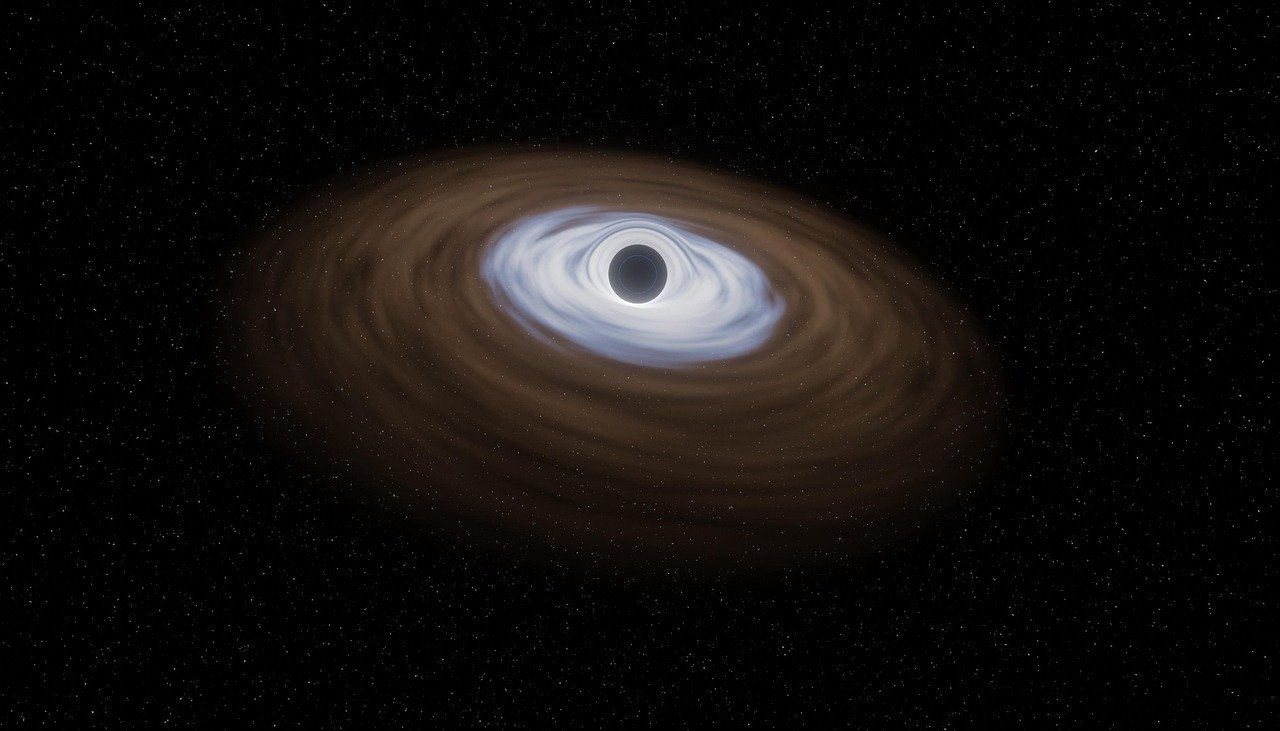
Tidal disruption events unfold when a star strays too close to a black hole’s gravitational grasp. The intense tides stretch and tear the star into a stream of plasma, a process dubbed spaghettification.
Some debris spirals inward to fuel the black hole, while the rest launches outward in high-energy jets. Astronomers typically witness these spectacles near galaxy centers, where supermassive black holes reign.[1]
Yet AT2022zod’s profile diverged sharply. Its rapid fade indicated a black hole too small for supermassive status but potent enough for such violence.
The Hunt for Intermediate-Mass Black Holes
Intermediate-mass black holes, with masses between hundreds and hundreds of thousands of solar masses, bridge stellar-mass black holes and their supermassive kin. Dage emphasized the challenge: “I think it’s really difficult to overstate how bad we are at finding intermediate mass black holes.”[1]
These objects evade easy detection, lacking the gravitational wave signatures of mergers or the steady glow of active galactic nuclei. TDEs offer a rare glimpse, as event duration scales with black hole mass – shorter flares point to lighter predators.[1]
- Off-nuclear position avoids central supermassive interference.
- Short timescale aligns with lower masses.
- High energy matches expected disruption power.
- Elliptical host favors dense star clusters.
- Potential in globular clusters or ultracompact dwarfs.
Star Clusters as Black Hole Nurseries
Dense environments like globular clusters or ultracompact dwarf galaxies pack stars tightly, boosting encounter odds. Dage explained: “These systems are basically black hole factories, and their crowded and dynamical systems provide opportunities for black holes to merge and grow into the intermediate mass range.”[1]
AT2022zod likely originated in such a cluster, where stellar collisions and mergers foster intermediate masses. Researchers favor an ultracompact dwarf as the host, given patterns in nearer systems.
Future surveys, including the Vera C. Rubin Observatory, promise deeper hunts. Dage anticipates: “Rubin is poised to make such a huge impact – it will provide incredibly sensitive 10-year optical coverage of millions of star clusters.”[1]
Key Takeaways
- AT2022zod’s one-month duration and off-center location scream intermediate-mass black hole.
- Elliptical galaxies harbor prime star clusters for these rare beasts.
- TDEs emerge as powerful tools to map the missing link in black hole evolution.
This discovery underscores TDEs’ potential to illuminate black hole demographics. As telescopes peer deeper, more such events may reveal how intermediate masses seed supermassive giants. What do you think this means for black hole origins? Tell us in the comments.