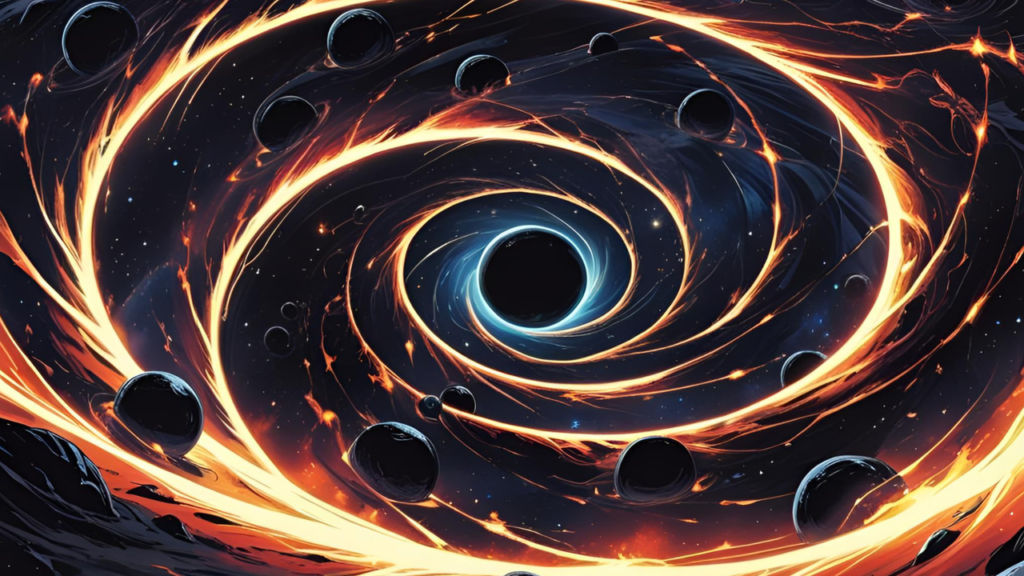
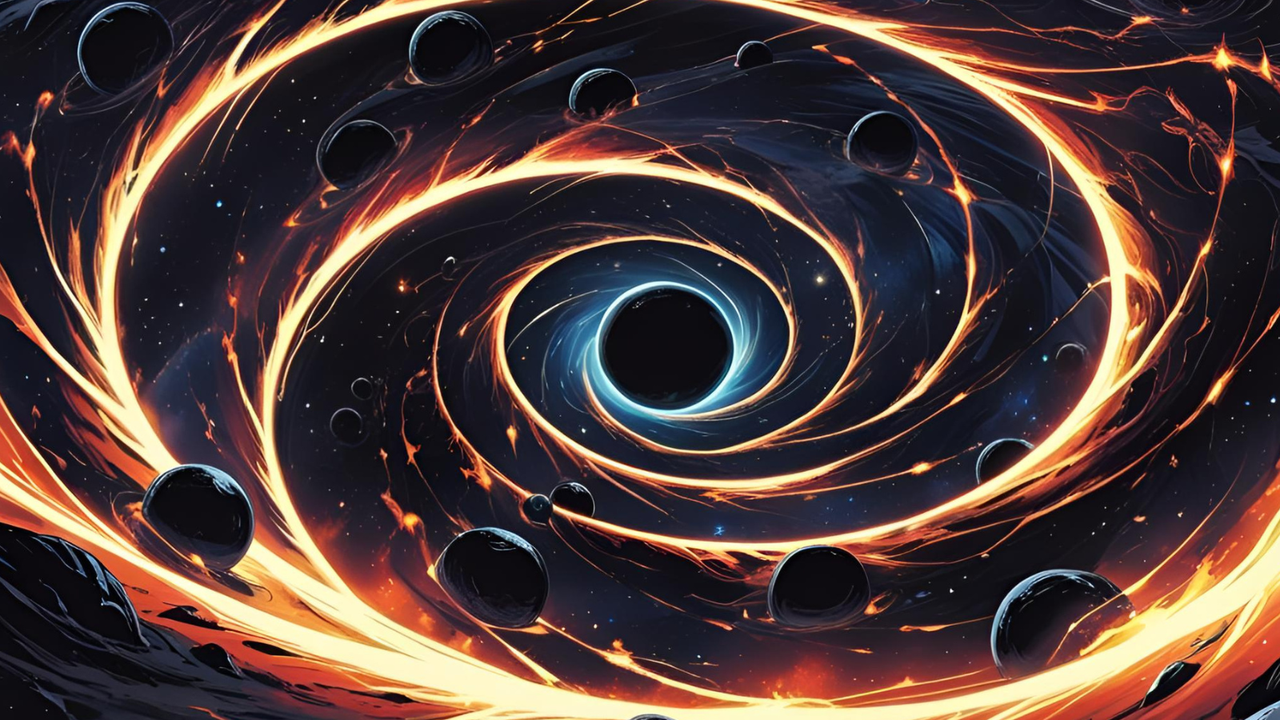
The Violent Birth of a Fugitive (Image Credits: Cdn.mos.cms.futurecdn.net)
Astronomers using the James Webb Space Telescope confirmed the discovery of the first runaway supermassive black hole, a cosmic behemoth ejected from its host galaxy and racing toward intergalactic space.[1][2]
The Violent Birth of a Fugitive
Supermassive black holes typically reside at the centers of galaxies, but mergers between galaxies can disrupt this stability. When two such black holes spiral together and coalesce, they release enormous energy through gravitational waves in mere seconds.[3]
The merger process imparts a powerful recoil kick to the newly formed black hole due to asymmetric emission of these waves. Speeds exceeding 1,000 kilometers per second become possible, often enough to hurl the object free from its galactic home. Researchers have predicted this phenomenon for over 50 years, but direct evidence remained elusive until now.[1]
Three-body interactions offer another pathway. During chaotic galaxy collisions, a trio of supermassive black holes can interact gravitationally, slingshotting one away at velocities up to several thousand kilometers per second.
JWST’s Breakthrough Observations
The James Webb Space Telescope targeted a peculiar linear feature first noted in Hubble images, spanning 200,000 light-years near a distant galaxy pair 8 billion light-years away. Dubbed RBH-1, this object boasts a mass of at least 10 million solar masses and travels at 954 kilometers per second – equivalent to roughly 2.1 million miles per hour.[1][4]
NIRSpec observations revealed a bow shock at the leading edge, with gas velocities shifting by 600 kilometers per second across the structure – blueshifted ahead and redshifted behind. This kinematic signature confirmed a supersonic object plowing through interstellar gas.[2]
Pieter van Dokkum of Yale University led the study, noting that the data matched theoretical models precisely. The black hole’s path tilts slightly toward Earth, placing it closer than its trailing wake.
Chaos in Its Wake
As RBH-1 surges outward, it compresses surrounding gas into a bow shock, triggering bursts of star formation along a vast trail twice the Milky Way’s diameter. This wake glows with young stars and ionized oxygen, heated to extreme temperatures.[4]
Such runaways disrupt galactic ecosystems. A million- or billion-solar-mass intruder shreds stars and gas clouds in its path, potentially altering orbits and fueling quasar-like activity far from galactic cores.[3]
- Generates bow shocks that ignite starbursts over hundreds of thousands of light-years.
- Perturbs stellar dynamics, ejecting stars into intergalactic voids.
- Drags accreted material, sustaining luminosity as a wandering active galactic nucleus.
- May seed rogue star clusters in the intergalactic medium.
- Challenges models of black hole-galaxy co-evolution.
Cosmic Implications and Future Hunts
RBH-1 validates long-standing theories and hints at a population of intergalactic supermassive black holes lurking unseen. Future surveys with Euclid and the Nancy Grace Roman Space Telescope promise to uncover more such fugitives.[4]
These wanderers reshape our view of universe structure formation. Early mergers likely produced runaways that influenced reionization and supermassive black hole growth in young galaxies.
Key Takeaways
- JWST confirmed RBH-1 via bow shock kinematics, the first empirical proof of runaway SMBHs.
- Formation stems from merger recoils or three-body ejections during galaxy collisions.
- Runaways carve star-forming trails, disrupting host galaxies long-term.
Runaway black holes remind us that even the universe’s most massive objects bow to gravitational chaos. As telescopes peer deeper, more cosmic exiles will emerge, rewriting galactic histories. What impacts might these wanderers have on the cosmos? Share your thoughts in the comments.