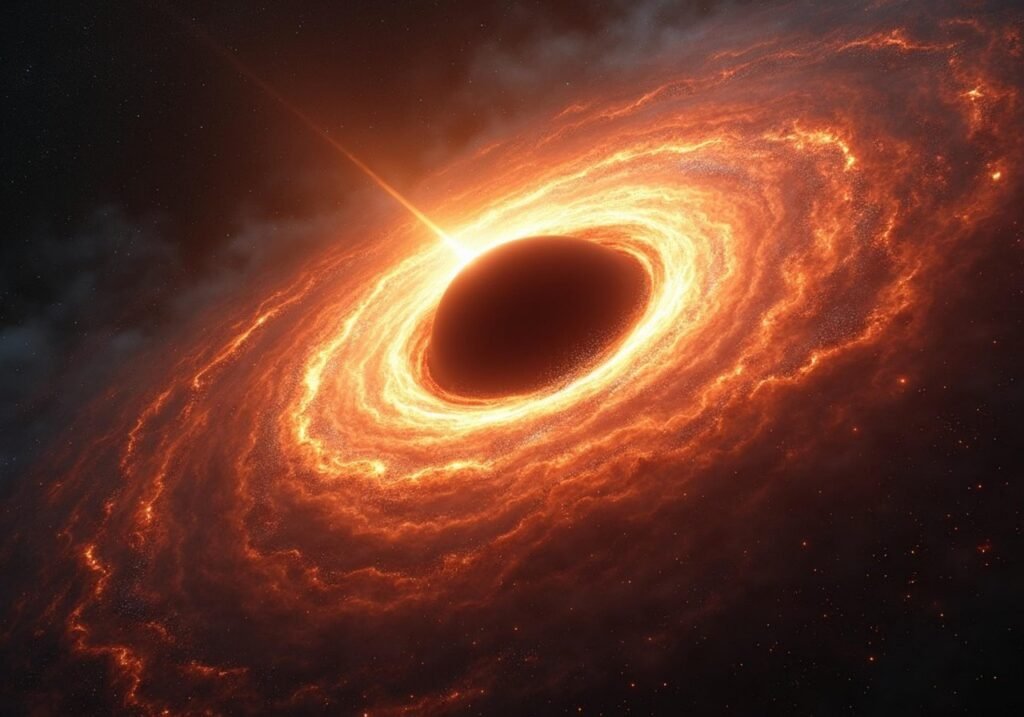
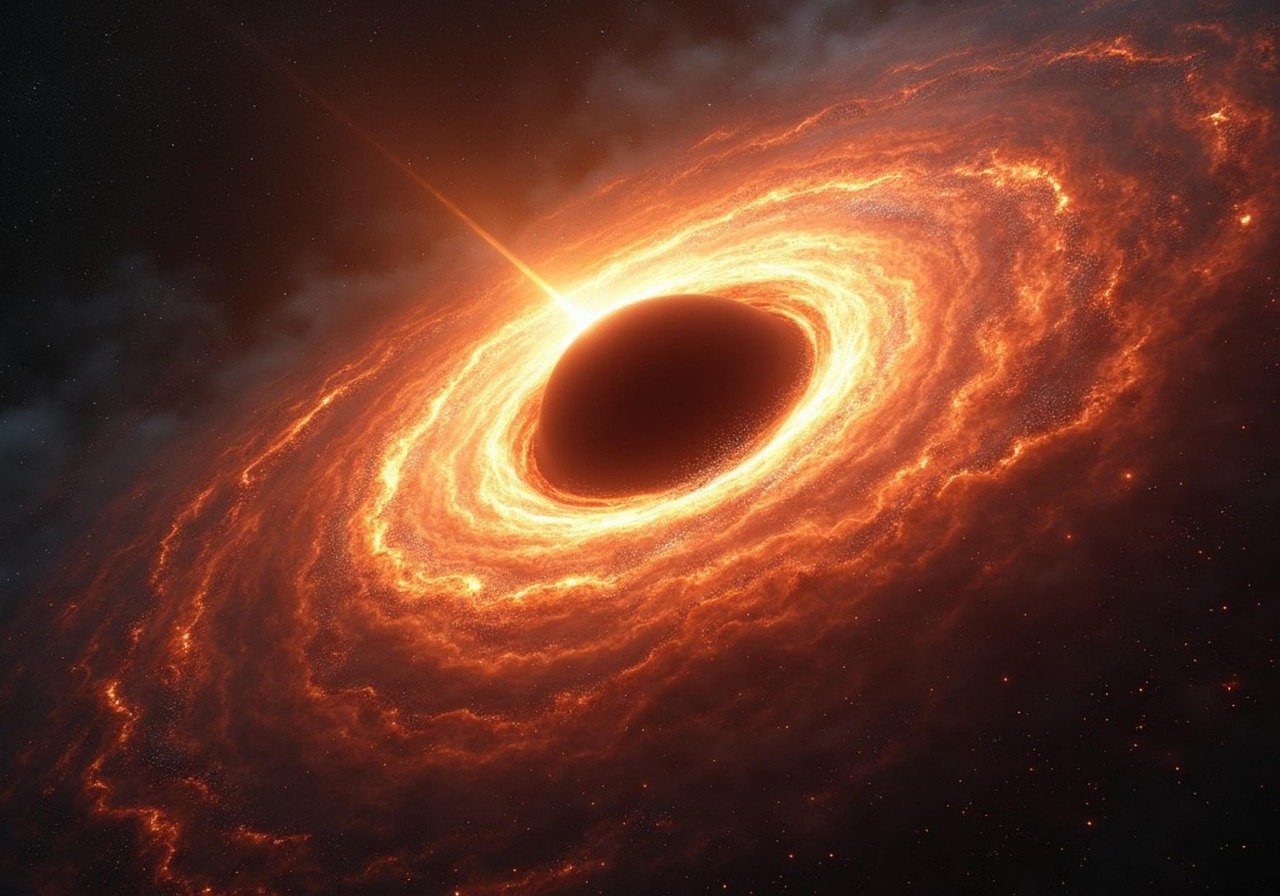
Unprecedented Delay in Cosmic Digestion (Image Credits: Pixabay)
A supermassive black hole, having torn apart a star nearly eight years ago, now unleashes intensifying radio waves that astronomers predict will reach a dramatic crescendo next year.[1][2]
Unprecedented Delay in Cosmic Digestion
Astronomers first spotted unusual activity in 2018 when the galaxy LEDA 3119592 suddenly brightened in optical light. This flare marked a tidal disruption event, where the central supermassive black hole – cataloged as AT2018hyz – shredded a passing star through intense gravitational forces.[1]
The star’s material stretched into thin streams, a process known as spaghettification. Much of it spiraled into an accretion disk around the black hole, emitting radiation as it heated up. Yet, for the next 2.5 years, the system fell silent in radio wavelengths, defying typical expectations for such cataclysmic feasts.[1]
Radio Silence Breaks with a Roar
Starting around 2021, powerful radio emissions emerged from the same location, 665 million light-years away in the constellation Sextans. By early 2026, these signals had surged to 50 times their strength from 2019.[1][3] Lead researcher Yvette Cendes of the University of Oregon described the phenomenon as extraordinary. “This is really unusual,” she stated. “I’d be hard-pressed to think of anything rising like this over such a long period of time.”[1]
Her team suspects a high-speed jet of material, possibly approaching light speed, blasts outward from the black hole. This outflow rivals the energy of gamma-ray bursts, some of the universe’s most violent explosions.[1]
Key Observations Fuel the Mystery
Radio telescopes captured the evolving spectacle. The Very Large Array in New Mexico imaged the source at 6 GHz frequencies from 2022 through 2024, revealing a compact point source.[1] Sensitive instruments in South Africa complemented these efforts, tracking the steady brightening. No recent optical glow appeared, as the object dimmed in visible light long ago.
- 2018: Optical flare signals star disruption.
- 2019–2021: Radio quietude persists.
- 2022–2024: Emissions ramp up dramatically.
- February 2026: 50-fold increase confirmed.[1]
Forecast: Brighter Days for Jetty McJetface
Cendes playfully dubbed the black hole “Jetty McJetface,” nodding to its jet-like behavior. Models project the radio output will climb exponentially, peaking in early 2027.[1][4] The team’s findings appeared in the Astrophysical Journal on February 5, 2026. Follow-up observations with global radio arrays aim to probe the jet’s structure and speed.[1]
Such delayed emissions challenge assumptions about tidal disruptions. Previously, black holes were thought to quiet down post-meal until the next cosmic snack. This event underscores how black holes can surprise scientists years after their feasts, offering fresh insights into jet formation and supermassive growth. As AT2018hyz builds toward its 2027 summit, it stands among the most energetic phenomena observed.[1]
Key Takeaways:
- AT2018hyz disrupted a star in 2018 but ignited radio jets years later.
- Emissions have brightened 50 times and count on rising until 2027.
- The jet’s power evokes gamma-ray bursts, reshaping TDE models.
What do you think about this cosmic belch? Share your thoughts in the comments.