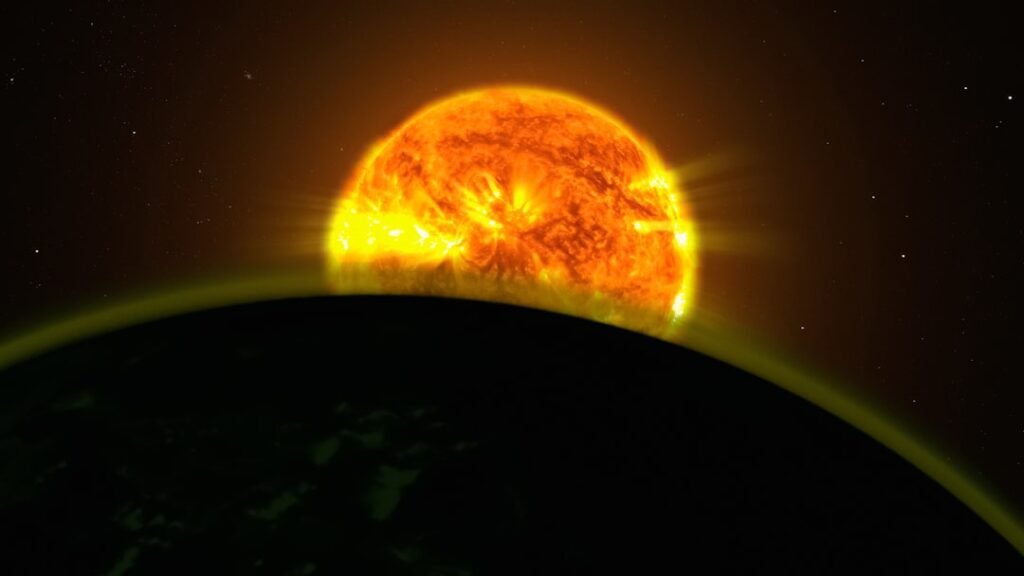
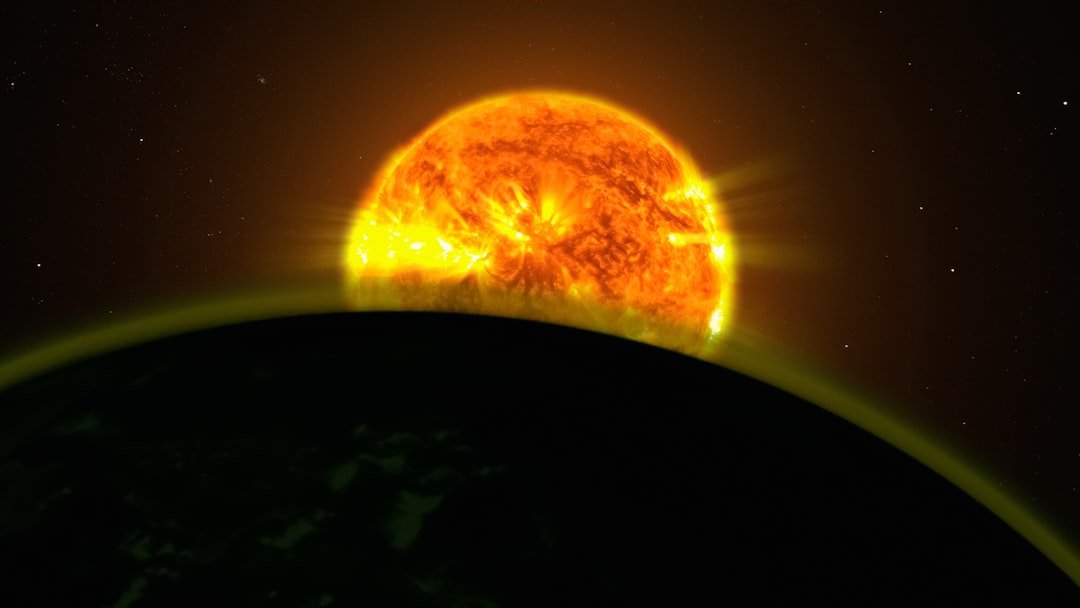
The Fury of Stellar Eruptions (Image Credits: Unsplash)
Astronomers captured a colossal stellar outburst from a young red dwarf, prompting fresh scrutiny of how such cosmic tempests imperil atmospheres and life prospects on nearby exoplanets.
The Fury of Stellar Eruptions
Stars unleash powerful flares through magnetic reconnection, where twisted magnetic fields snap and release pent-up energy. These events often propel coronal mass ejections, vast clouds of plasma hurtling into space. While Earth’s Sun produces occasional flares that spark auroras and rattle satellites, cooler red dwarfs – M stars – generate far more frequent and ferocious versions.
Pre-main-sequence M dwarfs, still contracting toward maturity, churn with vigorous convection that amplifies their magnetic activity. Researchers documented one such star’s tantrum, revealing blasts capable of dwarfing humanity’s most infamous solar storm.
Unveiling a Monster Flare
The Next Generation Transit Survey spotted the eruption on NGTS J121939.5–355557, a pre-main-sequence M dwarf. Observations caught the star surging 7.2 times brighter than normal, with peaks at roughly 30 minutes and 2.6 hours into the recorded phase.[1][2]
Calculations pegged the flare’s total energy at 3.2 ± 4.2 × 10²⁹ joules – about 10,000 times the Sun’s 1859 Carrington Event, history’s strongest recorded solar flare. The star likely unleashes around 70 such flares annually, each at least 10 times more potent than Carrington.[1]
This detection, detailed in a study accepted by Monthly Notices of the Royal Astronomical Society, featured quasi-periodic pulsations, adding to the event’s intrigue.
Space Weather’s Assault on Alien Worlds
M dwarfs dominate the galaxy, comprising roughly 70 percent of stars, and their tight habitable zones make exoplanets around them prime targets for detection. Yet their hyperactivity spells trouble for orbiting worlds.
Frequent coronal mass ejections can disrupt planetary magnetic field development, heightening vulnerability to photoevaporation – where stellar radiation strips away atmospheres. Flares bombard surfaces with X-rays and ultraviolet light, shredding ozone layers and fraying DNA-like molecules.[2]
- Atmospheric erosion leaves planets barren and exposed.
- Radiation doses threaten any emerging biology.
- Weakened magnetospheres fail to deflect incoming plasma blasts.
- Close orbits amplify the onslaught for habitable-zone candidates.
Could Flares Spark Life Instead?
Intense radiation poses clear dangers, but M dwarfs offer a counterintuitive twist. These cool stars emit scant near-ultraviolet light under normal conditions, unlike hotter Sun-like stars.
Near-UV radiation drives key steps in abiogenesis, the origin of life from non-living chemicals. Flares temporarily flood systems with this wavelength, potentially jump-starting pre-biotic reactions on otherwise dim worlds.
Key Takeaways:
- Giant flares like this one pack 10,000 times the punch of the Carrington Event.
- Red dwarfs predict dozens of super-flares yearly, ravaging nearby exoplanets.
- While destructive, flare-induced UV might foster life’s chemical beginnings.
This duality underscores the complex dance between destruction and creation in space weather. As telescopes like NGTS peer deeper, they challenge assumptions about where life might endure – or emerge. What role do these stellar storms play in the cosmic search for neighbors? Share your thoughts in the comments.