The Record-Shattering Arrival (Image Credits: Cdn.mos.cms.futurecdn.net)
Utah’s remote desert expanse yielded one of the most powerful cosmic visitors ever recorded when the Telescope Array captured the Amaterasu particle in 2021.[1][2]
The Record-Shattering Arrival
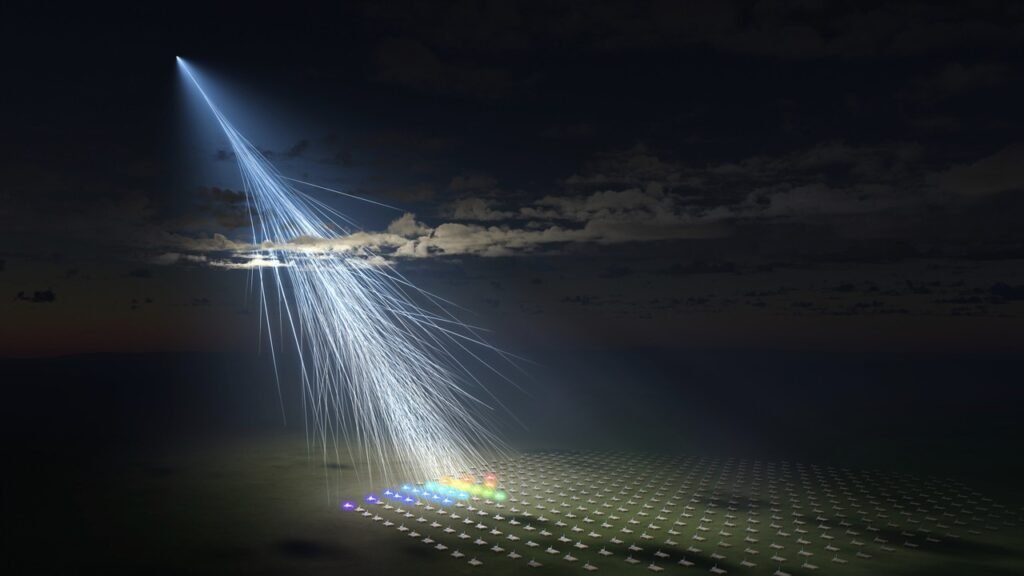
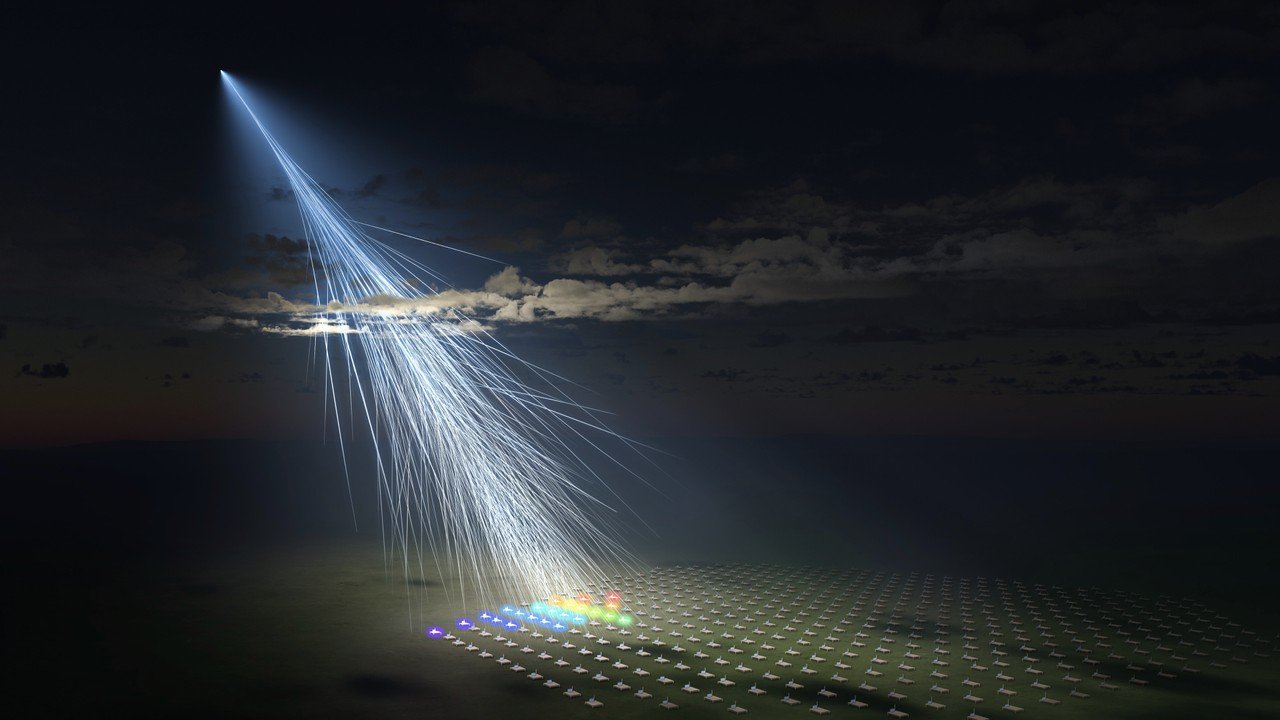
Researchers at the Telescope Array first spotted the particle on May 27, 2021. It streaked through Earth’s atmosphere, unleashing a cascade of secondary particles across 23 detectors spread over hundreds of square kilometers. This event marked the second-highest energy cosmic ray detection in history, surpassed only by the famed “Oh-My-God” particle from 1991.[3]
The Amaterasu particle packed roughly 244 exa-electronvolts (EeV), equivalent to the kinetic energy of a brick dropped from waist height. That figure dwarfs the output of human-made accelerators like the Large Hadron Collider, where particles reach mere tera-electronvolts—about 40 million times less energetic. Such ultra-high-energy cosmic rays (UHECRs) remain exceedingly rare, with fewer than a handful confirmed above 200 EeV.[4]
A Direction Devoid of Sources
Initial analysis pointed the particle’s trajectory straight toward the Local Void, a sprawling, low-density expanse bordering the Milky Way. This region lacks obvious galaxies, stars, or other energetic phenomena capable of hurling protons or nuclei at such speeds. Scientists puzzled over how such a force could emerge from apparent emptiness.[3]
Traditional cosmic ray sources include supernova remnants and the accretion disks around supermassive black holes. Yet none aligned with Amaterasu’s path. The mystery deepened questions about propagation limits imposed by interactions with cosmic microwave background photons, known as the GZK cutoff.[1]
Innovative Simulations Rewrite the Trail
Francesca Capel and Nadine Bourriche of the Max Planck Institute for Physics introduced a game-changing approach last year. They employed Approximate Bayesian Computation, a statistical method that merges detailed three-dimensional simulations of magnetic field deflections with real observational data. This generated probability maps tracing the particle’s likely backward path through interstellar space.[5]
“Our results suggest that, rather than originating in a low-density region of space like the Local Void, the Amaterasu particle is more likely to have been produced in a nearby star-forming galaxy such as M82,” Bourriche stated. Published January 28 in The Astrophysical Journal, their work challenges prior assumptions and opens doors for similar analyses on other UHECRs.[2]
Leading Candidates Surface
M82, the Cigar Galaxy, stands out at about 12 million light-years distant. This starburst galaxy teems with supernovae and intense star formation, ideal for accelerating particles to extreme energies. Other prospects include NGC 6946 and NGC 2403, all within reach before significant energy loss.[3]
| Cosmic Ray | Energy (EeV) | Year Detected |
|---|---|---|
| Oh-My-God Particle | 320 | 1991 |
| Amaterasu | 244 | 2021 |
These findings hinge on assumptions about the particle’s composition—proton, light nucleus, or iron—which influences bending by galactic magnetic fields. Upcoming upgrades to arrays like Pierre Auger will refine such distinctions.[4]
Key Takeaways
- Amaterasu rivals the most energetic cosmic rays, with 244 EeV packing immense power.
- New Bayesian simulations favor star-forming galaxies over the barren Local Void.
- Tools like these promise sharper hunts for UHECR sources and cosmic accelerators.
This breakthrough not only demystifies one particle’s journey but equips astronomers to probe the universe’s most violent engines. “Exploring ultra-high-energy cosmic rays helps us to better understand how the Universe can accelerate matter to such energies,” Capel noted.[1] As detectors expand, more revelations loom. What do you think launched the Amaterasu particle? Share your views in the comments.